Showing posts with label Thanksgiving. Show all posts

Thursday, November 27, 2014

Happy Thanksgiving

Thanksgiving was a harvest tradition long celebrated in New England, but it took a while to catch on in Montana. In 1863 there really was no harvest to celebrate and Henry Plummer was perhaps the only resident to observe the occasion. He used it to cultivate good relations with the Sidney Edgerton family, and spent a small fortune freighting in a turkey. You can follow that story here.  

In 1864, miners at Last Chance were too busy searching for gold to celebrate. In 1865, President Abraham Lincoln proclaimed Thanksgiving a holiday to unify the nation torn by the Civil War. Cornelius Hedges observed, however, that southern sympathizers were too busy mourning the “lost cause” to be thankful. In 1875, the Montana territorial legislature formally proclaimed Thanksgiving a holiday. At Sun River, residents held a grand Thanksgiving dance with music by the Fort Shaw band. When the dance ended at three in the morning, everyone had had such a good time they organized a dance club.

By the 1880s, Thanksgiving was a tradition. In 1881, ladies at Helena’s Presbyterian Church held a holiday sale of items that mirrored their roots. New Englanders contributed, for example, miniature Boston baked bean pots. In 1892, the Red Lodge Picket noted that on Wednesday before Thanksgiving, the Miners’ Meat Market featured an exceptionally artistic display arranged by E. J. Dugan, a Kansas City butcher. Beautifully dressed beeves, sheep, and veal hung on the pegs along with turkey and other fowl. The fantastic display was the “finest of any ever made in Red Lodge.”    

By the start of the twentieth century, Thanksgiving traditions were well established, and elaborate meals the norm. The Anaconda Standard noted in 1903 that “The stranger will find Anaconda equal to providing the great American feast.” At the Montana Hotel, orchestra music filtered throughout the hotel from nine till midnight. But the meal was the focus. Along with standard fare, the menu included green sea turtle quenelles, calves’ sweetbreads Genovese, orange fritters with brandy sauce, and frozen egg nog.

May you all once again eat too much and enjoy this day of national celebration.

Montana Historical Society Photograph Archives, postcard collection

Wednesday, November 27, 2013

Thanksgiving in December

The first official observance of Thanksgiving after the creation of Montana Territory came in 1865. Although President Lincoln had established the last Thursday of November as Thanksgiving Day, following Lincoln’s assassination, President Johnson chose December 7 as the day of official observance.

President Andrew Johnson, courtesy Library of Congress
Residents of the mining camps paused in their relentless search for golden treasure and gave thanks for their good luck and for the end of the Civil War. Virginia City businesses closed. There were private celebrations and culinary preparations in many homes and restaurants. The Montana Post reported that sleighs were gliding merrily around town all day, men hobnobbed at the bars, and there was a singing party in the governor’s office. The next year, 1866, at Last Chance, celebrations were more community oriented. Young ladies put on their pretties and attended the Firemen’s Ball on Thanksgiving Eve at the Young America Hall. Markets were well supplied for Thanksgiving Day feasts. Shoppers could choose elk, deer, bear, sage hens, grouse, and pheasant. There was no mention of turkeys, however, at Thanksgiving tables on that particular holiday.

This Helena meat market on Bridge Street offered mostly wild game in 1869.
Montana Historical Society Photograph Archives, 954-179

Friday, November 23, 2012

Thanksgiving at the Madison House 1903

If you're tired of eating turkey after yesterday's feast, you might want to try out some of these dishes...

The Madison House was Virginia City’s best hotel from the 1890s into the twentieth century. The hotel consisted of seven connected buildings, all at slightly different levels. For this reason it was nicknamed the seven-story hotel.

“Seven Story Hotel.”  Sanborn-Perris Map Company, Virginia City  1907.
Proprietors F. W. Allen and Dennis Mahagin set a nice table in the early 1900s. On Thanksgiving Day in 1903, the Madisonian invited those who might be unfortunate to be away from their own family firesides not to let the day pass without enjoying a good dinner. The Madison House prepared an especially elaborate meal, which was served between 4:00 in the afternoon and 8:00 in the evening. The published menu for Thanksgiving was indeed a delectable one. The first course included New York or fresh oysters, cole slaw, or consommé, and relishes. The salad course included lobster salad in mayonnaise. For the main course, diners could choose baked salmon, boiled ox tongue in wine sauce, roast prime rib of beef, roast goose with baked apples, macaroni in red wine—presumably for vegetarian guests—and of course, young turkey with oyster dressing, cranberry jelly, and pineapple sherbet. The choice of vegetables included mashed and steamed potatoes, braised sweet potatoes, French peas, or asparagus on toast. For dessert the offerings included mince pie, sliced green apple pie, English plum pudding with brandy sauce, walnut ice cream, assorted cakes, and grapes, cheese, apples and mixed nuts. The Madison House closed as the town declined in the 1920s, and its seven buildings were later torn down. The memory of that wonderful Thanksgiving dinner in 1903 is preserved only in the archives of the local newspaper.

Thursday, November 22, 2012

A Mild Thanksgiving in Wild Miles City, 1882

Miles City was a wild town in its day. Wooden false fronts, wide dusty streets, and saloons where whiskey flowed made the town on every cowboy’s route and a place where a good time was easily found. Cowboys and soldiers at Fort Keogh frequented the numerous houses where the ladies entertained them lavishly, for a fee, of course.

Miles City prostitutes and patrons in a parlor house reception hall.
Montana Historical Society Photograph Archives, Morrison Collection
But for one day in the 1880s, an unusual atmosphere pervaded the air. The Miles City Daily Press noted after Thanksgiving Day in 1882 that seldom had there been such a mild holiday. The weather that day was clear and brilliant and the temperature balmy, precisely the kind of day one would choose for a holiday. And so Miles City gave itself up to relaxation and enjoyment. The bank and the post office were closed although citizens received their daily mail. Stores were open early for shoppers planning holiday meals, and by noon, all stores had hung their closed signs in their windows. Visitors flocked into town from neighboring settlements and reaches to see what fun might be going on. But, said the paper, there was only the mildest type to be found. There was never a more sober and orderly day witnessed in Miles City. The saloons were all open and they were well patronized and did a brisk business, but the patrons were all unusually well behaved.  Unlike the usual barroom scuffles and rowdy behavior, the spirit of good behavior seemed to hover over all. Miles City was in it glory that Thanksgiving night in 1882, and it was gratifying to record that not a single disturbance occurred to mar the general harmony that had prevailed throughout that pastoral Thanksgiving Day.

May yours be as pleasant.

Wednesday, November 21, 2012

Mining Camp Thanksgiving

Abraham Lincoln set a precedent during his presidency proclaiming the national observance of Thanksgiving the last Thursday in November. In 1863 Harriet and Wilbur Sanders, the soon to be famous vigilante prosecutor, spent their first Montana Thanksgiving at Bannack.

Wilbur Fisk Sanders. R.A. Lewis, photographer
Montana Historical Society Photograph Archives
Goods were scarce, freight was slow arriving, and no one even thought about serving a turkey. Near neighbors invited Harriet and Wilbur along with Henry Edgerton, Sanders’ uncle, to Thanksgiving dinner. This neighbor wanted to make a good impression on the family. Edgerton was the newly appointed Chief Justice of the Supreme Court of Idaho Territory, which then included present-day Montana. Their host offered the invitation well in advance. He miraculously procured a turkey—an unheard of, unbelievable luxury—for thirty dollars in gold dust, and paid a fortune to have it freighted all the way from Salt Lake City. Harriet wrote later that their Thanksgiving meal was as fine and beautifully cooked as any meal she ever enjoyed in New York City’s finest restaurant. Unfortunately, their host failed to make a good impression. In early January, just weeks later, Sanders and the vigilantes saw to the hanging of Sheriff Henry Plummer, the same man who had hosted their Thanksgiving Day feast.

Bill for the coffin and burial of Henry Plummer
Montana Historical Society Archives


Monday, November 19, 2012

Thanksgiving Day Murder at Elkhorn

The silver mines at Elkhorn yielded $14 million and the mining camp once had more than 2,500 residents. Three passenger trains arrived weekly on the Northern Pacific’s branch line.

Montana Historical Society Photograph Archives
In 1893, the Fraternity Hall Association built the town’s architectural and social centerpiece. Fraternity Hall was aptly named: the town’s various fraternal organizations, including the Masons, Oddfellows, and Knights of Pythias, shared its upstairs lodge room. Dances, traveling theatrical troupes, graduations, prize fights, and other public gatherings at Fraternity Hall bound citizens together. The building’s outstanding architecture blends the western false front with a sophisticated twist. A unique neo-classical style balcony is suspended above the entry. After the Silver Panic of 1893, the mine began to play out and operated only off and on until 1931 when the Northern Pacific removed its tracks. Fraternity Hall has endured time, neglect, and heavy snows to become one of Montana’s most photographed buildings.

Gilliam's Hall and Fraternity Hall in Elkhorn
Although local lore says that an argument over a dance led to a murder at Fraternity Hall, the true incident actually began at a Thanksgiving Eve dance in 1889 at Gilliam’s Hall, Elkhorn’s other substantial surviving building. A shortage of women compelled Thomas King and George Peters to dance together. Manager Mat Fogarty asked them to stop. The ensuing quarrel later became a huge free-for-all bar fight at Lloyd’s Saloon. Taking their fight into the street early on Thanksgiving morning, King shot and killed Fogarty. Thomas King was hanged at Boulder for the crime in June of 1890, several years before Fraternity Hall was built. And this was especially noteworthy because King’s hanging was the first in the new state of Montana.

P.S. It makes Thanksgiving in Virginia City seem downright tame, doesn't it?

Wednesday, November 23, 2011

Thanksgiving Turkeys

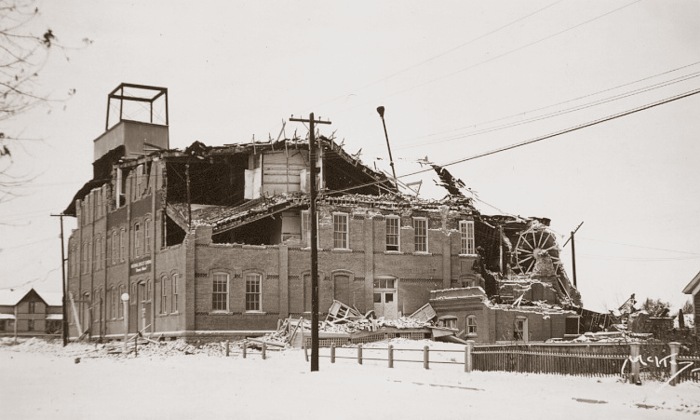
Earthquakes rocked the Helena valley in October of 1935, leaving four people dead, a community terrified, and widespread destruction in the aftermath. There was significant damage in the 6th Ward, especially at the National Biscuit Company, the Northern Pacific depot, and along Railroad and Helena Avenues.


East Side of the National Biscuit Co. Factory, Taken from Boulder Ave.
Photo from Helena As She Was
 One family on Boulder Avenue was buried under rubble when their house collapsed. The father dug himself out and rescued his injured wife and their two small children.

Charles Purdy and his wife and two small children were buried under the rubble of their house (at left).
Photo from Helena As She Was

In the nearby commercial district that had grown to serve the Northern Pacific Railroad, many small businesses suffered, and one grocer lost more than just his building. For many years this grocer had specialized in fresh turkeys he plucked and dressed himself. No one seemed to notice that the birds from this particular grocer never included gizzards. This is because he had a secret. His turkeys arrived via the Northern Pacific from an area that had once been extensively placer mined; the turkeys pecked around in the tailing piles. When he butchered the turkeys, he found that the stones collected in their gizzards were sometimes not just pebbles, but gold nuggets. The grocer kept his golden treasure in a huge jug he kept hidden in his basement. Over the years, his stash of nuggets had grown so that the jug was almost full. When the earthquake struck, his building collapsed in on itself, forever burying the jug full of golden nuggets. Neighbor kids talked about the 6th Ward’s buried treasure for years, and it became legendary. That jug full of treasure remains buried somewhere in the commercial district to this day.

P.S. You can see more photos of the earthquake damage on the Helena As She Was site.

Monday, November 21, 2011

Thanksgiving past and present

The first official observance of Thanksgiving after the creation of Montana Territory came in 1865. Although President Lincoln had established the last Thursday of November as Thanksgiving Day, following Lincoln’s assassination, President Johnson chose December 7th as the day of official observance. Residents of the mining camps paused in their relentless search for golden treasure and gave thanks for their good luck and for the end of the Civil War. In Virginia City, businesses closed. There were private celebrations and culinary preparations in many homes and restaurants. The Montana Post reported that sleighs were gliding merrily around town all day, men hobnobbed at the bars, and there was a singing party in the governor’s office. But in many a lonely cabin and isolated homestead, Thanksgiving was a time for  memories of other days, loved ones far away, and  serious reflection. The next year, 1866, at Last Chance, celebrations were more community oriented.  Young ladies put on their pretties and attended the Firemen’s Ball on Thanksgiving Eve at the Young America Hall. Markets were well supplied for Thanksgiving Day feasts. Shoppers could choose elk, deer, bear, sage hens, grouse and pheasant. There was no mention of turkeys, however, at Thanksgiving tables on that particular holiday. In Virginia City, the day was unremarkable. There were no church services, no suspension of labor, and no formal public thanks. The Montana Post noted, “When the population of Montana becomes stable, another order will prevail, and Thanksgiving will be greeted with more ceremony.” But in private, families gathered at their tables as earnestly and faithfully as if they lived in the States.

Some things haven't changed, have they? Are you planning any new Thanksgiving traditions this year? I am. I'm cooking a goose in addition to the usual turkey.