Showing posts with label Bannack. Show all posts

Wednesday, October 15, 2014

George Bartholomew and the Great Western Circus

Theatrical troops and circuses traveled to Montana from the earliest times. The first circus performed at Bannack, Virginia City, and Helena in 1867. The Montana Post reported on July 6 that George Bartholomew’s Great Western Circus drew a crowd of eight hundred at Virginia City. Mary Ronan remembered the much anticipated event in Helena and that the only animals in Bartholomew’s circus were horses. There were bareback riders, equestriennes, acrobats, tightrope walkers, and clowns. These earliest traveling circuses, as Mary correctly recalled, were limited to performing horses. Bartholomew’s horses, however, were highly skilled and later brought him fame.

In Virginia City, residents lined the major thoroughfares as the performers paraded along the main street to the rousing music of the circus band.  The next evening, the audience thrilled at the “perch act,” the trick ponies Napoleon and Zebra, the hurdle chase, and expert bareback riding. There was, however, one mishap. As Mademoiselle Mathilda entered the ring, the band stopped to switch music and the horse followed suit coming to an abrupt stop. Mademoiselle sailed off and crashed against the outer ring-boards. Despite her violent fall, she hopped up and gracefully skipped out of the arena. She did not return to perform, but the Post speculated that she was not seriously hurt.

 
Circus owner George Bartholomew was a colorful character and an uncanny horse trainer who traveled the West with his Great Western Circus between 1867 and 1869. Bartholomew was perhaps the first professional “horse whisperer.” Several times his fortunes were reversed until 1879 when his horses performed in Oakland, California, in front of an audience of ten thousand. The performance cemented his fame. The valuable horses in Bartholomew’s Equine Paradox traveled in a special train car across the country. The sides of the boxcar advertised gentleness and kindness toward helpless creatures. Bartholomew’s horses performed a play in which horses played the major characters. Bartholomew believed horses could be trained like children and treated his horses thus. They performed incredible feats. According to their trainer, the only difference between horses and children was that horses couldn’t talk, or talk back.

Wednesday, September 17, 2014

Captain James Williams

Pennsylvania native James Williams was the son of Irish and Welsh immigrants. The West lured him as a young man. In 1856, Williams was involved in the violent Border Wars in Kansas where he was a “Free State” man. He followed the rush to Pikes Peak in 1858 and came to Bannack with a wagon train from Denver in 1862. In the absence of a leader, the travelers elected Williams to lead the train and thereafter he was known as Captain, or Cap, for short. Cap Williams followed the rush to Alder Gulch in 1863. Then during those dark turbulent days of lawlessness, he again served as captain, this time of the vigilantes. When robberies and murders terrified citizens, Cap Williams stepped forward to lead the vigilantes in the capture and hanging of some two dozen suspected road agents during winter of 1863-1864.

Montana Historical Society Photograph Archives, 945-626
When this work was finished, Cap married and settled down in the emerald green ranchlands of Madison County’s Ruby Valley. But in March of 1887, searcher’s discovered Cap’s body hidden in a thicket. The newspapers reported that Cap had laid out his mittens and scarf as a pillow. He took a fatal dose of laudanum. He lay down knowing sleep would take over and the cold winter weather would do the rest. Some speculated that Virginia City banker Henry Elling was about to foreclose on his ranch. Others believed that his role as a vigilante weighed so heavily upon him that he could no longer live with the burden. Some however, had a different theory. Cap was a man of integrity, and he would never have willingly left his wife and seven children. Some believe that sentiments against Cap were still rife, and that he had enemies. Perhaps, they speculated, someone came along in the cold and offered him a fatal drink. A tombstone in a tiny burial ground today marks Cap’s grave. We will never know for sure what put him there.

Monday, June 9, 2014

Mining Camp Architecture

Bannack, Virginia City, and Helena each had a turn as Montana’s territorial capital, but each was destined for a different future. Today Bannack is a state park whose empty buildings mostly date to the 1880s and later. Helena owes its survival beyond the mining phase to the Northern Pacific which linked the town to distant markets in 1883. Few 1860s gold camp remnants survive in Helena. But Virginia City has a remarkable fifty-one 1860s gold rush-era buildings. Virginia City’s buildings retain their antiquated storefronts. Only small panes of glass, packed in sawdust, could survive transport over rough terrain. So merchants used French doors that allowed maximum light into their stores. Helena once sported the same type of storefront, but with the advent of the railroad, storefronts were remodeled with big display windows. Lack of rail transportation is partly why most of Virginia City’s storefronts escaped remodeling. Virginia City’s 1860s buildings illustrate how frontier architecture was all about illusion. As the town transitioned from a temporary mining camp to a more permanent settlement, shop keepers began to add false fronts to the log cabins. False fronts were architecturally important to mining camps because they made buildings seem taller, larger, and grander than they really were. This offered residents a sense of security in remote places like Alder Gulch.  To the false fronts, shopkeepers began to add half-columns, arches, and medallions. These, crafted in wood on the frontier, mimicked the stone and brick ornamentation in the buildings of cities far away. Inside, muslin stretched smooth and tacked down over the rough log walls gave the illusion of plaster. Then, wallpaper applied over the muslin made primitive interiors seem like tastefully decorated rooms.

Muslin stretched smooth over log ceiling and walls, seen here in the McGovern Store,  made interiors seem like finished rooms.
Virginia City’s first substantial buildings, like Content’s Corner and the Kiskadden Barn, were of rubblestone. A layer of plaster scored to look like stone blocks covered the rough stones. The effect was dramatic. These survivors and historic photographs of them give us a real sense of early residents’ attempts at civilization.

The Kiskadden Barn sports a tall false front and a on the ground level, plaster  scored to look like cut stone.
Montana Historical Society Photograph Archives, 956-249


Monday, May 19, 2014

Sidney Edgerton

Helena City Commissioners have proclaimed the week of May 17, 2014, Sidney Edgerton Week in tribute to the man who helped create Montana Territory and for whom Lewis and Clark County was originally named. Sidney Edgerton’s contributions to Montana’s earliest history have been largely forgotten. Appointed chief justice of the supreme court of Idaho Territory, he arrived at Bannack in September, too late to cross the Continental Divide. He soon learned that Idaho’s governor had snubbed him by assigning him to the territory’s most remote district area east of the Divide. Edgerton became committed to the creation a new territory to include the recently discovered gold fields in what became Montana. He traveled to Washington carrying two thousand dollars’ worth of gold dust sewn into his clothing to plead the case.

Sidney Edgerton, Montana Historical Society Photograph Archives, 942-074
The new territory was already under consideration, and on May 26, 1864, Congress created Montana Territory. President Lincoln appointed Sidney Edgerton the territory’s first governor. On February 2, 1865, the territorial legislature established Edgerton County as one of Montana’s original nine counties with Silver City as its county seat. Helena residents, however, had quickly garnered more population than any other community in the county and wanted to claim that designation for itself. Legend has it that attorney Wilbur Fisk Sanders, Governor Edgerton’s nephew, rode to Silver City and stole the scant county documents. With the papers in his saddlebags, he rode to Helena and thus unofficially transferred the county seat. Politics were fickle, however, and Edgerton County’s name changed to Lewis and Clarke County in December 1867 with a legislative vote of 7 to 0. Civil War rivalries were vicious. Montana had some radical Republicans like Sanders and Edgerton, but by now Democrats outnumbered them. Republican Judge Hezekiah Hosmer noted in the December 28 Montana Post that the change came about only because of “partisan spleen.”  The change underscored bitter territorial politics.

Wednesday, March 12, 2014

They Lost a Claim

Hope Mommer tells a story in her biography Look Out West: Here Comes Robert Dempsey about an opportunity Robert Dempsey's little daughters lost. Dempsey was a well-known horse trader with a large extended family. The Dempseys arrived at Bannack at the height of the gold rush. They settled in a log cabin outside the gold camp while the hired hands lived in elkskin lodges, tending the livestock, and watching the miners in their frantic search for gold. The Dempsey daughters, ten-year-old Maggie and eight-year-old Mary, also watched the miners panning in Grasshopper Creek. Maggie studied the procedure. She and her sister found a spot along the creek, and imitated the miners, slushing and swirling water and gravel around in a pan. Their work paid off, and suddenly the girls saw something yellow and gleaming. They had found gold! They ran to the cabin to show their father. He got very excited. Dempsey was an Irishman, and exclaimed in his thick brogue, “On Maggie, me darl’n, to be sure it’s gold! I’ll be gone to file me daughter’s gold claim.”  And Dempsey immediately set off for town to file a claim on his daughters’ behalf.

Bannack in the 1860s. Montana Historical Society Photograph Archives, 940-703
But before Robert Dempsey reached the claim office, he stopped off at one of the numerous watering holes to have a wee nip or two in celebration. So proud was he of Maggie and Mary and their great discovery, the whiskey loosened his tongue. He began to brag about it. Miners kept a watchful eye and an open ear for such casual talk, and were known to take advantage. In this case, some other miner overheard the Irishman telling his friends about Maggie’s gold and the location of the discovery. The miner made a beeline for the claim office, filing on what should have been the little Dempsey girls’ claim. When Dempsey finally arrived at the land office, the claim had already been taken.

Wednesday, February 5, 2014

Mathilda Dalton

Epidemics were a terrible danger in all mining camps. Not only were diseases and their causes not well understood, but miners were careless with their water sources and the streams needed for placer mining quickly became polluted. Typhoid, spread through contaminated water, was particularly common. The Dalton family learned about this danger firsthand. The Daltons were natives of Maine and came west from Wisconsin traveling with the first Fisk expedition in 1862. The family of six settled at Bannack. Granville Stuart nicknamed Mathilda “Desdemona” after the character in Shakespeare’s Othello because “she was beautiful and so good.” Edwin Ruthven Purple in his gold rush narrative Perilous Passage describes “Dez” as tall and magnificently formed, and one of the belles of Bannack. One smitten lad supposedly blew out his brains for her. Another spurned lover, however, said that everything she ate went to her feet which were unusually large.

Mathilda Dalton, Montana Historical Society Photograph Archives
 The Daltons moved to Virginia City the following year in 1863. Mathilda Dalton, at twenty, was the oldest child; her three siblings were much younger than she. The family had hardly settled at Virginia City when Mathilda fell victim to typhoid. Mrs. Dalton nursed her daughter through the illness, but then fell ill herself. Her husband also contracted the disease. Mathilda was still recovering in January 1864 when both her mother and her father died. There were few options for single women, and men greatly outnumbered them in the gold camp. Mathilda was left to care for her three younger siblings, and so she decided to marry. She and her husband, Zebulon Thibadeau, returned to Wisconsin and later relocated to Wallace, Idaho.


Both Mr. and Mrs. Dalton are buried on Boot Hill, Virginia City’s first cemetery. The Daltons’ lonely graves are the only marked burials, except for the five road agents. Because of the stigma attached to the five, most families moved their loved ones’ graves to Hillside Cemetery across the ridge. By that time there was no one to move the Daltons, or who remembered where they were buried. It was not until the 1920s that Mathilda’s children returned to Virginia City to mark their grandparents’ graves.

Wednesday, January 15, 2014

Hydraulicking

Placer gold is that which is loose in the soil and closest to the surface. Placer mining requires water to wash the dirt, perseverance, and a strong back. Gold is the heaviest material in the soil, and so in the process of washing, the heavy gold is the residue remaining in the pan or the sluice box. The rich goldfields that drew miners to Montana in the mid-1860s only held so much placer gold. Miners wanted to be sure to extract all of it, and so when that closest to the surface was depleted, they resorted to other methods of extraction. Hydraulic mining, or power washing, was one method. The Romans used a similar technique. They filled a reservoir or tank above the area to be flushed and allowed the water to flow down the hillside to expose the veins of gold. The first hydraulic mining in the West was done in California in 1853. Using a hose made of rawhide and a wooden nozzle to channel the water into elevated flumes, gravity created enough water pressure to move large rocks and boulders. Miners employed much the same method at Bannack, Alder Gulch, and Last Chance. They created a reservoir, and then water wheels channeled water under tremendous pressure into huge hoses. These were then directed to the hillsides to power wash the soil down to the bedrock. A series of sluices filtered the dirt. This destructive mining method drastically changed the landscape, reducing once-timbered hills to bare rock.

Montana Historical Society Photograph Archives, Lot 26 B7 F6

Wednesday, January 1, 2014

Mining Camp New Year’s

Martha Edgerton Plassman wrote in 1926 about early New Year’s celebrations in Montana and how they evolved as times changed. On New Year’s Day at Bannack in 1863, fourteen-year-old Martha and two other young girls set out to keep the custom of visiting. There were few women in the mining camp, and no proper houses to call upon, and so the three stopped at George Chrisman’s cabin, then moved down the street to Thompson and Swift’s general store. Inside they found Henry Plummer—later hanged by the vigilantes—in an argument with another fellow, both quite inebriated. The conversation was heated, and Mr. Thompson put a hand on Plummer’s shoulder, pointing him to the back door. The three teenagers, caught in the middle, made a hasty retreat out the front. Martha was so frightened that she never again stepped inside a store in Bannack.

This photo of the governor's official residence shows what Bannack looked like in 1863.
Montana Historical Society Photograph Archives, 
In Virginia City, between Christmas and New Year’s of 1867, things were different. The streets were gay with fashionable ladies visiting from house to house. Music and dancing were easy to find, and spirits flowed freely under many hospitable roofs. Nearly ten years later in Helena on New Year’s Day 1877, the New York tradition of ladies receiving gentlemen acquaintances was the practice. The newspaper listed the names of ladies receiving callers; several usually went together as hostesses. Dressed in their most beautiful gowns, they received guests throughout the afternoon. Tables were set with the best china and silver and heaped with many kinds of cakes and rolls. But Martha recalled that unlike rough and raw Virginia City, in Helena coffee usually took the place of strong spirits.

P.S. Remember when Henry Plummer hosted Thanksgiving dinner?

Friday, August 30, 2013

Friday Photo: Bannack, Montana

Montana Historical Society Photograph Archives, 940-695
Did you hear about the flash flood that swept through Bannack in July? Today's photo shows the town as it was circa 1900, looking west. The dredge on the left was launched in 1895. Click the photo for a bigger version.

P.S. A beautiful photographic tribute to Bannack
P.P.S. The Bannack Association has posted lots of photos of the cleanup, plus historic photos.
P.P.P.S. Do you think Bannack's Meade Hotel is haunted?

Wednesday, June 5, 2013

Mining Camp Dangers

Epidemics were fairly commonplace throughout the nineteenth century and knew no social boundaries. Rich or poor, no person was immune. Typhoid and cholera plagued mining camps because miners quickly polluted the water source. But measles, whooping cough and diphtheria also invaded the communities. The great silver camp of Elkhorn that flourished in the 1880s has a particularly pathetic legacy, reminding us that sometimes the sacrifices of parents—leaving home and family for new opportunities—were minor compared to the sacrifices they imposed on their children. Dr. William Dudley served as camp doctor but could do nothing when a diphtheria epidemic in 1889 claimed most of Elkhorn’s children. His wife was pregnant with their second child, and the Dudleys left Elkhorn abruptly, leaving their first born son, a casualty of the epidemic, buried in the hillside cemetery. During that same year, on September 27, Harry Walton, 9, and Albin Nelson, 10, found a quicksilver container full of black powder. Adults filled these containers to detonate for community celebrations like the Fourth of July, and had overlooked this one. The boys managed to explode it and blew themselves to bits. They share a grave in the small cemetery.

Young boy in a coffin. Illness knew no social boundaries in Montana’s mining camps.
Montana Historical Society Photograph Archives
Mining-related accidents were a hazard to children, and explosives and mine shafts were not the only perils. Dredging created its own danger. At Bannack in 1916, three girls were enjoying the warmth of a summer afternoon, splashing and wading in Grasshopper Creek. Laughing and talking, they waded out into a pond created by the dredge boat, not realizing they had gone too far. Suddenly the girls stepped off a ledge into nine feet of water. None could swim. Twelve-year-old Smith Paddock heard the commotion and managed to pull two of the girls out, but the third girl, sixteen-year-old Dorothy Dunn, drowned.

Dorothy Dunn, second in line on the left, wading in the dredge pond at Bannack.
Courtesy of Kathie Stachler, Dorothy's great-niece.


Wednesday, February 20, 2013

J. L. Campbell’s Guide to Idaho

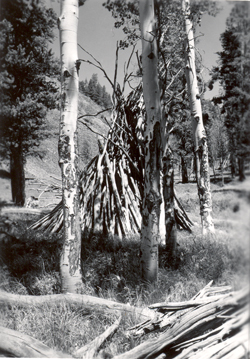
J. L. Campbell’s travel guide to the Territory of Idaho, Idaho: Six Months in the New Gold Regions, was intended to aid would-be emigrants contemplating a journey to the new gold fields. Campbell traveled the region in 1863, but by 1864 when his guide was published, it was already outdated. Montana Territory had been carved out of the vast chunk of Idaho. Campbell’s guide, however, was a useful tool because it described the route from Omaha, Nebraska, to the diggings at Bannack and Virginia City. Campbell offers advice, suggests items to take on the journey, and lists good campsites. His description of the Bannack mines includes a fascinating historical tidbit. He claims that he saw an ancient mine shaft where the miners presumably dug down to gold. A large pine tree, one foot in diameter, had grown in the mine shaft, attesting to the age of the mine. A couple of ancient timber huts stood nearby. Campbell noted that in the dry climate, timber exposed to weather could last a very long time. He theorized that the mines were the work of Spaniards who came north from Mexico exploring in the 1700s as some chronicles suggest. Most modern historians agree, however, that Spanish explorers did not venture this far north. A more likely explanation for this anomaly is that the mine was a stone quarry where Native Americans dug for chert to make weapons.

A Shoshone wickiup. Image from explorebigsky.com
Certainly the timber huts are Native American wickiups, not shelters of Spanish origin. These temporary shelters do survive to great age and—along with tipi rings, rock cairns, and other manmade features—are part of Montana’s archaeological record.

Monday, January 14, 2013

Mining Camp Courthouses

The gold-rush-era towns of Bannack and Virginia City have something in common that has gone almost unnoticed. Bannack, originally the county seat of Beaverhead County, and Virginia City, the county seat of Madison County, share courthouses of very similar design built almost at the same time in the mid-1870s. Loren Olds was the architect of both buildings.

Madison County Courthouse, 1963. Photo by John N. DeHaas Jr.
Library of Congress, HABS MONT,1-BRAN,2--3
While the Madison County courthouse in Virginia City still serves the public housing county offices and the county courtroom, Bannack’s courthouse is known today as the Meade Hotel. That’s because in 1881, the seat of Beaverhead County moved to Dillon. The courthouse sat empty until 1888 when Dr. John Meade remodeled it into a hotel.

Original Beaverhead County Courthouse, 1963. Photo by John N. DeHaas Jr.
Library of Congress, HABS MONT,1-BRAN,2--2

If you have visited each of these two buildings, you may have noticed especially that their grand staircases are identical. These gracefully curving staircases are distinctive, with beautiful newel posts and banisters, manufactured in sections, by the same unknown competent craftsman.

Stairway to second floor, Beaverhead County Courthouse, 1963. Photo by John N. DeHaas Jr.
Library of Congress, HABS MONT,1-BRAN, 2--3
Each staircase has a window with a very deep sill, almost like a window seat. The two courthouses, also similar in exterior appearance, are important landmarks not only because they recall early territorial justice, but also because they were among the first architect-designed buildings on the Montana frontier.

From Montana Moments: History on the Go

Friday, January 4, 2013

Friday Photo: Was Henry Plummer Innocent?

Recently, I got to chat with radio host Aaron Flint about Henry Plummer and the vigilantes, Custer's dogs, Langford Peel's tombstone, and lots of other wonderful tidbits from Montana history. Here's a link to Voices of Montana where you can hear the whole conversation.

E.C. Schoettner, photographer, Montana Historical Society Photograph Archives.
We'll probably never have absolute proof of Henry Plummer's guilt or innocence. But while you listen to the show and ponder the evidence, here's a photo of his grave. Plummer was buried in Hangman's Gulch within sight of Bannack.

Wednesday, November 21, 2012

Mining Camp Thanksgiving

Abraham Lincoln set a precedent during his presidency proclaiming the national observance of Thanksgiving the last Thursday in November. In 1863 Harriet and Wilbur Sanders, the soon to be famous vigilante prosecutor, spent their first Montana Thanksgiving at Bannack.

Wilbur Fisk Sanders. R.A. Lewis, photographer
Montana Historical Society Photograph Archives
Goods were scarce, freight was slow arriving, and no one even thought about serving a turkey. Near neighbors invited Harriet and Wilbur along with Henry Edgerton, Sanders’ uncle, to Thanksgiving dinner. This neighbor wanted to make a good impression on the family. Edgerton was the newly appointed Chief Justice of the Supreme Court of Idaho Territory, which then included present-day Montana. Their host offered the invitation well in advance. He miraculously procured a turkey—an unheard of, unbelievable luxury—for thirty dollars in gold dust, and paid a fortune to have it freighted all the way from Salt Lake City. Harriet wrote later that their Thanksgiving meal was as fine and beautifully cooked as any meal she ever enjoyed in New York City’s finest restaurant. Unfortunately, their host failed to make a good impression. In early January, just weeks later, Sanders and the vigilantes saw to the hanging of Sheriff Henry Plummer, the same man who had hosted their Thanksgiving Day feast.

Bill for the coffin and burial of Henry Plummer
Montana Historical Society Archives


Monday, October 1, 2012

Dorothy Dunn

I'm booked across the state through October to tell the ghost stories I've uncovered in my research on Montana history. I thought I'd share a few on here. Warning: spine-tingling tales ahead!

Spirits shroud the ghost town of Bannack, where sluices once ran and whiskey flowed. Vigilantes bestowed violent beginnings. But dig deeper. The town’s windswept cemetery where spirits rest, or don’t rest, is evidence of tragedies even more indelible than hangings and shootings. In August of 1916, sixteen-year-old Dorothy Dunn, her cousin Fern, and a friend waded into a dredge pond and stepped off a shelf into deep water. None could swim. A passerby saved Fern and her friend, but lovely, vivacious Dorothy drowned. The site of the accident to this day is known as Dorothy’s Hole. Bertie Mathews, whose parents ran the Meade Hotel, took the death of her best friend Dorothy very hard. Some time after the tragedy, Bertie was upstairs in the hotel where she saw the apparition of her friend. Bertie recognized Dorothy’s long blue dress. The experience scared her, and she seldom talked about it. Since then, many others have seen Dorothy upstairs in the hotel. Visitors report cold spots, and children who know nothing of Dorothy claim to have talked with a girl in a long blue dress.

The Meade Hotel, where Dorothy's ghost has been seen and felt.
John Vachon, photographer. Library of Congress LC-USF34-065619-D

Story from Montana Moments: History on the Go

Monday, September 24, 2012

Robber’s Roost

Because events supposedly connected to Sherriff Henry Plummer and his suspected gang occurred near the Daly ranch in 1863 and 1864, mystery, legend, and mistaken identity have long been part of the history of the stage stop called Robber’s Roost. Although it never served as a gathering place for the road agents and no early-day murders have been documented there, the inn is historically important as a link between the two territorial capitals—Bannack and Virginia City—and one of few surviving log stage stations of this very early territorial period. Orlin Fitzgerald Gammell, who was born in 1846 and died in 1952, helped procure the logs that built Robber’s Roost. He says in his written reminiscence that ranch owner Pete Daly built the structure in the winter of 1866–1867, well after the vigilante hangings of Sheriff Henry Plummer and other suspected road agents.

From http://www.rootsweb.ancestry.com/
Robber’s Roost never served as a hideout for robbers during that turbulent time, but it did later serve as an inn and stage station along the busy road between Bannack and Virginia City. So-called Robber’s Roost is actually important for a different reason. It was the place where Bill Fairweather, credited as the discoverer of the vast Alder Gulch gold deposits, died in 1875. Mrs. Daly cared for him during the final stages of acute alcoholism. He died penniless at the age of thirty-nine.

From Montana Moments: History on the Go

Monday, July 23, 2012

Bannack School

Did you go to Bannack Days over the weekend? Here's a Bannack memory in case you missed it:

The Masonic Lodge in the ghost town of Bannack was designed to serve a double function as a fraternal meeting hall and a schoolhouse. The odd combination was really not so strange. Masons were a strong presence in Montana Territory and education of children on the frontier was one of the first considerations in the earliest mining camps. A double ceiling and floor between stories kept the ground floor school and the upstairs meeting room entirely soundproof and separate to protect the Masons’ secret rites. An outside stairway provided access to the meeting room. The final element the building required was a large, smooth piece of wood on which the lodge numbers and emblem could be carved. But Bannack had no piece of wood large enough or smooth enough for the purpose. Then a woman came forward and offered her treasured breadboard brought from her home back east. W. G. Blair carved the lodge numbers and the Masonic square and compass upon it. Workmen installed it beneath the peak of the roof. The Masons used the lodge hall only briefly, but the school long served Bannack’s children.

This 2012 photo shows Bannack's well-preserved Masonic Lodge, complete with breadboard.
Photo originally shared on the Montana Historical Society Facebook page.
By the mid-twentieth century, however, the building sagged. Its roof disintegrated, the windows stood open to the elements, and only shreds of paint covered the outside walls. The carved breadboard, once tucked under the roof’s peak, was removed for safekeeping. In 1954, Bannack became a state park, and in the 1970s, staff began preservation of the Masonic Lodge. Reinstalling the cherished breadboard to its original position was the final step, and there it remains today.

From More Montana Moments
P.S. remember this scandal at the Normal School in Dillon?

Sunday, January 1, 2012

Mining Camp New Year’s

Martha Edgerton Plassman wrote in 1926 about early New Year’s celebrations in Montana and how they evolved as times changed. On New Year’s Day at Bannack in 1863, fourteen-year-old Martha and two other young girls set out to keep the custom of visiting. There were few women in the mining camp, and no proper houses to call upon, and so the three stopped at George Chrisman’s cabin, then moved down the street to Thompson and Swift’s general store. Inside they found Henry Plummer—later hanged by the vigilantes—in an argument with another fellow, both quite inebriated. The conversation was heated, and Mr. Thompson put a hand on Plummer’s shoulder, pointing him to the back door.  The three teenagers, caught in the middle, made a hasty retreat out the front. Martha was so frightened that she never again stepped inside a store in Bannack. In Virginia City, between Christmas and New Year’s of 1867, things were different. The streets were gay with fashionable ladies, visiting from house to house. Music and dancing were easy to find, and spirits flowed freely under many hospitable roofs. Nearly ten years later in Helena on New Year’s Day 1877, the New York tradition of ladies receiving gentlemen acquaintances was the practice. The newspaper listed the names of ladies receiving callers; several usually went together as hostesses. Dressed in their most beautiful gowns, they received guests throughout the afternoon. Tables were set with the best china and silver and heaped with many kinds of cakes and rolls. But Martha recalled that unlike rough and raw Virginia City, in Helena coffee usually took the place of strong spirits.