 |
| Montana Historical Society Photograph Archives, 981-576 |
Showing posts with label cowboys. Show all posts
Showing posts with label cowboys. Show all posts
Friday, June 6, 2014
Friday Photo: Cow Camp

Monday, January 13, 2014
Cowboy Boots
Imagine shoes without a left and a right. There was a time when ready-made shoes had to be broken in to fit. Only custom-made shoes and boots had a left and a right. There were basically two styles of boots worn on the early frontier. One was Hessian boots, worn by the German mercenaries who fought for the English during the Revolutionary War. Hessian boots came below the knee and had a large v-cut top with a decorative tassel. Wellingtons were the other style, made popular after 1815 when the Duke of Wellington defeated Napoleon at Waterloo. Wellingtons had a stacked leather heel, square or round toes, and were cut straight or slightly curved just below the knee. Both types later influenced cowboy boots. These early boots had leather soles that tended to slip. Nails placed in patterns on the soles helped give the boots better traction. Hobnail boots were rough on wooden floors, and this explains why saloon floors were notoriously in rough shape. The Hyer Boot Company in Olathe, Kansas, supposedly made the first pair of cowboy boots in 1875. A cowboy who was wearing frontier boots had just returned from a long cattle drive. He asked Hyer for a custom pair of boots with a pointed toe that would easily slip into a stirrup, a slanted heel that would stay put, and a high top with a V-cut scallop in front and back for comfort. They immediately caught on and others began to make them. In 1903, Hyer’s added decorative toe stitching, or toe wrinkles, as the final flourish. Montana cowboys, and cowgirls, wear these same boots today.
 |
| Cowboy, Honeycut on White Star. August, 1904, by L.A. Huffman Montana Historical Society Photograph Archives, 981-491 |
Wednesday, December 11, 2013
Long George Francis
One of the most colorful characters of the High Line was an old time cowboy who came to a hideous end. Long George Francis was well known on the rodeo circuit. He lived along the Milk River west of Havre on a small ranch.
But Francis lived by the old range rules, believing unbranded stock was fair game. Times were changing, range laws evolving, and opinions about Francis were divided. Some were outraged when the court convicted Francis of grand larceny for the theft of a bay mare. Others saw Francis as a cattle rustler and approved of his conviction. But after sentencing in 1918, Francis went into hiding. He was on the lam for two years until he finally grew tired of running. On Christmas Eve, 1920, he prepared to give himself up to serve his sentence. But first he determined to make one last trip to visit his schoolteacher girlfriend near the Canadian border. He loaded his car with apples and gifts for her and the children and started out on the journey. It was snowing and cold. Thirty miles northwest of Havre in the middle of nowhere, he wrecked his car and broke his leg in the accident. Fashioning a splint from an apple box, he tried to crawl for help. Exhausted and in pain with little hope of rescue, Francis slit his own throat and bled to death in the snow.
 |
| This photo of Long George Francis was taken at the Great Northern Montana Stampede in Havre Montana Historical Society Photograph Archives, 952-167 |
Monday, November 18, 2013
Pierre Wibaux
Pierre Wibaux, for whom the town and county of Wibaux are named, was born in Roubaix, France, to a distinguished family of textile manufacturers. Pierre’s father sent him to England to study the English textile industry so that he could manage the family business. In England, Pierre heard stories of English relatives who had gone to the American West and made fortunes in cattle ranching. After two years, Pierre returned to France and informed his father that he would not take over the family business, but rather go into ranching in America. He first studied cattle in Chicago and arrived at the settlement of Mingusville in eastern Montana near the North Dakota border in 1883. Pierre established his ranch headquarters, the W-Bar, on Beaver Creek at the eastern edge of Montana Territory. Wibaux was very poor during this time and lived in a primitive dugout cave where he ate and slept and learned how to be a cowboy, foreman, and rancher.
Except for his financial status, Wibaux was much like his infamous North Dakota neighbor, the Marquis de Morés: young, handsome, courageous, rugged, and somewhat argumentative. Legend has it that on a visit to the Marquis’ chateau at Medora, North Dakota, Wibaux and the Marquis had a heated conversation. The Marquis’ wife excused herself and went to bed. But soon she heard her husband’s “en garde” and the clash of swords. She knew that Wibuax was no match for him, as her husband been involved in fatal duels. She descended the stairs and ordered them to stop. Fortunately, they did. One biographer speculates that the argument had more to do with an evening of champagne than real differences. After the hard winter of 1886-87, Pierre bought up remnant herds of unfortunate ranchers with money borrowed from his father. By the mid-1890s, his ranch was one of the largest cattle operations in the nation, running about 65,000 head of cattle.
 |
| Courtesy State Historical Society of North Dakota, D0187 |
Friday, August 9, 2013
Friday Photo: Chuck Wagon
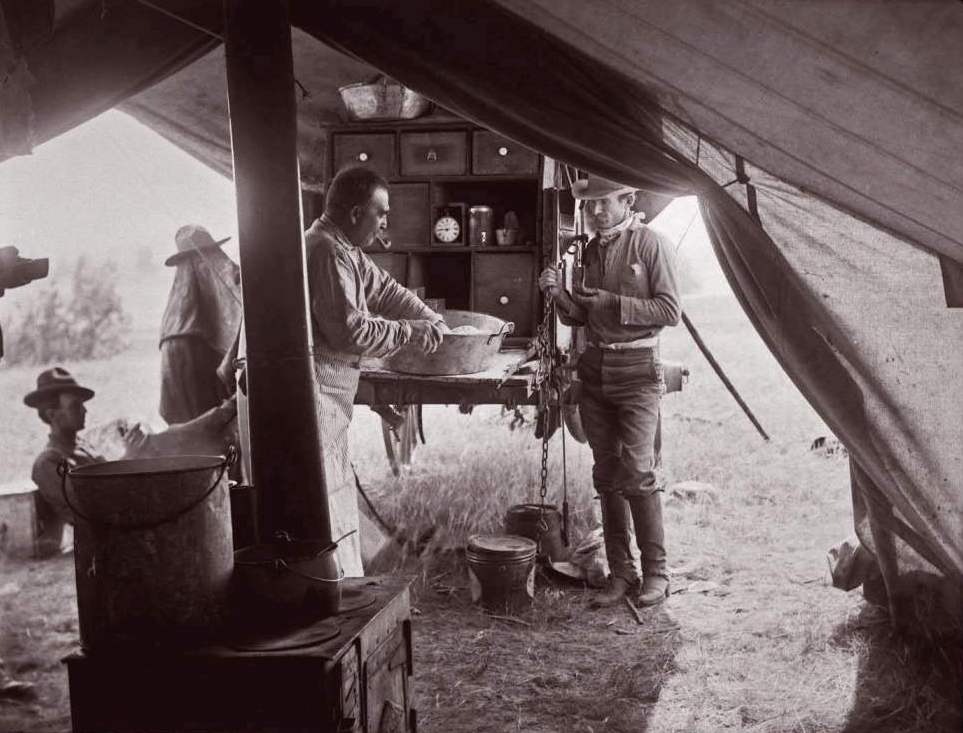 |
| Montana Historical Society Photograph Archives, 981-256 |
Friday, June 28, 2013
Friday Photo: Turk Greenough
 |
| Montana Historical Society Photograph Archives, Byerly Collection |
P.S. Remember Turk's rodeo star sisters?
Friday, June 21, 2013
Friday Photo: The Bob Saloon
 |
| Montana Historical Society Photograph Archives, 981-837 |
Monday, June 3, 2013
A Cowboy and his Horse
The Great Falls Tribune of August 30, 1951, related a heartwarming true tale of a cowboy and his horse. Henry Haughian and Buck were rounding up cattle in the rugged outback country of the Sheep Mountains north of Miles City in Dawson County. Buck, usually a surefooted horse, probably got to daydreaming and stumbled on the steep hillside. Henry had no time to jump off. He was caught beneath the horse as Buck rolled down the hill. The fall frightened Buck, who got up, shook himself, shied away, and took off down the hill as fast as he could go. But when Buck got over his fright, he realized that his master was missing. He climbed back up the rocky hillside, searching for him. He found Henry lying unconscious on the slope. Buck then climbed to the top of the hill and stood sentinel there.
No one knows how long he must have waited, motionless on that hilltop. Finally sometime later, two sheepherders happened along and saw the horse silhouetted against the Montana sky. They noticed the empty saddle right away and made their way to the riderless horse. Once the men reached the top of the hill, Buck led them down the steep incline to the spot where Henry lay, still unconscious. The men carried Henry to their truck and took him to the hospital. Henry suffered three broken bones and extensive bruises but recovered from his ordeal. The story proves that humans and their animal companions have special bonds. Or maybe it proves that horses know where their next meal comes from. Whatever the explanation, Henry never forgot Buck because Buck did not forget him.
P.S. Remember this heartwarming story?
 |
| Henry Haughian. Range Riders Museum Collection, via Range Rider Stories |
P.S. Remember this heartwarming story?
Thursday, November 22, 2012
A Mild Thanksgiving in Wild Miles City, 1882
Miles City was a wild town in its day. Wooden false fronts, wide dusty streets, and saloons where whiskey flowed made the town on every cowboy’s route and a place where a good time was easily found. Cowboys and soldiers at Fort Keogh frequented the numerous houses where the ladies entertained them lavishly, for a fee, of course.
But for one day in the 1880s, an unusual atmosphere pervaded the air. The Miles City Daily Press noted after Thanksgiving Day in 1882 that seldom had there been such a mild holiday. The weather that day was clear and brilliant and the temperature balmy, precisely the kind of day one would choose for a holiday. And so Miles City gave itself up to relaxation and enjoyment. The bank and the post office were closed although citizens received their daily mail. Stores were open early for shoppers planning holiday meals, and by noon, all stores had hung their closed signs in their windows. Visitors flocked into town from neighboring settlements and reaches to see what fun might be going on. But, said the paper, there was only the mildest type to be found. There was never a more sober and orderly day witnessed in Miles City. The saloons were all open and they were well patronized and did a brisk business, but the patrons were all unusually well behaved. Unlike the usual barroom scuffles and rowdy behavior, the spirit of good behavior seemed to hover over all. Miles City was in it glory that Thanksgiving night in 1882, and it was gratifying to record that not a single disturbance occurred to mar the general harmony that had prevailed throughout that pastoral Thanksgiving Day.
May yours be as pleasant.
 |
| Miles City prostitutes and patrons in a parlor house reception hall. Montana Historical Society Photograph Archives, Morrison Collection |
May yours be as pleasant.
Friday, July 13, 2012
Friday the 13th Photo: Rodeo
Some days just don't go well.
Location, photographer, and date unknown, though the clothing of the boy on the fence points to the 1950s or 60s. Maybe someone can identify the rodeo arena or the cowboys?
 |
| From Montana Views. Original in Montana Historical Society Photograph Archives PAc 76-82 3-C-206 |
Wednesday, May 30, 2012
Cattle Dog
An undated clipping from the 1940s in a Bozeman newspaper tells a poignant story of man’s best friend. Oldtime cattleman Ott McEwen was devastated when the cattle dog who had been at his side through blizzards and summer winds, long days and lonely nights, suddenly disappeared. The dog had been his constant companion, sharing hardships and joys. McEwen grieved for the loss of the best friend he ever had.

Four years later at a Stockgrowers meeting, cattlemen had gathered in the Bozeman Hotel’s lobby. Someone noticed a shaggy old dog, limping badly, whining outside the door. The man let him in and watched curiously as the dog wandered from man to man sniffing. Finally the dog dove into the crowd and leapt upon an old geezer. Old Ott McEwen couldn’t believe it. He went down on his knees and on the floor of the lobby, threw his arms around the dog as tears ran down his cheeks. Someone said he had seen the dog weeks before way over in eastern Montana. How did the dog make his way across the mountains, and how did he know his master would be there? Many a gruff cattleman wiped away a tear, and the talk grew gentle among the men, for they understood well the special bond between a cattleman and his dog.
From Montana Moments: History on the Go
P.S. Remember this faithful dog?

Four years later at a Stockgrowers meeting, cattlemen had gathered in the Bozeman Hotel’s lobby. Someone noticed a shaggy old dog, limping badly, whining outside the door. The man let him in and watched curiously as the dog wandered from man to man sniffing. Finally the dog dove into the crowd and leapt upon an old geezer. Old Ott McEwen couldn’t believe it. He went down on his knees and on the floor of the lobby, threw his arms around the dog as tears ran down his cheeks. Someone said he had seen the dog weeks before way over in eastern Montana. How did the dog make his way across the mountains, and how did he know his master would be there? Many a gruff cattleman wiped away a tear, and the talk grew gentle among the men, for they understood well the special bond between a cattleman and his dog.
From Montana Moments: History on the Go
P.S. Remember this faithful dog?
Friday, May 11, 2012
Friday Photo: Fannie Sperry Steele
Famed bronc buster Fannie Sperry Steele competed in rodeos until 1925. Then she and her husband bought a dude ranch near Lincoln. After her husband died in 1940, Steele ran the ranch by herself for another twenty-five years. She was one of the first women to receive a packer’s license and well into her sixties spent long days in the saddle guiding hunters into rough country. She stocked Meadow Creek before environmental concerns were fashionable, packing six horses with cans of fish over treacherous terrain, stopping at every stream to keep the water cool. She broke her own horses and at the end of the season trailed her twenty-five pintos seventy miles across the Continental Divide to winter pasture. In 1974 at eighty-seven, Steele could no longer live alone and had to move from the ranch. The worst part for her was leaving her beloved string of pintos behind. In 1975, Steele was honored as was one of the first of three women inducted into the Rodeo Hall of Fame. A few years later at ninety, Steele summed up her life: “To the yesterdays that are gone, to the cowboys I used to know, to the bronc busters that rode beside me, to the horses beneath me (sometimes), I take off my hat. I wouldn’t have missed one minute of it.” Steele died in 1983. She was the quintessential Montana woman: determined, gritty, and independent of spirit.
From Montana Moments: History on the Go
P.S. Remember these rodeo-champion sisters?
 |
| Fannie Sperry Steele rides a steer at the Gilman Stampede, September 1919. Montana Historical Society Photograph Archives, 947-603 |
From Montana Moments: History on the Go
P.S. Remember these rodeo-champion sisters?
Friday, April 27, 2012
Friday Photo: Spring Roundup
Happy Friday! Here's an iconic photo of a highly romanticized chapter in Montana history.
Photographer L. A. Huffman snapped this photo during the spring roundup near Miles City, probably in the 1890s. He called it "Foreman Telling Off the Men for the Circle," describing the routine to start the day's work.
P.S. Remember this depiction of cowboy life?
 |
| Montana Historical Society Photograph Archives, 981-460 |
P.S. Remember this depiction of cowboy life?
Friday, April 13, 2012
Cattle Drives
Cattle drives might be a thing of the past, but supposedly there are still three cows to every person in Montana. Some still practice cowboy skills. And for greenhorns like myself, there are learning opportunities if you know where to look. I will be honing my limited skills at a cow horse cutting clinic this weekend!
Jesuit missionaries in the Bitterroot Valley and some of the early traders, including Johnny Grant in the Deer Lodge Valley, drove the first shorthorn cattle herds to Montana long before the gold rushes of the 1860s. James Liberty Fisk noted cattle grazing in the Prickly Pear Valley in 1863. But it was Nelson Story who drove the first herd of Texas longhorns into Montana in 1866 in a legendary drive fraught with danger. Story invested a good portion of his $30,000 fortune in gold dust on this venture. He purchased a thousand head of cattle at ten dollars a head and hired twenty-five of the most experienced, toughest cowboys. Armed with colt revolvers, these men were full of courage and grit driving the huge herd through dangerous territory in Oklahoma, Kansas, Colorado, Nebraska, and Wyoming. At Fort Laramie, Story armed his men with new Remington breech-loading rifles for protection along the dangerous Bozeman Trail. It was needed, too, as Sioux attacked the group, wounded several drovers, stole some cattle, and stampeded the herd. At dusk, drovers rode into the Sioux camp and, in a daring raid, recovered their stolen cattle. Sioux again attacked several times more. At Fort Reno, the army ordered Story to halt, promising that Indians would kill them all. But defying orders, Story and his men drove the cattle by night, and in December 1866, after nine months, they arrived in the Gallatin Valley. Livestock and open range ranching quickly became a huge industry, and skilled cowboys were essential. Roundups gathering the herds for spring branding and fall shipping were the pulse of the cowboy life. As the Northern Pacific steamed across America’s last frontier in 1883, overland cattle drives, once a necessity to move livestock to market, became a thing of the past. Barbed wire encroached and the open range and the vast herds of yesteryear disappeared. Cowboys and their way of life passed into legend.
 |
| B.B. Sheffield cattle roundup in coal creek badlands, Diamond W Ranch, Calabar, Montana, date unknown. Montana Historical Society Photograph Archives, 981-624 |
Thursday, March 8, 2012
Extra! Extra! Laugh Kills Lonesome
I just handed the manuscript of my next book to my editor. It's a collection of the radio scripts I've been writing for "History on the Go," some of which have appeared on this blog (like this post about the Placer Hotel). I figured that since the book won't be on shelves until August, you all deserve a sneak peek. Here's the first entry of More Montana Moments:
Artist C. M. Russell carefully chose the subjects of his art based on personal experience. He, more than any other western artist, painted what he knew with great longing and nostalgia for the cowboy way of life he lived and loved so well. In 1925, a year before his death, Russell painted Laugh Kills Lonesome, a tribute to this vanishing cowboy lifestyle. He depicts an evening campfire scene, one that he probably recalled from his youth. He painted himself into the picture as an old cowpoke stopping by the warm and friendly circle for a cup of coffee and a hearty laugh at the end of a long day in the saddle. The title has been hailed as fine as the painting and several contemporary artists have used it and further interpreted Russell’s famous scene. One of these is poet Mike Logan. Another is musician-songwriter Michael Nesmith of the 1960s pop rock group The Monkees who went on to a stellar career as a songwriter and musician. His insightful, lyrical song “Laugh Kills Lonesome” plays upon the camaraderie and the universal power of humor. His lyrics tell the story that Russell meant to convey. The lyrics read in part:
All around the campfire stood seven dusty men
The cook was drinking applejack, the cattle were all penned
Someone must have cracked a wise one because the men began to grin
Their smiles shot out like sunbeams and made the night give in
Because
Laugh kills lonesome every single time
That's why Charlie Russell painted it
And why it looks so fine
Laugh kills lonesome every single time.
And Nesmith’s lyrics still ring as true as the subject of Russell’s painting.
Artist C. M. Russell carefully chose the subjects of his art based on personal experience. He, more than any other western artist, painted what he knew with great longing and nostalgia for the cowboy way of life he lived and loved so well. In 1925, a year before his death, Russell painted Laugh Kills Lonesome, a tribute to this vanishing cowboy lifestyle. He depicts an evening campfire scene, one that he probably recalled from his youth. He painted himself into the picture as an old cowpoke stopping by the warm and friendly circle for a cup of coffee and a hearty laugh at the end of a long day in the saddle. The title has been hailed as fine as the painting and several contemporary artists have used it and further interpreted Russell’s famous scene. One of these is poet Mike Logan. Another is musician-songwriter Michael Nesmith of the 1960s pop rock group The Monkees who went on to a stellar career as a songwriter and musician. His insightful, lyrical song “Laugh Kills Lonesome” plays upon the camaraderie and the universal power of humor. His lyrics tell the story that Russell meant to convey. The lyrics read in part:
All around the campfire stood seven dusty men
The cook was drinking applejack, the cattle were all penned
Someone must have cracked a wise one because the men began to grin
Their smiles shot out like sunbeams and made the night give in
Because
Laugh kills lonesome every single time
That's why Charlie Russell painted it
And why it looks so fine
Laugh kills lonesome every single time.
And Nesmith’s lyrics still ring as true as the subject of Russell’s painting.
 |
| Montana Historical Society Museum Collection x1955.01.01. Click on the image for a big version. |
Subscribe to:
Posts (Atom)