 |
| Quake Mountain, showing the earthquake slide area. U.S. Geological Survey photo |
Showing posts with label earthquake. Show all posts
Showing posts with label earthquake. Show all posts
Wednesday, March 26, 2014
Earthquake Lake
On Monday night August 17, 1959, actress Vicki Smith and a group of fellow Virginia City Players had the night off from performing at the Opera House. They were enjoying their rare free time by camping at nearby Ennis Lake. But there was something odd. Things had seemed off kilter all day. The group had camped here many times, but the lake had never been so still and glasslike. There were no crickets singing in the night, no bugs flitting over the water, not a sound except the strange mooing of some nearby cattle. Vicki and her friends felt lethargic. Monday morning they packed up and left the lake, still wondering what felt so odd. Their questions were soon answered. The Monday evening performance had ended and the cast assembled at a local bar for a nightcap. At 11:37, the elk’s head on the wall suddenly tilted, and the ground shook. The street and wooden sidewalks undulated like waves. A 7.5 earthquake jolted the summer night, bringing worldwide attention to Montana and the West Yellowstone area. The worst of it hit the southern end of the Madison range near Hebgen Lake. The quake triggered a massive landslide that dammed the Madison River, creating Earthquake Lake.
The earth bucked, heaved, and dropped, moved an entire mountain, fantastically tilted a lake, dumped sections of highway into it, and claimed the lives of twenty-nine people. The widespread temblors even destroyed a cell block at the Montana State Prison at Deer Lodge. The Forest Service has preserved and marked the quake-damaged area northwest of West Yellowstone. It was an event that Vicki Smith has never forgotten.

Friday, January 20, 2012
Stained Glass Artistry
Update: More photos and info in my article in Signature Montana here.
The fifty-nine stained-glass windows in the capital city’s St. Helena Cathedral are a rare and irreplaceable collection of imported German art. The firm of F. X. Zettler, whose exquisite “Munich style” glasswork is found in St. Peter’s Basilica at Vatican City in Rome, crafted the windows between 1908 and 1926. These windows tell the stories of historical events and recall the middle ages when most could not read. Pictures of Christian teachings served as the “Bible of the Poor.” But the exquisite pictorial style Zettler’s studio blended nineteenth-century Romantic and German Baroque styles with Italian Renaissance artistry. Painting on large sheets of glass and firing them at high heat allowed fantastic portraiture and detail. The leaded seams of the Munich style do not interrupt the scene but are part of it. Zettler’s paintings are multi-dimensional. Even the plants have such miniscule detail that the flowers and foliage can be botanically identified. Zettler windows are still in place in many American cathedrals, but the artist himself believed that St. Helena’s windows were the finest his company ever turned out. In 1982, stained glass expert Father Dan Hillen began restoration of St. Helena’s windows. The glass had suffered damage, especially in 1935 when earthquakes rattled the area. Father Hillen uncovered and repaired over one hundred broken pieces that had been patched with window glass and touched up with house paint. Careful maintenance remains ongoing. Many artists copied Zettler’s work, and without a signature it is difficult to authenticate. The company signature of F.X. Zettler, however, appears in the first panel to the left in the cathedral’s foyer, authenticating St. Helena’s irreplaceable treasures.
The fifty-nine stained-glass windows in the capital city’s St. Helena Cathedral are a rare and irreplaceable collection of imported German art. The firm of F. X. Zettler, whose exquisite “Munich style” glasswork is found in St. Peter’s Basilica at Vatican City in Rome, crafted the windows between 1908 and 1926. These windows tell the stories of historical events and recall the middle ages when most could not read. Pictures of Christian teachings served as the “Bible of the Poor.” But the exquisite pictorial style Zettler’s studio blended nineteenth-century Romantic and German Baroque styles with Italian Renaissance artistry. Painting on large sheets of glass and firing them at high heat allowed fantastic portraiture and detail. The leaded seams of the Munich style do not interrupt the scene but are part of it. Zettler’s paintings are multi-dimensional. Even the plants have such miniscule detail that the flowers and foliage can be botanically identified. Zettler windows are still in place in many American cathedrals, but the artist himself believed that St. Helena’s windows were the finest his company ever turned out. In 1982, stained glass expert Father Dan Hillen began restoration of St. Helena’s windows. The glass had suffered damage, especially in 1935 when earthquakes rattled the area. Father Hillen uncovered and repaired over one hundred broken pieces that had been patched with window glass and touched up with house paint. Careful maintenance remains ongoing. Many artists copied Zettler’s work, and without a signature it is difficult to authenticate. The company signature of F.X. Zettler, however, appears in the first panel to the left in the cathedral’s foyer, authenticating St. Helena’s irreplaceable treasures.
 |
Wednesday, December 21, 2011
Christmas at the Rio
In December of 1935, Helena was still suffering from the Great Depression and the devastation of the recent October earthquakes. The series of temblors left many families in dire need, camping out in their yards for weeks as winter cold set in. Thanksgiving passed with more earthquakes, more terror for the community. Children especially felt the uncertainty of these very bad times. But with the start of the holiday season, people got into the spirit, stores realized good profits, and things began to look better. Movies helped people cope. The Rio Theater on North Last Chance Gulch had opened the year before, in 1934, and was celebrating its first anniversary. Theatre manager Paul McAddams had an idea for a way to celebrate this special occasion. He teamed up with the Helena Kiwanis to throw a special Christmas party for all the children of Helena. There was a flurry of planning, and Christmas morning dawned cold, clear, and mercifully, the Helena valley was peaceful. As the sun came up, there was a steady procession of children streaming into the theater. After a morning of free comedies, novelties, and cartoons, Santa Claus arrived on the stage and the Kiwanis Club helped distribute free candy from his pack. McAddams said at the time, “We consider children our best friends as they consistently advertise the shows. Their knowledge of pictures and stars is remarkable … It is our Christmas present to the children of Helena in celebration of our first anniversary, and we wish them a Merry Christmas.” Following the party, shows resumed with continuous showings of In Person starring Ginger Rogers.
Wednesday, November 23, 2011
Thanksgiving Turkeys
Earthquakes rocked the Helena valley in October of 1935, leaving four people dead, a community terrified, and widespread destruction in the aftermath. There was significant damage in the 6th Ward, especially at the National Biscuit Company, the Northern Pacific depot, and along Railroad and Helena Avenues.
One family on Boulder Avenue was buried under rubble when their house collapsed. The father dug himself out and rescued his injured wife and their two small children.
In the nearby commercial district that had grown to serve the Northern Pacific Railroad, many small businesses suffered, and one grocer lost more than just his building. For many years this grocer had specialized in fresh turkeys he plucked and dressed himself. No one seemed to notice that the birds from this particular grocer never included gizzards. This is because he had a secret. His turkeys arrived via the Northern Pacific from an area that had once been extensively placer mined; the turkeys pecked around in the tailing piles. When he butchered the turkeys, he found that the stones collected in their gizzards were sometimes not just pebbles, but gold nuggets. The grocer kept his golden treasure in a huge jug he kept hidden in his basement. Over the years, his stash of nuggets had grown so that the jug was almost full. When the earthquake struck, his building collapsed in on itself, forever burying the jug full of golden nuggets. Neighbor kids talked about the 6th Ward’s buried treasure for years, and it became legendary. That jug full of treasure remains buried somewhere in the commercial district to this day.
P.S. You can see more photos of the earthquake damage on the Helena As She Was site.
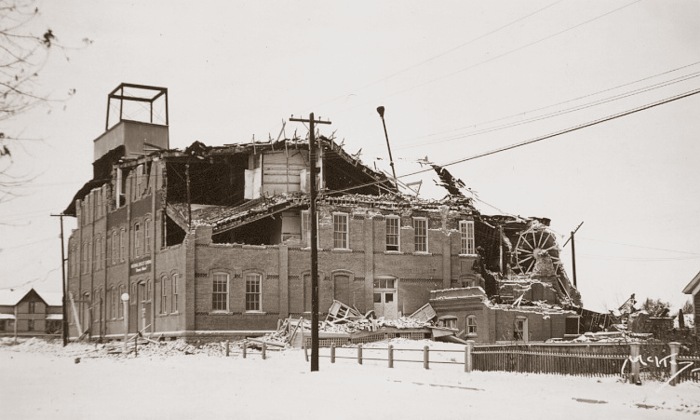 |
| East Side of the National Biscuit Co. Factory, Taken from Boulder Ave. Photo from Helena As She Was |
 |
| Charles Purdy and his wife and two small children were buried under the rubble of their house (at left). Photo from Helena As She Was |
In the nearby commercial district that had grown to serve the Northern Pacific Railroad, many small businesses suffered, and one grocer lost more than just his building. For many years this grocer had specialized in fresh turkeys he plucked and dressed himself. No one seemed to notice that the birds from this particular grocer never included gizzards. This is because he had a secret. His turkeys arrived via the Northern Pacific from an area that had once been extensively placer mined; the turkeys pecked around in the tailing piles. When he butchered the turkeys, he found that the stones collected in their gizzards were sometimes not just pebbles, but gold nuggets. The grocer kept his golden treasure in a huge jug he kept hidden in his basement. Over the years, his stash of nuggets had grown so that the jug was almost full. When the earthquake struck, his building collapsed in on itself, forever burying the jug full of golden nuggets. Neighbor kids talked about the 6th Ward’s buried treasure for years, and it became legendary. That jug full of treasure remains buried somewhere in the commercial district to this day.
P.S. You can see more photos of the earthquake damage on the Helena As She Was site.
Subscribe to:
Posts (Atom)