Showing posts with label art. Show all posts

Wednesday, August 27, 2014

There’s Something Out There!

Here's a link to some background about the Flathead Lake monster, the topic of today's post.

Skeptics have explained the mysterious creature sighted in Montana's Flathead Lake as an overweight skindiver, a mother-in-law in a swimsuit, a sturgeon, a superfish, a prehistoric holdover, even a wayward seal. As unlikely as it may seem, however, the USO (unidentified swimming object) may not be a hoax. For well more than a century, reports of something in the third largest body of fresh water west of the Great Lakes has kept residents and tourists on the lookout. And sightings have been numerous.

Stories about a creature living in Flathead Lake have long been the subject speculation.
Flathead Lake, Ralph De Camp, oil on canvas, Montana State Capitol
Visitor Services Bureau Chief Ken Soderberg of Montana State Parks related an incident that FWP Maintenance Supervisor Merle Phillips shared with him a few years ago. Phillips and his crew were called to Wild Horse Island to dispose of a dead horse that was, as Soderberg puts it, "making a bit of a stink." While sometimes in such a situation the men will resort to dynamite, a nearby cabin made that solution unwise. The horse was stiff as a board and too big to load on the boat, so they built a raft of inflated inner tubes and boards intending to haul it across to shore. They lashed the horse to the boards, legs sticking straight up in the air, but they slightly miscalculated the weight of the horse. Once in the water, it partially submerged.
The boat moved slowly, dragging the raft with its unusual cargo. Boats passing by gave the FWP crew double takes as they saw what was tethered to the raft. Finally one boat turned around, pulled alongside the FWP craft and the driver asked, "Hey, what are you guys doing?"  
Phillips replied in all seriousness, "Mister, I would advise you to stay back from this official boat."
The driver was taken aback, "Well, how come? What are you doing?"
Phillips realized he had to come up with an answer. The look on the fellow's face was priceless when he heard Phillips' response, "We're trolling for the Flathead Lake monster!"


Monday, June 30, 2014

John L. Clarke

Artist J. K. Ralston said that when John L. Clarke finished carving a bear, you could smell it. Clarke was a gifted wood carver, highly celebrated in his own lifetime. John D. Rockefeller even purchased eight of his carvings. The grandson of trader Malcolm Clarke and his Piegan wife, John was three-quarters Blackfeet. His grandfather Malcolm was killed in 1869 over a dispute with his in-laws. His father, Horace, was shot through the head during that incident but recovered. When John was a toddler, scarlet fever claimed five of his brothers and left him profoundly deaf. He was sent away to schools for the deaf in the 1890s and educated at North Dakota and at Montana’s state school at Boulder. There he learned wood carving. Clarke mostly communicated through sign language and was known by his Blackfeet name, Catapuis, which means the Man Who Talks Not.

John L. Clarke with A Blackfeet Encampment, 1956, wood frieze,  Montana Historical Society, X1959.12.01.
Montana Historical Society Photograph Archives, 941-735
Despite his handicap, Clarke was highly gifted, largely self-taught, and spent most of his life carving spectacular wildlife at his studio in East Glacier. His work includes clay sculpture, paintings, sketches, and the famed mountain goat insignia of the Great Northern Railway. His last work was a carving of a grizzly bear freeing itself from a trap. Clarke did this remarkable carving almost entirely by feel, his ninety-year-old eyes so clouded with cataracts that he could hardly see. Clarke’s work has been exhibited throughout the United States and in London, England. President Warren G. Harding commissioned an eagle holding an American flag that he displayed in the Oval Office during his presidency. The John L. Clarke Western Art Gallery and Memorial Museum in East Glacier commemorates the work of this exceptional artist who was one of Montana’s finest native sons.

Monday, June 23, 2014

Edgar S. Paxson

Beloved Montana artist Edgar S. Paxson was the son of Quaker parents. His father was a painter of theatrical scenery. Like his fellow artist Charlie Russell, Paxson came west looking for adventure. He arrived in Montana in 1877 and like Russell worked as a wrangler, cow punching, scouting, and hunting for his cattlemen bosses. Paxson’s life experiences on the range gave him subject matter, but he put his own twist on history. He knew and interviewed many of the characters he later depicted and carefully painted them as he wanted them to be, not always as they really were. For example, Paxson knew the great Salish chief Charlo. His painting of the Salish exodus from the Bitterroot Valley, The Salish, led by Chief Charlo, leaving their Bitterroot home for the Flathead Reservation, portrays finely dressed warriors brandishing rifles. In reality, the Salish were a poor and broken people forced out of their homeland.

E.S. Paxson, The Salish, led by Chief Charlo, leaving their Bitterroot home for the Flathead Reservation
Oil on linen, 1914, Missoula County Art Collection. Photographed by Chris Autio, 2000.
Paxson settled in Butte in 1880, painting signs and theatrical scenery to support his family. Paxson was entirely self-taught like Russell, but he lacked the marketing opportunities and exposure that that Russell gained from his wife Nancy’s determined salesmanship. The Spanish American War intervened with Paxson’s career, and he and his son Harry together volunteered for service. En route home, the ship encountered a typhoon, and a wave slammed Paxson against a spar causing serious internal injuries from which he never recovered. But despite his feeble health, he moved to Missoula and, driven by his art, worked until the day he died in 1919, leaving a wonderful legacy. His most famous work, Custer’s Last Stand, is in the Buffalo Bill Center of the West in Cody, Wyoming. In Montana, Paxson’s murals grace the Montana State Capitol and the Missoula County Courthouse.

Wednesday, April 2, 2014

State Capitol Rotunda Roundels

The Pedretti brothers painted much of the art in the Montana State Capitol, but it was Governor Joseph K. Toole who dictated the subject matter. Toole wanted the Capitol to reflect the people and events important to Montana’s heritage. In the magnificent Capitol’s rotunda, four roundels, painted on canvas in 1902, portray people important to Montana’s past.


The Trapper represents famous mountain man Jim Bridger (1804–1881), who guided many early trappers and explorers into the Montana wilderness. The portrait acknowledges the trappers and explorers who paved the way for the first white settlers.


The Indian Chief represents the Salish chief Charlo (1830–1910), who resisted the removal of his people from the Bitterroot Valley to the Jocko Reservation. Whether Governor Toole meant to emphasize Charlo’s resistance to government authority or his final acquiescence poses an interesting question.


The Prospector commemorates those who exploited Montana’s mineral wealth with pickax and gold pan. The portrait represents Henry Edgar, one of the six discoverers of Alder Gulch. Edgar became a respected member of the early community and lends a special dignity to the image of the rough miner.


Cowboys were already romanticized as a dying breed by 1902, but they provided the foundation for the huge cattle industry that brought immense wealth to Montana. Governor Toole suggested that the Pedrettis study the cowboys in Charlie Russell’s paintings for inspiration for The Cowboy. The cowboy is the only anonymous figure among the four roundels.

Monday, March 24, 2014

Fannie Sperry Steele

On a homestead beneath the picturesque Sleeping Giant in the Prickly Pear Valley, Fannie Sperry’s mother taught her to ride almost before she could walk. As a teenager, Fannie rode the roughest horses with the best of the men. At a time when most women still rode sidesaddle, and riding astride was considered coarse and unladylike, Fannie earned a reputation for courage and sticking power on the backs of the wildest broncos wearing a scandalous divided skirt. In the summer of 1903, sixteen-year-old Fannie so awed spectators on a bucking white stallion that onlookers passed the hat. She made her first professional ride as a relay racer at the Montana State Fair in Lewis and Clark County in 1904. Inspired by Buffalo Bill’s “Pony Express Race,” the Montana relay featured only women riders who changed horses and saddles at top speed. Fannie and the popular Montana Girls—wearing bloomers that shocked the crowds—rode the very first relays at Helena, Butte and Anaconda and across the Midwest in 1905.

Relay racers in their shocking bloomers at the North Dakota State Fair in Bismarck, 1907.  L-R Anna Pauls, Christine Synness, Violet Keagle, Fannie Sperry. Montana Historical Society Photograph Archives
Fannie rode in women’s bucking horse competitions and earned a gold medal in 1907 at Helena. At the Calgary Stampede in 1912, her ride on the killer bronc Red Wing went down in rodeo history earning her the title “Lady Bucking Horse Champion of the World.” Artist C. M. Russell commemorated that event with a sketch of Fannie’s prowess.

Rodeo Cowgirl on a Bucking Bronc, Charles M. Russell
She earned the title again in 1913. Unlike most bronc-busting women of the time, Fannie Sperry rode “slick” instead of hobbled. Hobbling, tying the stirrups together beneath the horse’s belly for stability in the saddle, was a concession allowed women contestants. Slick riding, however, demanded precision, balance, courage, and unusual strength. Fannie was the only woman rider among her contemporaries to ride her entire career slick, just like her male counterparts.  She was one of the first women inducted into the National Cowboy Hall of Fame.

P.S. Read more about Fannie here.

Monday, March 17, 2014

Elizabeth Lochrie

The U.S. Treasury Department, the State of Montana, the Ford Motor Company, New York Life Insurance Company, and the First National Bank of Seattle were among the distinguished patrons of Deer Lodge native Elizabeth Lochrie. Formally trained as an artist at the Pratt Institute in New York City, she graduated in 1911 and settled in Butte. From the 1920s to the 1950s, Lochrie established herself as a fine portrait artist. She also painted local rural and urban landscapes and scenes. During 1924 and 1925, Lochrie painted eighteen children’s murals for the Montana State Hospital at Galen. She also created murals for several post office buildings.

Montana Historical Society Photograph Archives, PAc 80-61
In 1937 Lochrie won the U.S. Treasury Department’s competition for News from the States at the Dillon Post Office, depicting the historic arrival of mail in that community. At Glacier National Park, Lochrie studied under Winold Reiss and then served as artist for the Great Northern Railway from 1937 to 1939. While other artists documented the vanishing Indian lifeway, Lochrie did more than that. She immersed herself in Indian culture and learned to converse in various dialects. She traveled the lecture circuit and often used her fees to buy clothing and other items for needy tribal members, especially Blackfeet. In 1932, the Blackfeet Nation adopted her and named her Netchitaki, Woman Alone in Her Way. When she died in 1981, Lochrie left a legacy of more than one thousand paintings, murals, and sculptures. She was one of Montana’s most outstanding twentieth-century artists.

P.S. Have you seen the Women's History Project?

Monday, March 10, 2014

Driving the Golden Spike

The most visible art in the Montana State Capitol attests to the importance of the arrival of the Northern Pacific Railroad. Driving the Golden Spike commemorates the great event that took place at Gold Creek on September 8, 1883, marking the completion of the last section of track across the vast stretches of the state.

Amédée Joullin, Driving the Golden Spike, 1903. Oil on canvas, 183" x 90". Grand Stairway
While Governor Joseph Toole oversaw the subjects of the Capitol’s other art, the Northern Pacific insisted upon the right to dictate the subject matter and the people depicted in this painting. Railroad officials chose as the artist Amédée Joullin, who earned his credentials as an artist at the Ecole des Beaux-Arts and the Académie Julian in Paris. Finished in 1903, the oil on canvas was unveiled first in California and subsequently mounted in its place of honor at the top of the grand stairway beneath the stained glass barrel vault in the Capitol. It is indeed impressive in its place of honor. In consultation with railroad officials, Joullin drew on photographs of the event and portraits of the participants to create the mural. Former President Ulysses S. Grant holds the sledgehammer while Northern Pacific president Henry Villard looks on. A delegation of Crow Indians, whose land the railroad crossed, includes Chief Iron Bull. Generic onlookers include soldiers, cowboys, miners, and railroad men. Absent, however, are those who actually did the work laying the tracks across Montana: the Irish, the Chinese, and other laborers. The golden spike used in the ceremony was not actually gold at all but a working iron spike that reputedly was used to begin the transcontinental project in Minnesota in 1872.

This view shows the Last Spike ceremony on which Joullin's painting is based. Photo by F. Jay Haynes.
Montana Historical Society Photograph Archives, H-984


Friday, March 7, 2014

Friday Photo: Charlie Russell

Montana Historical Society Photograph Archives, 944-703
Charlie Russell posed for this formal portrait in his Great Falls studio in 1912 while he was working on Lewis & Clark Meeting Indians at Ross' Hole. The painting hangs in the senate chambers of the Montana State Capitol.

Wednesday, January 29, 2014

Jack Beauchamp

Artist Jack Beauchamp was born in Indiana in 1906. His family relocated to Fort Benton and later came to Helena where Beauchamp graduated from Helena High School. He studied art and painting, and during the Great Depression, Beauchamp won several competitions to paint murals in U.S. post offices. In 1941, he became the Helena Art Center director at Carroll College. While he was in Helena, Beauchamp’s art was often exhibited and locally coveted and collected. In the mid-1940s, he left Helena for wider markets in California and painted murals and portraits there until his death in 1956. One of his well-known projects was a series of historical murals painted for Kenny Egan in 1943 on the walls of Helena’s Mint Cigar Store and Tavern at 20 1/2 North Main Street. When the bar was later demolished, owners carefully removed the murals from the walls and stored them. In 1981, the Dennis and Vivian Connors family donated the murals to the Montana Historical Society. There they remained until an opportunity to display them came in 2003. The Commission Room in the City-County Building was undergoing restoration. Commissioners secured Helena artist Robert F. Morgan to create three paintings depicting local history. Jack Beauchamp’s murals were brought out of storage, cleaned, and hauled via crane through a fourth-story window.

Montana Historical Society Museum collection
Today the colorful murals of the two artists not only enhance the historic ambience of the Commission Room, but also tell a local story. When Jack Beauchamp was art director at Carroll College, Morgan was just beginning to study art and was his student. The work of the two acclaimed artists together, teacher and student, brings history full circle.

Wednesday, January 22, 2014

Ralph DeCamp

Charlie Russell, Edgar S. Paxson, and Ralph DeCamp make up the great triumvirate of Montana’s best-loved frontier artists. All three contributed to the art in the Montana State Capitol and were great friends. Although DeCamp was also a fine photographer and portrait painter, he is best known for his landscapes. DeCamp spent his teen years in Moorehead, Minnesota, the terminus of the Northern Pacific Railroad. He studied at the Pennsylvania School of Art and then, back at Moorehead, got a big break when he sketched a train accident he had witnessed. His drawings, as evidence in court, drew the attention of a high-ranking railroad official. The Northern Pacific hired DeCamp to join a group of artists painting and photographing Yellowstone National Park. This was a huge opportunity as train stations displayed original artwork and were Montana’s first art galleries. DeCamp fell in love with Montana’s landscape potential and soon moved to Helena. There, painting the Gates of the Mountains, he met Margaret Hilger, daughter of a prominent rancher. They married and were a good match. Margaret was a renowned violinist, and she accompanied her husband on his countryside excursions, practicing her violin as he painted.

DeCamp (left) and Charlie Russell circa 1910, Montana Historical Society Photograph Archives, 944-735
Charlie Russell said that DeCamp painted the wettest water he had ever seen, so wet you could hear it ripple. Consequently, he always had more buyers for his art than he had paintings. After Margaret died suddenly in 1934, DeCamp went to live in Chicago with his son, bought a car, and continued painting the countryside until his death in 1936. DeCamp’s work is rarely for sale because those who own his paintings cherish them.

Stormy Day, Ralph DeCamp. Montana Historical Society collection #1977.04.29

Wednesday, July 11, 2012

Paul Maclean’s Unsolved Murder

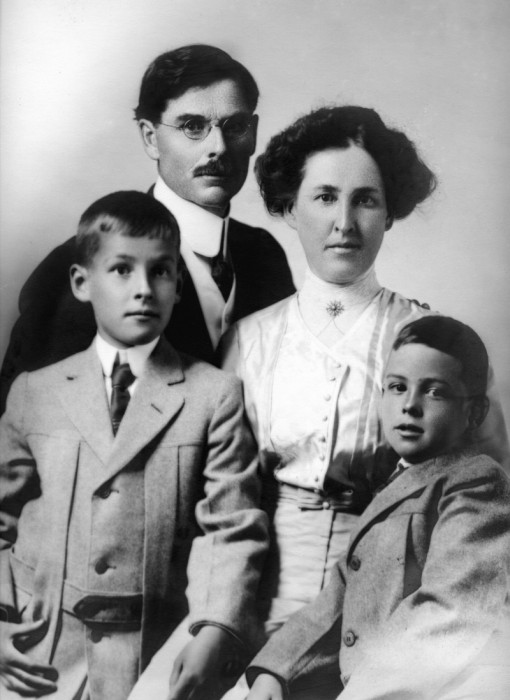
Norman Maclean’s novella, A River Runs Through It, has an interesting back story. As youngsters, Norman and his brother Paul lived in Helena and Missoula where their father was a Presbyterian minister.

From The Norman Maclean Reader, University of Chicago Press
The brothers were fighters and daredevils, and some still remember their antics. Paul later worked for the Helena and Great Falls newspapers, earning a fine reputation as House reporter during the 1930s legislative sessions. In 1938, Norman was teaching at the University of Chicago, and Paul had almost completed his masters degree in English there. In the wee hours of May 3, 1938, Paul was beaten to death in a back alley. Terry Dwyer of the Great Falls Tribune worked with Paul and knew him as a good reporter, but also as a man who would never back down from a fight. Many believed Paul’s murder was mob related—that he owed money, or knew something for which he needed silencing. But the murder was never solved, and Norman had to come to terms with his brother’s death. After he retired from teaching Shakespeare, Norman, at the age of seventy, took up writing. He cast his wild brother as that artistically perfect, but flawed, fly fisherman in A River Runs Through It. As Norman wrote the novella so many years later, he confronted demons of the past, discussing his brother’s death publicly for the first time. Norman’s daughter, Jean Maclean Snyder, told the Livingston Enterprise that her father believed you come to terms with something by understanding it. Norman finally reconciled Paul’s senseless death through his writing. “All good things,” he wrote, “come by grace and grace comes by art and art does not come easy.”

From More Montana Moments
P.S. Remember this unsolved mystery?

Friday, June 29, 2012

Friday Photo: Glacier National Park Tour Bus

Did you hear? The Going-to-the-Sun Road is open, and the forecast for the park is calling for sixties and seventies all weekend. Wouldn't you love to take a tour?

Montana Historical Society Photograph Archives, PAc 93-25 A3 214
The Blackfeet inducted western artist E. W. Deming into the tribe and named him Eight Bears for his family of eight. In this photo, the Demings pose in a tour bus circa 1914 with their Blackfeet driver, Lazy Boy, at the wheel.

Monday, June 11, 2012

Bill Stockton’s Chief Joseph

Bill Stockton was a sheepman and artist who returned to Montana after World War II to settle on his family ranch near Grass Range. Art and sheep seem an odd combination, but Stockton’s tender heart, love for his animals, and closeness to the land provided a lifetime of inspiration. His legacy includes writings, sketches, paintings, and sculpture. Stockton found the plight of Chief Joseph and the Nez Perces, who tried unsuccessfully to flee from the U.S. Army to sanctuary in Canada, extremely troubling. So in the 1950s he created a haunting metal sculpture known as Chief Joseph. It depicts a head with arms upraised in poignant recapitulation.  

Stockton sent the piece to an art retailer in Billings. Thieves broke into the business and stole the sculpture and several other pieces of Stockton’s work.A year later, a young Indian man allegedly committed suicide by jumping off a bridge into the Yellowstone River. As Yellowstone County officials dragged the river looking for him, they not only recovered the young man’s body, but they also discovered Stockton’s sculpture of Chief Joseph. It had been in the river for a year. It was as if the spirit of the young man aided in the recovery of the artwork. The sculpture later was entered in the Great Falls Russell Art Show and Auction where journalist Kay Hansen saw it. She knew she had to have the piece. With only nine dollars in her pocket, Hansen bid and acquired the sculpture, paying for it in monthly installments. She has recently donated it to the Montana Historical Society. It is one of Stockton’s most important creations.


Sunday, May 13, 2012

Women’s Mural


Happy Mother's Day!

The Women’s Commemorative Mural, painted in 1979, has been a longstanding presence in Helena at Last Chance Gulch and Broadway. Funding came from the Montana Arts Council, the Helena Indian Alliance, President Carter’s CETA program, and other sources. Designer Anne Appleby worked with eight teenage girls, teaching them all aspects of research, planning and design. Many Helena women put their brush strokes on the mural. The figures include an old woman and a little girl who are the same person, representing the true pioneer as well as time and change in Montana. There’s a school teacher who brought education and culture to the far reaches of the frontier. Fanny Sperry Steele, the famous bronc-buster, on her favorite pinto, stands for independence, grit, courage, determination and the freedom to be what you want to be. The suffragists, ladies of the evening, a modern housewife, and two musicians underscore the diversity of Helena’s women. It is the sleeping mother with her newborn baby, however, that is central to the mural. The model was Helenan Debi Corcran and her son Eli who was born as the mural was being designed. They are wrapped in the quilt of the past, a symbol of things handed down from mother to child and of women coming together in the spirit of community for quilting bees. An eclipse of the sun occurred during the mural’s creation. It was such a profound experience it was included in the design.  Finally, the last panel illustrates the unspoiled wilderness of Montana, the pristine country that all people who have lived here have loved, and the generations of women who have gone before us. This history from a feminine point of view was meant to last no longer than twelve years, but more than thirty years later, it still graces the side of the Livestock Building.

Thursday, March 8, 2012

Extra! Extra! Laugh Kills Lonesome

I just handed the manuscript of my next book to my editor. It's a collection of the radio scripts I've been writing for "History on the Go," some of which have appeared on this blog (like this post about the Placer Hotel). I figured that since the book won't be on shelves until August, you all deserve a sneak peek. Here's the first entry of More Montana Moments:

Artist C. M. Russell carefully chose the subjects of his art based on personal experience. He, more than any other western artist, painted what he knew with great longing and nostalgia for the cowboy way of life he lived and loved so well. In 1925, a year before his death, Russell painted Laugh Kills Lonesome, a tribute to this vanishing cowboy lifestyle. He depicts an evening campfire scene, one that he probably recalled from his youth. He painted himself into the picture as an old cowpoke stopping by the warm and friendly circle for a cup of coffee and a hearty laugh at the end of a long day in the saddle. The title has been hailed as fine as the painting and several contemporary artists have used it and further interpreted Russell’s famous scene. One of these is poet Mike Logan. Another is musician-songwriter Michael Nesmith of the 1960s pop rock group The Monkees who went on to a stellar career as a songwriter and musician. His insightful, lyrical song “Laugh Kills Lonesome” plays upon the camaraderie and the universal power of humor. His lyrics tell the story that Russell meant to convey. The lyrics read in part:
  
All around the campfire stood seven dusty men
The cook was drinking applejack, the cattle were all penned
Someone must have cracked a wise one because the men began to grin
Their smiles shot out like sunbeams and made the night give in
Because
Laugh kills lonesome every single time
That's why Charlie Russell painted it
And why it looks so fine
Laugh kills lonesome every single time. 

And Nesmith’s lyrics still ring as true as the subject of Russell’s painting.

Montana Historical Society Museum Collection x1955.01.01. Click on the image for a big version.