Showing posts with label shopping. Show all posts

Monday, December 31, 2012

Shopping the Gulch on New Year’s Day 1894

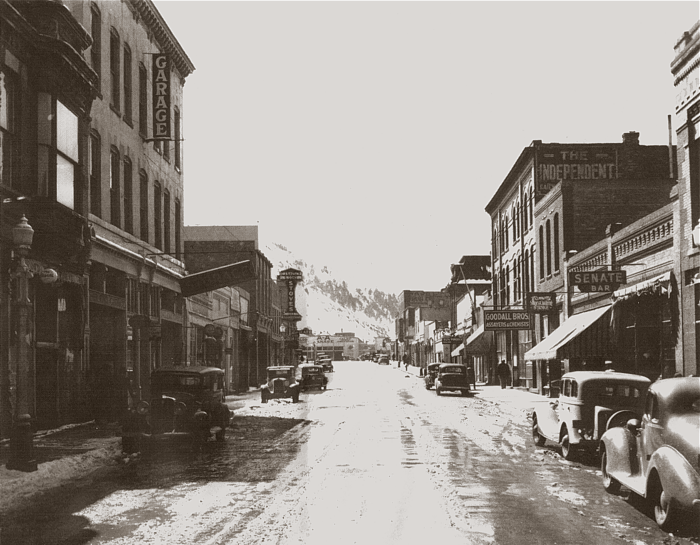
On New Year’s Day in 1894, the Helena Independent advertised numerous sales, activities, and special deals. For three dollars, you could buy a year’s subscription to the Weekly Independent and receive a free leather-bound 800-page cookbook. August Fack advertised that you could visit his California Wine House and enjoy his brand-new art acquisitions just in from Germany. The New York Store offered a variety of dress fabric reduced from a dollar a yard to 75 cents.

In 1894, the New York Store was located on Main Street in the three-story building on the right. When this photo was taken in the 1930s, that building housed the Independent newspaper.
Photo from the Wes and Carol Synness collection via Helena As She Was.
At the railway agent’s office, $100 could buy you a roundtrip, two-week vacation to Hot Springs, Arkansas, including train fare, all meals, and choice of hotels. If you dropped in the City Drug Store, you could find Gypsy Queen Hair Grower or Hockio’s Turkish Myrrh for the teeth.  Shopping the gulch in the 1890s was never complete without a stop at Hepperdiezel’s in the Novelty Block at 13 South Main Street.
 
Hepperdiezal’s was located in the Novelty Block during the 1890s and early 1900s. The building, shown here in 1970,  was a victim of Urban Renewal.
Montana Historical Society Photograph Archives, 953-209
According to Belle Fligelman Winestine, “you could smell this delicious butter and sugar smell as you came up the Gulch, a half a block away.” Mrs. Hepperdiezal stayed behind the counter in her crinkly clean starched pink and white striped shirtwaist and white collar selling less expensive taffy and butterscotch. Mr. Hepperdiezel was in charge of the more expensive candies, which the customer chose one by one to be carefully packed in elegant satin boxes. Three steps spanned the back of the store and led to a second level. Lanes of artificial palm trees and a fountain decorated the parlor area where patrons sat at marble-topped tables. Hepperdiezel’s ice cream sodas, at two for 24 cents, were the perfect end to a long day of shopping.  

Friday, December 21, 2012

Miles City Christmas 1884

Miles City, Montana, looked forward to the holidays in 1884. On Christmas Eve, the Daily Yellowstone Journal instructed its readers to “Get the hinges of your jaws ready to warble “Merry Christmas” to friends and neighbors. And be sure,” said the Journal, “to clear your chimneys for the descent of Kris Kringle.” But not entirely in the Christmas spirit, the Journal recorded the final percentile grades of public school students, certainly embarrassing several like George Busch of the senior class who earned a 40, Kate Cupples who earned a 56, and others. Now that’s a gift for a parent—to have your child’s ill achievement published in the newspaper, and on Christmas Eve.

From Chronicling America, Library of Congress
On a more festive note, the Journal advertised the perfect Christmas present: The Missouri Steam Washer. No home, said the Journal, is complete without it. Patented in 1883, the advertisement claimed that the contraption was so simple to use that a ten-year-old could do the family wash in an hour. Wouldn’t the kids love that present! Or you could buy a buffalo coat for $15, or pantaloons for $1.50. And the Journal had some advice on sizing up the roasted Christmas turkey: “Don’t look in its mouth as if it were an old horse with a tooth ache,” said the Journal. “Just gently dislocate its wings. If it’s old and tough, you’ll have to tug pretty hard on the flappers.” When it comes to dessert, said the Journal, there will be no poison in your pastry if you use Dr. Price’s pure extract of vanilla. So shake the snow out of the Christmas tree and unhinge your jaws for Christmas dinner.
Monday, December 3, 2012

Wreck of the Bertrand

John J. Roe of St. Louis founded the Idaho and Montana Transportation Line and the Diamond R Transportation Company in 1864. The company carried everything imaginable by steamboat up the Missouri River from St. Louis to Ft. Benton. Its ox-drawn freighters then carried the goods to the various destinations. The treacherous steamboat voyage took two months. The steamer Bertrand left St. Louis in the early spring of 1865 carrying an astonishing inventory bound for Fort Benton, including 6,000 kegs of nails, mining equipment, and food and clothing. The goods were to be delivered to Virginia City, Deer Lodge, and Hell Gate (present day Missoula). On April 1, the boat hit a snag twenty miles north of Omaha and sank. All passengers and crew escaped, but the inventory—fortunately insured—was lost. In 1968, the wreck was rediscovered and the goods, preserved for a century in the river’s silt, were recovered. The cargo is a microcosm of frontier life. Among the recovered items are powdered lemonade; canned pineapple; brandied cherries; imported olives; salted and dried beef, mutton, and pork; jars of French mustard, catsup, and honey; clocks and combs; lamps and mirrors; patent medicines with their paper labels intact; 3,000 textiles including bolts of silk and 137 men’s coats in 7 different styles; shoes and boots; barrels of whiskey; hammers, doorknobs, pick axes, and blasting powder; washboards; plows; and sleigh bells. It’s hard to imagine some of these luxury items for sale in primitive log cabins. The DeSoto National Wildlife Refuge in Iowa includes a museum displaying some of the artifacts recovered from the Bertrand.


Artifacts recovered from the steamboat Bertrand, displayed in the visitor center at DeSoto National Wildlife Refuge

Friday, December 16, 2011

Shopping 1896

Christmas Eve is eight days away! Do you have your shopping done?

Shopping is an important part of the holiday season, and that was just as true in 1896. For the holiday meal, shoppers could buy 2 dozen oranges for 35 cents and a gallon of fancy cranberries for 35 cents. California wines were 25 to 40 cents a bottle and “very fine” brandy went for a whopping 85 cents. Meat department specials included fresh flounder at 10 cents a pound, Jack rabbits for 24 cents each, quart cans of New York select oysters at 35 cents and freshly skinned perch at 3 pounds for 25 cents. Whole opossums were 95 cents each. If holiday shopping brought on a headache, the local drug store could provide a 10 cent bottle of Bromo-Seltzer, and to promote “digestion, cheerfulness and rest” in children, mothers could count on Castoria; 35 doses sold for 35 cents. The nasty-tasting brown liquid was a longtime staple. Generations of taste buds—including my own—recoil at the memory of that abominable root-beerish flavored stuff. Advertisements for gifts in 1896 included a muff footstool for the elderly grandmother or aunt. It consisted of a round leather portable footstool, three inches off the ground. A Japanese stove concealed within allowed elderly toes to stay toasty. Another popular item at Christmastime in the 1890s provided a much safer alternative than a Japanese stove. This was the Hot Water Bag, advertised with this poem:
In winter when it’s snowing and the storms are wildly blowing,
And all the earth is covered o’er with robes of ice and sleet,
Oh, then our hearts are mellow with compassion for the fellow,
Who is tortured through the night with his wife’s cold feet.

Friday, November 25, 2011

Friday Photo

Happy Friday, history buffs! Are you shopping today, or are you avoiding the stores?


Making a sale in the general store. Birney, Montana. Photo by Arthur Rothstein, June 1939.