 |
| Montana Historical Society Photograph Archives, PAc 90-87.N041 |
Showing posts with label homesteading. Show all posts
Showing posts with label homesteading. Show all posts
Friday, October 17, 2014
Friday Photo: Pet Cat

Friday, September 26, 2014
Friday Photo: Threshing Crew
 |
| Montana Historical Society Photograph Archives, PAc 90-87 4-3 |
Monday, September 8, 2014
Jersey Lilly
Completion of the “Milwaukee Road” brought hundreds of homesteaders to Ingomar in Rosebud County during the 1910s. During its heyday, Ingomar was the sheep-shearing and wool-shipping center. It saw two million tons of wool annually. On July 2, 1914, the Ingomar Index announced that a bank would soon open, marking an important milestone in the community’s development. Investors H. B. Wiley, C. W. Greening, and E. B. Clark hired bookkeeper W. T. Craig. All, declared the Index, were businessmen of sterling reputations. When the new building was completed that October, the newspaper declared it a “pippin,” noting that “cashier Craig feels like a kid with a new toy.” It was Ingomar’s first brick building. The bank indeed prospered, reorganizing and expanding in 1917 as a state bank, and reorganizing again in 1921 under federal charter. Economic reversal led to the bank’s sudden closure later that year. Craig was convicted of misuse of bank funds, a ruling that was later overturned on appeal. The bank stood empty, a painful reminder of delinquent loans and failed homesteads. In 1933, the Oasis Bar opened in the building and the Jersey Lilly Bar and Café moved into the former bank in 1948.
Named for the beautiful nineteenth-century actress Lilly Langtry, the Jersey Lilly has since served as a community gathering place with a devoted clientele. Original pressed tin ceilings, bank vaults, and the outline of teller cages on unfinished hardwood flooring suggest the building’s previous function. Recalling the sheepmen who once drove their flocks through the area, the Sheep Herder Hors d’Oeuvre — orange slices, onions, and cheddar on saltine crackers—is a favorite. And as in days of old, there is always a pot of beans on the stove. Fare is simple and facilities are out back, but today’s Jersey Lilly Saloon and Eatery is an unforgettable Montana experience.
 |
| The Jersey Lilly is a Montana must! |
 |
| The interior of the Jersey Lilly preserves some of the original features of the former bank. |
Monday, August 4, 2014
Frozen Charlotte
Here’s a story that will give you chills even on the hottest summer day. The story of Frozen Charlotte is a Maine folktale. A short notice in the New York Observer on February 8, 1840, told about a girl who froze to death on her way to a New Year’s ball. This was the beginning of a folk tradition that eventually included poems, a ballad, a doll, and even a dessert. The original poem, attributed to well-known editor Seba Smith, recounts in verse how it was New Year’s Eve and Charlotte was to attend a dance some miles away. It was a bitter cold night, and Charlotte, dressed in a beautiful gown, did not want to cover her dress with a heavy blanket that would wrinkle it. Instead, she wore a light cape and ignored her mother’s warnings that she would catch her death of cold. Charlotte and her beau drove off into the night. Several times on the journey the young man asked Charlotte if she was cold, and she, shivering, answered yes. The last time he asked, however, she said she was feeling warmer. When they arrived at the dance:
He took her hand in his—O, God! 'Twas cold and hard as stone,
He tore the mantle from her face, cold stars upon it shone;
Then quickly to the glowing hall, her lifeless form he bore,
Fair Charlotte's eyes were closed in death, her voice was heard no more.
From this tale, several other poems and ballads emerged. Little girls played with Frozen Charlotte dolls, and in 1896, Fannie Farmer’s Boston Cooking-School Cook Book published the recipe for Frozen Charlotte. Even today Martha Stewart has recipes for this popular dessert.
Frozen Charlottes made their way to Montana. On the flat plateau of First People’s Buffalo Jump, where one family tried unsuccessfully to make a go of homesteading, a Frozen Charlotte doll was discovered in the ruins.

You can read Seba Smith’s entire poem, “Young Charlotte,” here.
He took her hand in his—O, God! 'Twas cold and hard as stone,
He tore the mantle from her face, cold stars upon it shone;
Then quickly to the glowing hall, her lifeless form he bore,
Fair Charlotte's eyes were closed in death, her voice was heard no more.
From this tale, several other poems and ballads emerged. Little girls played with Frozen Charlotte dolls, and in 1896, Fannie Farmer’s Boston Cooking-School Cook Book published the recipe for Frozen Charlotte. Even today Martha Stewart has recipes for this popular dessert.
Frozen Charlottes made their way to Montana. On the flat plateau of First People’s Buffalo Jump, where one family tried unsuccessfully to make a go of homesteading, a Frozen Charlotte doll was discovered in the ruins.
You can read Seba Smith’s entire poem, “Young Charlotte,” here.
Wednesday, July 30, 2014
Homestead Teachers
The homestead boom brought thousands of immigrants and challenged teachers who had few resources in one-room schools. Charles Beardsley, at seventeen, had a college degree and a provisional certificate when he began teaching at Five-Mile School in eastern Montana. He boarded in a student’s home for thirty dollars a month. His board was the only money the family earned that entire year. Beardsley wrote: “Bedbugs infested the house. In my bedroom, which was nicely whitewashed, the bed stood in four pans of kerosene to prevent the bedbugs from finding me. I never got a single bite but at night when I was reading, the heat of the kerosene lamp focused on the ceiling and the bedbugs gathered up there for a merry circle dance.” The family had bitter ongoing feuds with local relatives. They also kept a pack of hound dogs that bayed all night. They wore shoes only on Sundays, carrying them to church and only putting them on once they were inside. These colorful folk spoke an odd New England dialect and read an archaic kind of music. But they left a permanent impression on the young teacher. Beardsley wrote that the children in this family were very fine, for all their odd behaviors, and they so loved to learn. This rich experience inspired Beardsley’s life as an educator, and he enjoyed a long career following his avocation.
 |
| Charles Beardsley likely taught in a school similar to Betts School in Cascade County. Montana Historical Society Photograph Archives, PAc 98-24.17 |
Friday, July 25, 2014
Friday Photo: Family Portrait
 |
| Montana Historical Society Photograph Archives, PAc 90-87.31-1 |
Monday, July 21, 2014
Boxcar Adventure
Emma Gardner was a homesteading wife who came with her husband and children to the brand-new town of Ryegate in what would later become Golden Valley County. Like many families during the homestead boom, the Gardners came by boxcar. It was a seven day trip from their home in Minnesota, and the boxcar was loaded with all their earthly possessions including chickens and cows, furniture, children, and the family dog. Traveling in a boxcar in warm weather, especially with livestock, could be very uncomfortable. The boxcars were unbearably hot and stuffy, and so most families kept their big doors at least partially open so the fresh air could circulate. At one point, the train slowed down to travel up a steep grade. The dog decided to seize the moment and jump out of the car. Not only did he jump out, he took off running like mad across a field. The children were screaming, thinking that they would never see their pet again. Mr. Gardner did the noble thing and jumped out after him. Emma and the children lost sight of them both. The children began to think they would not only lose the dog, but maybe their dad, too. However, the dog was finally captured, and Mr. Gardner ran with him in his arms back to the train. But the train was starting down the other side of the grade, and it began to pick up speed. Mr. Gardner made it back to the train, but his own boxcar was way up ahead. As the train rumbled past, he had no choice but to toss the dog into someone else’s open boxcar. He hopped on the speeding train and, according to the family, hopped from car to car until he got back to his very anxious family and told them the dog was just down the way. The next time the train stopped, the Gardners collected their pet and all ended well.
 |
| A locomotive pulls boxcars across green horn trestle on Mullen Pass west of Helena. Photo by F. J. Haynes. Montana Historical Society Photograph Archives, H-3202 |
Wednesday, May 14, 2014
Heikkila-Mattila Homestead
Finnish immigrant Gust Heikkila homesteaded along the Little Belt Creek coulee in 1902. Soon other Finnish settlers homesteaded the area, calling it Korpivaara, meaning “dangerous wilderness,” for its remote wooded surroundings. Here the Heikkilas raised eleven children, expanded their holdings, and were among the first to shift from farming to ranching. The skills of Gust and local Finnish builders Victor Mattila and Matt Maki reveal an outstanding folk vernacular building style that transferred the Finnish farmstead to a New World setting. The men showcased their traditional skills, building a sauna, residence, and other structures using Old World tools like the broadaxe and awl. The result is a classic Finnish farm with log buildings around an open courtyard. In 1938, the sons of Victor Mattila, who helped build the homestead, bought the property from the Heikkalas. The brothers, trained in woodworking by carpenter Matt Maki, expanded some of the buildings and also built new ones.
The result is American in design but Finnish in construction. The 1938 barn, in particular, represents a masterful blending of the two cultures by second-generation Finnish builders. This unusual homestead, listed on the National Register of Historic Places, is one interesting example of building by Montana’s diverse European homesteaders.
 |
| Barn built by John Mattila. Photo by Dena Sanford in Montana The Magazine of Western History, Winter 2013 |
Friday, May 9, 2014
Friday Photo: Barn Raising
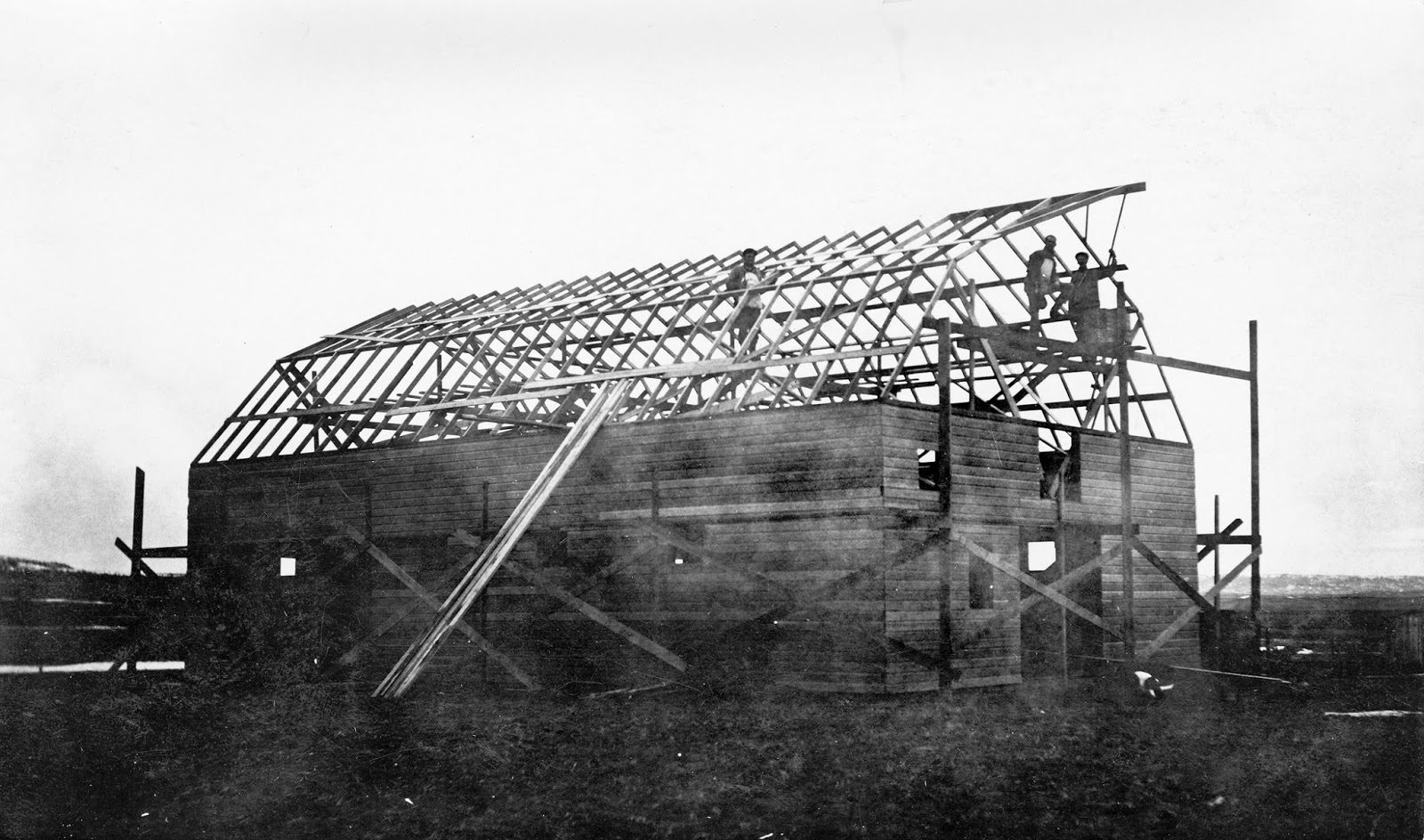 |
| Montana Historical Society Photograph Archives, PAc 2008-23.9 |
Friday, February 14, 2014
Friday Photo: Homestead Wedding
 |
| Montana Historical Society Photograph Archives, PAc 90-87 G065-002 |
Wednesday, October 16, 2013
Birdie Brown
The rutted road was a familiar one to Fergus County locals during the days of Prohibition. You had to be careful—bad hooch could cause blindness and even death. Those looking for a place to party knew to point their cars toward Black Butte and Birdie (or Bertie) Brown’s place. She was as nice a woman as they come, and her still—according to locals—produced some of the best moonshine in the country. Birdie was among a very small number of young African American women who homesteaded alone in Montana. She was in her twenties when she settled in the Lewistown area in 1898. She later homesteaded along Brickyard Creek in 1913.
During Prohibition in the 1920s, Birdie carved a niche for herself. Her neat homestead where she lived with her cat was a place of warm hospitality. Birdie’s parlor was legendary. In May 1933, just months before the end of Prohibition and Birdie’s livelihood, the revenue officer came around and warned her to stop her brewing. But as Birdie multitasked, dry cleaning some garments with gasoline and tending what would be her last batch of hooch, the gasoline exploded in her face. She lived a few hours, long enough to request that someone take care of her beloved pet. But the cat that followed her everywhere was never found. Birdie’s once orderly homestead now lies in a state of collapse, tragically transformed into a ghost of its former self. Roundup artist Jane Stanfel, who has painted Birdie’s homestead, makes a strange observation. Although it’s been nearly eighty years since Birdie’s passing, every so often someone catches a glimpse of a black cat perched in her parlor window.
 |
| Birdie Brown's Homestead in Fergus County. Courtesy Great Falls Tribune. |
Friday, October 4, 2013
Friday Photo: Inside a Homestead Cabin
 |
| Montana Historical Society Photograph Archives, PAc 90-87.34-8 |
P.S. Remember this cramped homestead cabin?
P.P.S. Have you seen the beautiful postcards in Evelyn Cameron's Montana?
Wednesday, August 28, 2013
Homesteaders Take Care of Their Own
"Ma” Smith, a homesteading wife in Garfield County, was locally well known and greatly respected. She is a good example of women in isolated places who sometimes made difficult personal choices and material sacrifices because there was no one else to make them. In addition to running her own homesteading partnership with her husband, Ma was a practical nurse who traveled with elderly Doctor Lon Keith. Dr. Keith had given up his practice, but came out of retirement because Garfield County desperately needed him. Ma Smith helped Dr. Keith deliver scores of babies and assisted him in countless other cases.
In 1918, Dr. Keith made his last house call alone, breaking a fifteen-mile path through a blinding blizzard to set an elderly man’s broken leg. Before he left his patient, Dr. Keith was coughing. By the time he reached home, he was very ill. Ma hitched her horse to her bobsled when word came of Doc’s illness. She was by his side when he died of pneumonia. She took charge of the doctor’s household because there was no one else to do so. She bundled the doctor’s frail white-haired widow in warm clothes, packed her in the bobsled, covered her with a blanket, and took her to the nearest neighbor. While a neighbor hand made a coffin, she brushed and pressed the doctor's good black suit, prepared his body, and laid him out. She took a dress length of fine gray silk from the suitcase that she had hastily packed and stroked it with her work-roughened hand. The fabric was a special Christmas gift from her son in Chicago who was an inspector at the stockyards. She had intended to make herself a new dress with the gift. New dresses did not come often, and Ma hadn't yet had time to sew. She had, however, packed the silk thinking that it would make the perfect lining for Doc Keith’s coffin, if needed. She was right. And there was enough left over to make a pillow. Her sacrifice made a lovely bed for Dr. Keith’s final rest.
 |
| From Garfield County History |
Sunday, May 12, 2013
Happy Mother's Day
.jpg) |
| Montana Historical Society Photograph Archives, PAc 90-87 21 D |
P.S. The photo was taken by Evelyn Cameron in 1913 near Fallon, Montana.
Monday, March 25, 2013
Scherlie Homestead
The Enlarged Homestead Act of 1909 lured many homesteaders to Montana and to an area in Blaine County called the Big Flat. One of these was thirty-two-year-old Anna Scherlie, who arrived in 1913 to file a claim near her brother’s place. Anna was one of many women homesteaders in Montana. In fact, in the four surrounding townships, women made up about one-fourth of the total homestead applicants. By 1916, Anna had forty acres planted in wheat, oats, and flax. Isolation on the Big Flat led many settlers to winter elsewhere, and Anna followed suit. Legend has it that she went to St. Paul to work for the family of railroad magnate James J. Hill. Over the decades, Anna made few changes to her small wood-frame shack, adding only a vestibule to use as a summer kitchen and laundry.
Droughts, depression, and two world wars passed. Anna’s neighbors built modern homes, but she insisted that she was too old for modern conveniences. Anna died in 1973, leaving an estate of more than one hundred thousand dollars to eighteen nieces and nephews. Her ashes were scattered beneath a lilac bush on the property. Leon and Nellie Cederburg purchased the homestead, but rather than return it to cropland, the Cederbergs maintain Anna’s home exactly as she left it.
P.S. Anna's neighbor Lois Imler Warren kept a detailed diary.
 |
| Photo by Nellie Cederberg, May 6, 1996. On file at Montana State Historic Preservation Office, Helena. |
P.S. Anna's neighbor Lois Imler Warren kept a detailed diary.
Friday, March 22, 2013
Friday Photo: Homestead Mom
 |
| Montana Historical Society Photograph Archives, Farms and Farming Collection |
P.S. Homesteading was a hard life! Remember Myrtle Hagadone Hledik?
Friday, March 15, 2013
Friday Photo: Turning Sod
.jpg) |
| Montana Historical Society Photograph Archives, PAc 90-87-65.6 |
P.S. Here's another iconic Cameron photo of homesteaders.
P.P.S This website showcases wonderful stories for Women's History Month.
Monday, March 11, 2013
Josephine Doody
On the way to isolated Harrison Lake, in the wilderness area on the southern border of Glacier National Park, lie the ruins of a secret cabin. The area is extremely difficult to access because you have to cross the Middle Fork of the Flathead and there is only a short time when it’s not frozen or deep. The remote cabin was home to Josephine Doody, a woman even more notorious than Calamity Jane. And unlike calamity, the events of her life are not disputed. John Fraley, in his book Wild River Pioneers, details Josephine’s adventures. Around 1890. Josephine shot a man in Colorado, she claimed in self-defense. Awaiting trial, she fled to MacCarthyville, Montana, a railroad town Montana along James J. Hill’s Great Northern Railway. There, as a dance hall girl, she met Dan Doody who fell for her. But Josephine had an opium addiction. So Dan kidnapped her, tied her to a mule, took her to his homestead on the Flathead River and locked her in to dry out.
Josephine survived and took up moonshining. Dan kept a tiny cabin where she could hide when the revenue officers of Colorado lawmen came looking for her. James Hill built a siding to the Doody place, and the engineer would blow the whistle once for each quart of moonshine the engineers wanted. Dan was one of the first park rangers at Glacier, but was soon fired because he liked to poach the game.
He died in 1919, and Josephine stayed in the two-story homestead, keeping guest rooms and leading occasional fishing parties. She died in 1936 after a long, colorful life.
 |
| Josephine Doody in front of her cabin on the Flathead. Photo courtesy Glacier National Park. |
 |
| Dan Doody. Photo courtesy Glacier National Park. |
Friday, March 8, 2013
Friday Photo: The Daily Grind
Happy Friday, history buffs!
In today's photo, bachelor Henry Syverud grinds coffee in his homestead shack in 1911.
Bonus: Speaking of coffee, Viola Fowler shared this recipe of coffee fudge in the YWCA Cook Book published by Montana State College circa 1916. If you try it, let me know how it turns out:
Two cupfuls of white sugar; one-half cupful of strong coffee, one cupful of chopped nuts. Boil the sugar and coffee together without stirring until stringy. Take off the fire, add nuts, and beat until creamy. Pour into a buttered pan to cool.
 |
| Montana Historical Society Photograph Archives, PAc 77-94 |
Bonus: Speaking of coffee, Viola Fowler shared this recipe of coffee fudge in the YWCA Cook Book published by Montana State College circa 1916. If you try it, let me know how it turns out:
Two cupfuls of white sugar; one-half cupful of strong coffee, one cupful of chopped nuts. Boil the sugar and coffee together without stirring until stringy. Take off the fire, add nuts, and beat until creamy. Pour into a buttered pan to cool.
Wednesday, February 27, 2013
Annie Morgan
Legend has it that African American Annie Morgan was a cook for General George Armstrong Custer. After the Battle of the Little Bighorn, she was out of a job and eventually made her way to Philipsburg in Granite County. This part of the story has been disputed, and Annie’s past is uncertain. However, it is a fact that Granite County attorney David Durfee hired her to take his uncle—who had a severe drinking problem—to an abandoned fox farm on Upper Rock Creek to dry out. Annie cared for the uncle, accomplished a cure, and when he eventually went his own way, she stayed on, filing a homestead claim.
One day in 1894, Annie happened upon a local character named Joseph Case, lying on the banks of Rock Creek gravely ill with typhoid. Case was a Civil War veteran from New Jersey who made a living catching fish to sell in Philipsburg where he was known as “Fisher Jack.” Annie nursed Jack through the illness, and to repay her, Jack fenced Annie’s homestead. The pair developed a mutual affection, and when the fence was done, Jack stayed on. Annie died in 1914, and both she and Jack are buried in the Philipsburg cemetery. The Forest Service has beautifully restored Annie’s cabin. In the process, workers discovered a curious object hidden in the upper door frame. Bits of red string, a soap wrapper, and other items consistent with the bundles carried by African root doctors suggest that perhaps Annie carried these traditions, handed down to her from family members, to the Montana frontier. She certainly proved her skills at doctoring. The Morgan-Case Homestead, listed in the National Register of Historic Places, is available for short-term rental by lottery through the Missoula Ranger District.
P.S. If you're interested in staying at the cabin, watch this video.
 |
| Annie's cabin. Photo courtesy State Historic Preservation Office |
P.S. If you're interested in staying at the cabin, watch this video.
Subscribe to:
Posts (Atom)