 |
| Library of Congress, LC-B2-1183-14 [P&P] |
Showing posts with label Fort Benton. Show all posts
Showing posts with label Fort Benton. Show all posts
Monday, September 22, 2014
William T. Hornaday
In 1886, the Smithsonian sent an expedition to Montana to collect buffalo specimens. Expedition leader William T. Hornaday was an internationally known naturalist, author, and conservationist. He was also the Smithsonian’s chief taxidermist and considered the best in the U.S. The expedition collected specimens from the last free-roaming herd of wild bison as they were on the brink of total extinction. Hornaday’s experiences in Montana led him to write scathingly of the buffalo’s extermination and to publicize its sad plight.
One of the specimens Hornaday collected at the Big Porcupine Creek camp in Garfield County is among the bison that make up the famous American Bison Group. It is one of the largest bison bulls ever recorded, and later served as the model for the buffalo on the 1901 ten-dollar bill. In 1908, Hornaday helped establish the National Bison Range in Montana. The Hornaday Buffalo Camp on Big Porcupine Creek at Sand Springs was the expedition’s final base camp. Today it is a National Historic Landmark. Hornaday’s American Bison Group, evidence of Hornaday’s skill in taxidermy, is on display at the Museum of the Northern Great Plains in Fort Benton.

Wednesday, August 20, 2014
Fort Benton’s Hoo Doo Block
Vigilantes hanged desperado William Hynson at Fort Benton in 1868. The hanging on Block 25, some believed, triggered a series of dark events on that site. Sheriff John Morgan built a livery stable, a hand-dug well, and a home on Block 25 around the time of Hynson's hanging. Morgan's wife died and his house burned down. Soon after, during a skirmish in the streets of Fort Benton, an Indian was hanged on Block 25 and the bodies of several Blackfeet were thrown into Morgan’s well. It was thereafter known as the Place of Skulls. By 1870, Morgan had died and his livery passed to others. A small log house on Block 25 served as the county jail. On November 28, 1872, it burned down with three men inside. Officials found the charred remains of two men. Officials speculated that the third prisoner killed the other two and escaped. Locals whispered that the block was cursed, although Morgan’s livery continued to do a brisk business under other owners. Rumors circulated, however, that the ghost of a the dead prisoners spooked the livery’s horses, wandering over the other empty, overgrown lots of Block 25.
On the site of the jail in 1884, Ferdinand C. Roosevelt’s furniture store was nearly finished when a freak wind tore the boards apart and blew the entire frame structure into the river. The wind touched nothing else. Roosevelt rebuilt. In 1885, fire claimed the store, Roosevelt’s huge inventory, and nearly destroyed the River Press next door. Property owners did not rebuild on Block 25. Brothers Ed and George Lewis rebuilt the livery in 1895, then Ed died in 1897. By 1900 only George Lewis’s new livery stood on the east half of Block 25. In a final burst of evil energy, fire consumed it. George Lewis promptly relocated his business. Finally, A brave citizen built a home where the jail once stood. Renumbering of the townsite blocks, twice, helped erase the stigma of the Hoo Doo Block. W. S. Stocking wrote in 1906 that forty years later, only the one dwelling stood there: “…and good luck seems to attend the occupant—from which it may be argued that the ‘hoodoo’ has exhausted its power for evil."
 |
| Block 25 in 1884 included Ferdinand Roosevelt’s first furniture store, destroyed in a freak wind, the River Press offices, and the livery business. Sanborn fire Insurance Map, MHS Research Center. |
Monday, July 7, 2014
I Scream, You Scream, We All Scream for Ice Cream!
Summer makes you think of ice cream, but have you ever wondered where it came from?
It has a longer history than you might think. The Roman emperor Nero used ice brought down from the mountains to mix with fruit. In the seventh century A.D., the Chinese introduced milk and ice mixtures which were then brought to Europe. Sorbets and ices were popular at French and Italian courts. George Washington, Thomas Jefferson, and Dolly Madison served “iced cream” at their tables. Home cooks and ice cream parlor confectioners would put a bowl of sweetened cream into a larger bowl of salt and ice and stir until it froze. The invention of the wooden bucket freezer and rotary paddles was a major breakthrough, and along with the first hand-cranked freezers patented in 1846 and 1848, ice cream making became easier.
Ice cream was made from the very earliest days on the frontier. In 1865, the Montana Post advertised a Ladies' Ice Cream Saloon in Virginia City.
In 1868, ice cream was a major part of the Fourth of July in Helena. On May 11, 1869, as the steamer Nile made its way to Fort Benton, the crew acquired a load of ice from Fort Peck. The steamboat stopped at the mouth of the Musselshell to buy cordwood from woodchoppers “Liver Eating” Johnson and X. Beidler. As was customary, the woodchoppers were invited aboard. It was Captain Grant Marsh’s birthday, and the cook made ice cream to celebrate. Neither Johnson nor Beidler had ever heard of it. They were suspicious of its coldness on a hot day, but they bravely ate their portions. And in 1872 at Urgam’s Occidental Restaurant in Deer Lodge, a plate of ice cream cost twenty-five cents. But it wasn’t until the St. Louis World’s Fair in 1904 that “walk away” ice cream was introduced. We have been enjoying ice cream cones ever since.
It has a longer history than you might think. The Roman emperor Nero used ice brought down from the mountains to mix with fruit. In the seventh century A.D., the Chinese introduced milk and ice mixtures which were then brought to Europe. Sorbets and ices were popular at French and Italian courts. George Washington, Thomas Jefferson, and Dolly Madison served “iced cream” at their tables. Home cooks and ice cream parlor confectioners would put a bowl of sweetened cream into a larger bowl of salt and ice and stir until it froze. The invention of the wooden bucket freezer and rotary paddles was a major breakthrough, and along with the first hand-cranked freezers patented in 1846 and 1848, ice cream making became easier.
 |
| An early advertisement for an ice cream freezer. |
 |
| Advertisement from the Montana Post, August 5, 1865. Via Chronicling America. |
Wednesday, June 11, 2014
Early-day Travel on the Helena to Fort Benton Road
By the mid-1860s, Helena had surpassed Alder Gulch in population. Roads ran in all directions to Gallatin City, Virginia City, Deer Lodge, and Fort Benton. The road between Fort Benton and Helena was an especially well-worn path used by stagecoaches, horsemen, and freighters traveling between these two key settlements. The road saw heavy traffic from the earliest days of Montana Territory until the advent of the railroad in 1883. Bullwhackers performed an essential task, walking alongside the laboring teams. Their cracking whips kept the animals moving, especially on uphill grades. Way stations along the route offered respite as it was hard going for both humans and livestock. Malcolm Clarke’s ranch, today headquarters of the Sieben Ranch, was among the early stops.
The Benton Road, not the same as Helena’s Benton Avenue, entered Last Chance Gulch via North Main Street as did the other major routes to Prickly Pear Canyon and Gallatin City, Deer Lodge, and Virginia City. The popular notion that the Benton Road entered Helena by way of Benton Avenue and wound its way down through Reeder’s Alley is physically impossible. Until 1893, buildings spread into and up the alleyway toward the dead end that was Benton Avenue, preventing all types of traffic except horseback. Freighters could never bring six or eight span of oxen, or a mule team, or several thousand-pound wagons hooked together down that steep, narrow alley. The well-traveled North Main Street route into Last Chance Gulch was flat and plenty wide enough.
Freighters coming into town pastured their animals on the outskirts of Helena and camped overnight in the wide open spaces north of town. Sometimes the gentle, distant lowing of the oxen carried on the breeze as the animals bedded down in the evenings. The next morning, freighters hitched up the animals—but not necessarily the entire team—and brought the heavy freight wagons into town to unload.
 |
| A small span of mules and their freight wagon await unloading on Helena’s Main Street in 1874. Montana Historical Society Photograph Archives, 954-200. |
 |
| All roads entered Last Chance Gulch via Main Street, as illustrated in this 1868 map. Streets on the grid from left to right: Clore (today’s Park) Street, Main (today’s Last Chance Gulch), Rodney Street, and Davis Street. Click on the map for a bigger image. Courtesy of DNRC. |
Monday, January 20, 2014
African Americans in Montana
Several instances of the presence of African Americans in the territory before the major gold rushes are known. William Clark’s slave, York, traveled with the Lewis and Clark Expedition in 1805–1806, Henry “Negro Henry” Mills worked for the American Fur Company in Fort Benton from the late 1850s, James Beckwourth was a well-known trapper of the 1820s and 1830s whose life has been the subject of some interest, and Isaiah Dorman served as a Sioux interpreter for the army who fell with Custer at Little Bighorn. Blacks also often worked on the steamboats that traveled widely up and down the Missouri River and docked at Fort Benton.
With Emancipation in 1865, African Americans realized new opportunities and joined the westward migrations. While small in numbers, these pioneers contributed significantly to their communities. In 1870, the federal census counted 183 black people in Montana. The number doubled in 1880, reached 1,490 in 1890, and peaked in 1910 at 1,834. Western blacks, many of whom carried the burden of slavery, tended to settle in Montana’s larger urban areas and founded communities within a sometimes hostile and discriminatory larger society. Against the backdrop of the Civil War, blacks often found themselves caught in the bitter struggle between Democrats and Republicans who in theory supported African American equality, but did so in varying degrees. School segregation, black suffrage (achieved in 1867), and anti-miscegenation laws were controversial racial issues in Montana’s early territorial period. Finding consolation and community together, black citizens often established their own churches, benevolent societies, newspapers, and social clubs.
Despite the proportionately small numbers, the 1870 census shows that blacks on the Montana frontier engaged in diverse occupations and mostly concentrated in towns, especially Fort Benton and Helena. More than half of males listed their occupation as laborers, domestics, servants, or cooks, and twenty-seven percent represented themselves as barbers. A smaller percentage proffered their occupation as ranch hands, cowboys, and miners, with one listed as a saloon keeper. A decade later in 1880, blacks still clustered in the larger communities of Helena and Butte where mining activities necessarily attracted service providers and laborers. Fort Benton’s African American population jumped from twenty in 1870 to fifty in 1880 because of the steamboat travel that brought in population from diverse places and because of the employment opportunities steamboats offered.
African Americans who came to Montana in the nineteenth century include William Taylor, a teamster, Samuel Lewis, a highly successful Bozeman barber, John Gordon, a trained chef, and James Crump who worked as a miner. African American women also came to Montana with the first settlers and some assumed non-traditional roles. For example, sisters Parthenia Sneed and Minerva Coggswell ran a Virginia City restaurant, Sarah Bickford eventually owned the Virginia City Water Company, Mary Gordon owned a restaurant in White Sulphur Springs, and Mary Fields drove the stage and held the mail route between Cascade and St. Peter’s Mission.
In an interview in 1979 for the Helena Independent Record, Norman Howard, grandson of James Crump, reflected on what it was like to be black in Montana. He believed that discrimination was tougher for blacks than for Indians. While Montana never posted signs for “Whites Only” as in the South, the same rules applied and most blacks found menial employment as waiters, janitors, and hotel workers. Blacks were excluded from restaurants, bars, and barber shops. By virtue of such exclusion, tightly knit black communities formed; however, as the civil rights movement brought changes for the better, these communities slowly disappeared. Maintaining a strong black community also proved difficult as the lack of job opportunities in the state drew second and third generation blacks elsewhere.
Although Montana has made small gains in the last decade, 2012 statistics show this ethnic group makes up only 0.6% of the state’s population compared to 13.1% nationally.
 |
| James Beckwourth. Photo courtesy Nevada Historical Society. |
 |
| The Montana Federation of Negro Women's Clubs meets in Butte, August 3, 1921. Montana Historical Society Photograph Archives, PAc 96-25.2 |
 |
| Canyon Hotel waiters, Yellowstone National Park, 1901. Montana Historical Society Photograph Archives, H-4873. |
 |
| Mary Fields. Photo courtesy Ursuline Convent Archives, Toledo, Ohio. |
Although Montana has made small gains in the last decade, 2012 statistics show this ethnic group makes up only 0.6% of the state’s population compared to 13.1% nationally.
Wednesday, May 22, 2013
Sullivan Saddlery
Nevada City, once a booming gold camp, is now a recreated western town with buildings from across the state. One of its best treasures was rescued from demolition in 1940. Fort Benton was itching to demolish what they considered a public eyesore. The late Joseph Sullivan had crafted saddles in this shop for nearly forty years. Sullivan had died, and Charles Bovey of Great Falls chanced to meet the saddle maker’s daughter who gave him the building along with all its contents.
The historic saddler was one of the first buildings constructed outside the stockade of old Fort Benton. It was originally used as the first Blackfeet agency in 1863. Acting Governor Thomas Meagher, agent Gad Upson, and others negotiated an important treaty with Piegan chiefs Little Dog and Mountain Chief in the building in 1865. Later, it was a flop-on-the-floor hotel and saloon known as the Council House. In 1881, partners Sullivan and Goss set up their saddlery business in the building. Artist Charlie Russell was a frequent visitor. The rocking chair where he sat and told his endless yarns remains as if Russell were about to return. The entire Sullivan inventory remains intact in the shop. It still smells of horses and leather. This was the first building Charles Bovey “collected” and the beginning of his indoor exhibit in a huge barn at the Great Falls Fair Grounds called “Old Town.” When asked to remove the “Old Town” exhibit in 1959, Bovey relocated his buildings to Nevada City, and that began the fabulous building collection you can visit today.
 |
| Inside the Sullivan Saddle Shop. Photo by Daniel Hagerman |
 |
| The Sullivan Saddlery building in 2012. Photo by Larry Myhre via Flickr |
Monday, January 28, 2013
Madame Mustache
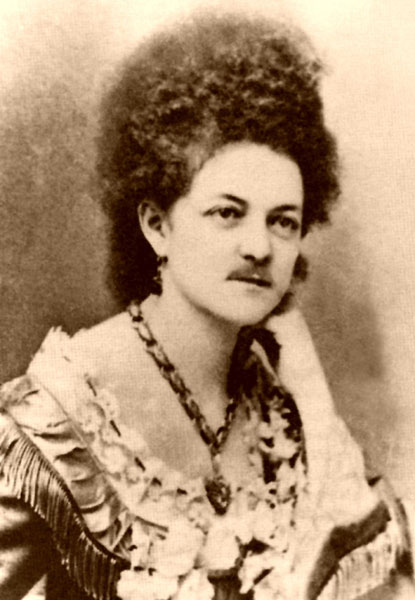
Of all the famous gold rush characters, one stands out as the most ubiquitous. Eleanor Dumont, commonly known as Madame Mustache, appears in an astonishing number of mining camps during the 1860s and 1870s. In her flamboyant wake, she left a trail of legends and stories where ever she dealt cards. And a skilled card dealer she was, introducing the game of twenty-one, the precursor of American Blackjack, at a time when Faro was the common game. An attractive Frenchwoman, she was the West’s first professional card dealer and her gambling emporiums were famous everywhere. In Montana, she reputedly ran houses in Virginia City, Fort Benton and Helena. In Fort Benton, her place of business was called The Jungle. In a second story room on Front Street overlooking the levee, Madame dealt her cards to sailors and miners. An enduring Fort Benton legend has it that Madame once left her card game brandishing a pair of pistols to warn a steamboat captain. She challenged him not to dock his ship as it was carrying a deadly cargo of passengers sick with smallpox. In Helena, Madame ran the Golden Gate, a gambling house near the Helena Herald offices that catered to newspaper employees. Madame in her later years sported a fine dark mustache on her upper lip. Perhaps she did not shave it off because the novelty brought her business.
Eleanor Dumont ended her career in Bodie, California, where she committed suicide by morphine overdose in 1879. She had a widely attended funeral, and all agreed that she may have been in a shady business, but she was always fair and kind to her customers.
 |
| Photo via Legends of America |
Monday, December 3, 2012
Wreck of the Bertrand
John J. Roe of St. Louis founded the Idaho and Montana Transportation Line and the Diamond R Transportation Company in 1864. The company carried everything imaginable by steamboat up the Missouri River from St. Louis to Ft. Benton. Its ox-drawn freighters then carried the goods to the various destinations. The treacherous steamboat voyage took two months. The steamer Bertrand left St. Louis in the early spring of 1865 carrying an astonishing inventory bound for Fort Benton, including 6,000 kegs of nails, mining equipment, and food and clothing. The goods were to be delivered to Virginia City, Deer Lodge, and Hell Gate (present day Missoula). On April 1, the boat hit a snag twenty miles north of Omaha and sank. All passengers and crew escaped, but the inventory—fortunately insured—was lost. In 1968, the wreck was rediscovered and the goods, preserved for a century in the river’s silt, were recovered. The cargo is a microcosm of frontier life. Among the recovered items are powdered lemonade; canned pineapple; brandied cherries; imported olives; salted and dried beef, mutton, and pork; jars of French mustard, catsup, and honey; clocks and combs; lamps and mirrors; patent medicines with their paper labels intact; 3,000 textiles including bolts of silk and 137 men’s coats in 7 different styles; shoes and boots; barrels of whiskey; hammers, doorknobs, pick axes, and blasting powder; washboards; plows; and sleigh bells. It’s hard to imagine some of these luxury items for sale in primitive log cabins. The DeSoto National Wildlife Refuge in Iowa includes a museum displaying some of the artifacts recovered from the Bertrand.
 |
| Artifacts recovered from the steamboat Bertrand, displayed in the visitor center at DeSoto National Wildlife Refuge |
Wednesday, November 28, 2012
Grand Union Hotel
Fort Benton’s beautifully restored hotel, the Grand Union, once welcomed travelers to the Gateway of the Northwest, offering them a luxurious refuge before they set out for less civilized destinations. Its opening in 1882 came at the end of the steamboat era when Fort Benton was still an unchallenged hub. But the very next year, the Northern Pacific stretched across Montana, bypassing Fort Benton and ending its reign as the Chicago of the Plains.
In its heyday, the Grand Union was the “Waldorf of the West.” It had a saloon, a grand dining room, a saddle room for cowboys to store their gear in winter, and a secret lookout room where guards could supervise gold shipments. A separate ladies’ stairway led to elegant parlors, since proper women never entered rooms adjoining saloons. Each bedroom had black walnut, marble-topped furnishings and its own woodstove and fancy chimney. From its vantage point near the docks, the Grand Union witnessed the arrival of everything from stamp mills to grand pianos brought by steamboat and transferred to freight wagons. The regal Grand Union reflects prosperity and optimism in a town unaware of the imminent coming of the railroad and the disastrous effects on its economy.
Have you ever stayed there?
From Montana Moments: History on the Go
 |
| Montana Historical Society Photograph Archives, 947-095 |
In its heyday, the Grand Union was the “Waldorf of the West.” It had a saloon, a grand dining room, a saddle room for cowboys to store their gear in winter, and a secret lookout room where guards could supervise gold shipments. A separate ladies’ stairway led to elegant parlors, since proper women never entered rooms adjoining saloons. Each bedroom had black walnut, marble-topped furnishings and its own woodstove and fancy chimney. From its vantage point near the docks, the Grand Union witnessed the arrival of everything from stamp mills to grand pianos brought by steamboat and transferred to freight wagons. The regal Grand Union reflects prosperity and optimism in a town unaware of the imminent coming of the railroad and the disastrous effects on its economy.
Have you ever stayed there?
From Montana Moments: History on the Go
Wednesday, May 2, 2012
Bill Hynson
Bill Hynson was a bad apple and a rough character who, in a strange manner, scripted his own death at Fort Benton in 1868. When saloon patrons who had overindulged began to report money missing from their pockets, many suspected Hynson. Locals observed Hynson keeping company with inebriated saloon patrons whose funds came up short. The local vigilance committee—that Hynson, ironically, took some credit for organizing—planned a trap to catch the perpetrator. They planted a supposedly drunken patron with heavy pockets in the local saloon. The plant pretended to pass out, and Hynson helped himself to the man’s pockets. The next day, the committee informed Hynson that the criminal had been discovered. Deputy Marshall X. Beidler was in town and the vigilantes announced that they intended to have a hanging. Hynson, unaware that he had been observed, volunteered to supply the rope and directed old-time trapper Henry Mills to dig a grave. Hynson promised Mills that in due time he would supply the corpse. Marshall Beidler, a cruel man well versed in the art of hanging, took the rope Hynson offered and placed it over his neck. Without a word, Hynson’s life was quickly snuffed. The corpse that filled the waiting grave was Hynson himself. His was one of three known vigilante hangings in Fort Benton.
Wednesday, April 25, 2012
Shep
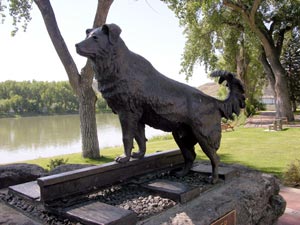
In the summer of 1936, a sheepherder became ill and was brought to the hospital in Fort Benton. A dog followed his flock of sheep into town and hung around the hospital where a kindly nun fed him. The herder died, and his relatives asked that his body be sent back East. The undertaker put the casket on the train, and the engine pulled away. The dog followed along the tracks until the train sped away, beginning a five-and-a-half year vigil. Day after day, the dog—named Shep by locals—met every passenger train, eying each person who got off. Neither heat nor rain nor snow prevented Shep from meeting those trains. Irene Schanche Bowker recalls that her father, depot agent Tony Schanche, coaxed the dog into the depot from the cold station platform. After gaining his trust, Schanche taught him tricks. Shep’s fame spread, and people came to photograph him, try to make friends, and possibly adopt him. But Shep was a one-man dog. The bond he had formed with the herder was simply the most important thing to him. Although railroad employees gave Shep food and shelter, that was all he wanted, except his master’s return. Time took its toll. On January 12, 1942, stiff-legged and deaf, Shep failed to hear the whistle as the 10:17 approached the depot that cold winter morning. Witnesses said he turned to look when the engine was almost upon him, moved to get out of the way, and slipped on the icy rails. His long vigil ended. Two days later, Shep had a grand funeral. Boy Scouts played taps, and a local minister read a moving eulogy on man’s best friend. Loving citizens laid Shep to rest on the bluff overlooking the station where his long wait had come to a sad end.
 |
| From Roadtripamerica.com |
Subscribe to:
Posts (Atom)