 |
| Mount Moriah has many beautiful sculpture tombstones like this tree stump, which symbolizes a life cut short. Photo from Buried in Butte by Zena Beth McGlashan |
Showing posts with label Anaconda. Show all posts
Showing posts with label Anaconda. Show all posts
Monday, November 25, 2013
Sculpture Gardens
During the nineteenth century, there was a national movement to plan park-like cemeteries with curving driveways and landscaped grounds outside urban areas. The idea took hold in Montana. Our major cities have beautiful park-like cemeteries where turn-of-the-century residents went not only to visit graves but also to picnic and enjoy nature. Missoula’s City Cemetery, Kalispell’s Conrad Cemetery, and Billings's Mountview are a few examples. Cemeteries were usually located out of town for aesthetic reasons, but planning cemeteries out of town in Butte was a necessity because of health and sanitation. Urban mining everywhere created ground disturbance, and early burials in city churchyards or on private property did not always remain underground. Bodies turned up in odd locations, and exposed burials, especially during epidemics, were a serious health hazard. Keenly aware of this grisly problem, fraternal organizations established Mount Moriah Cemetery in 1877. Rather than curving driveways, it was laid out in simple blocks since there was no landscape to accommodate curving driveways. As much as the community wanted a beautiful cemetery, in nineteenth-century Butte this was impossible. Open hearth smelting polluted the area and prevented anything from growing. The cemetery was bleak and ugly. Butte’s citizens, however, made up for the lack of landscaping by placing fanciful and lovely tombstones on their loved ones’ graves. Butte has the most unique and attractive cemetery art of any in Montana. The desire to create “a spot of beauty” was at first far-fetched. But by 1905, as smelting centralized in Anaconda, trees and shrubs did begin to grow. Today Mount Moriah and Butte’s other sculpture garden cemeteries rival any in Montana.

Wednesday, September 11, 2013
Marcus Daly’s Romance
Copper king Marcus Daly was the youngest of eleven siblings and began his career as a penniless Irish immigrant. He arrived in New York in 1856 when he was only fifteen years old. But Daly had a keen sense of business and a Midas touch with an uncanny instinct for the veins of copper that made his huge fortune. He founded Hamilton and Anaconda and was a generous patron to his fellow Irishmen and a benevolent boss to his workingmen. And he never forgot his humble Irish roots. But aside from all that, he was a great family man and father who loved his wife dearly. He and Margaret, or Maggie as he always called her, had a storybook marriage with a romantic beginning. In 1872, Daly was a foreman working for the Walker Brothers banking and mining syndicate of Salt Lake City. He was showing a newly discovered mine near Ophir, Utah, to miner Zenas Evans. Evans’ daughter, Margaret, was visiting the mine with her father. Daly hopped into a trench and held up some samples of the ore. Margaret was interested in looking at the samples and strayed too close to the edge. She lost her balance and tumbled right over the edge, landing right in Daly’s open arms. This chance encounter led to an engagement, and the couple was married in Salt Lake City at Joseph Walker’s home. Marcus doted on his Maggie until the day he died in 1900.
Curiously, Margaret had four sisters, and one of them, Miriam, was married to J. Ross Clark, a brother of Daly’s arch enemy, William A. Clark. The strange connection must have made for interesting family dynamics and dinner table conversation.
P.S. Remember Daly's prized racehorse?
 |
| Margaret Daly. Courtesy the Daly Mansion |
P.S. Remember Daly's prized racehorse?
Friday, July 5, 2013
Friday Photo: Mule Team
 |
| Montana Historical Society Photograph Archives, 957-871 |
Wednesday, June 26, 2013
Shoebox Annie
Alice Finnegan’s great book Goosetown: In Their Own Words puts the spotlight on oldtimers who grew up in this Anaconda neighborhood. Shoebox Annie is one memorable character that many recall with mixed emotions. She lived in Goosetown in the 1920s, but so great was the impression she left that even those growing up in the 1950s avoided the area of Alder and Commercial where her house once stood. Shoebox Annie carried a shoebox out of which she sold soap, shoelaces, and other items. She also carried her moonshine in the box. She had a pet magpie whose split tongue allowed it to talk. She sometimes went door to door with her magpie, selling soap. The bird knew how to pick up jewelry off dressers and fly out of the house with it. If you invited Annie into your house, she would steal things. The only way to get rid of her was to buy her soap. While some Goosetown kids frequented Annie’s house, others were deathly afraid of her.
Annie and her son Skidmore supposedly killed people and buried them in the basement. Sometimes horrible smells came from her house, and neighbors were convinced she was boiling body parts. There was truth to these tales. Annie’s real name was Mary Eleanor Smith. Authorities suspected her and her son of killing four people, including two who went missing while the pair lived in Anaconda. Authorities believed Annie and Skidmore dismembered the bodies in the bathtub and burned and disintegrated the pieces with acid. They did go to prison in Washington State for possessing items belonging to one of their victims. But lacking physical evidence, neither was ever convicted of murder. Annie is infamous as one of a few female serial killers.
P.S. Here's what the newspapers had to say about Annie and Skidmore.
P.P.S. Remember this sensational murder trial?
 |
| Photos courtesy The Unknown History of Misandry |
P.S. Here's what the newspapers had to say about Annie and Skidmore.
P.P.S. Remember this sensational murder trial?
Wednesday, December 5, 2012
Montana Trolleys
More than 80,000 trolleys once clanged over 45,000 miles of track in cities across the United States. Between 1888 and 1890, there were twenty-seven attempts to establish street railway service in nine Montana cities, but credit goes to Billings for establishing the first operational system. Two bright yellow horse-drawn cars ferried passengers in 1883. Business boomed temporarily when railway promoters offered twenty-five cent tickets and coupons for free beer at a local brewery. But the company soon went out of business. Its two wayward horses refused to keep to a schedule. Reliable service in Montana began in Helena on September 25, 1886. Hundreds watched in awe as the Helena Street Railway Company’s two horse-drawn Pullman cars made their maiden trips to the depot on newly laid iron rails. Soon, steam engines pulled some of the cars, but residents complained about the noisy, dirty coal-burning engines. Dust from the smoke settled in homes and the commotion frightened horse traffic. By the early 1890s, an assortment of trolleys operating on steam, horsepower, and the new electric system operated in Montana cities.
Montana first licensed automobiles in 1913. This, World War I, postwar inflation, and changing travel patterns took their toll. The Billings Traction Company folded in 1917. Bozeman’s system closed because of complaints that trolleys pushed aside snow, interfering with automobiles. Helena’s last car entered the barn at midnight on New Year’s Day in 1928; bus service began a few hours later. The Rainbow Hotel in Great Falls hosted a funeral in December 1931 for its trolleys. Guests filed past a battered streetcar and sang specially composed songs conceding that the trolleys "ain't gonna run no more." Missoula’s streetcar service ended in 1932, Butte’s in 1937, and Montana’s last trolley bell clanged in 1951 with a final run between Anaconda’s smelter and the town of Opportunity.
.JPG) |
| Horse-drawn trolleys like this newly-refurbished gem on Helena’s south Walking Mall once ferried passengers to the depot. Photo courtesy of Dean Rognrud. |
Montana first licensed automobiles in 1913. This, World War I, postwar inflation, and changing travel patterns took their toll. The Billings Traction Company folded in 1917. Bozeman’s system closed because of complaints that trolleys pushed aside snow, interfering with automobiles. Helena’s last car entered the barn at midnight on New Year’s Day in 1928; bus service began a few hours later. The Rainbow Hotel in Great Falls hosted a funeral in December 1931 for its trolleys. Guests filed past a battered streetcar and sang specially composed songs conceding that the trolleys "ain't gonna run no more." Missoula’s streetcar service ended in 1932, Butte’s in 1937, and Montana’s last trolley bell clanged in 1951 with a final run between Anaconda’s smelter and the town of Opportunity.
Wednesday, November 7, 2012
Bryan for President 1896
Did your candidate win yesterday's election? Here's a look back at the 1896 presidential election, which disappointed four out of five Montana voters.
The Populist Party was one of the most significant third political parties in the history of the United States. In the 1890s, Populism grew among Midwestern and southern farmers who believed that the free coinage of silver would cause inflation, which would raise farm prices and thus benefit the depressed agricultural economy. The populist platform also advocated nationalization of railroads, a graduated income tax, and more direct citizen participation in government. In Montana, where silver mining was an important industry, miners backed the Populist Party, especially after the collapse of the silver market in 1893. William Jennings Bryan’s “Cross of Gold” speech countered the Republicans’ backing of the gold standard.
Montana elected three Populists to the state senate and thirteen to the house. Populism in Montana reached its peak in the presidential election of 1896 when Populists joined Democrats to back William Jennings Bryan for president. Bryan was an advocate of free silver coinage and spokesman for the cause of the poor man. Marcus Daly reportedly gave $50,000 to Bryan’s campaign and was its largest contributor. Butte and Anaconda especially embraced Bryan as a champion of the working man, the antithesis of wealth and power, and thus one of their own.
Bryan carried Montana four to one in the election, but he lost to William McKinley. On the heels of his defeat, Bryan visited Montana the following August of 1897. Butte is famous for its hospitality, but Bryan received the greatest welcome Butte has ever bestowed on any visitor, and a poem, “When Bryan Came to Butte,” received national press. By 1906, Populism had faded and its free silver platform failed, but it left an important legacy. This included the eight-hour workday, direct election of senators by the people, the process of referendum and initiative, and a solid foundation for the Progressive era that followed.
P.S. I'll be signing books at the Montana Historical Society tomorrow (November 8) from 11:00 until 1:00. Plus there will be tea and cookies. Hope to see you there!
The Populist Party was one of the most significant third political parties in the history of the United States. In the 1890s, Populism grew among Midwestern and southern farmers who believed that the free coinage of silver would cause inflation, which would raise farm prices and thus benefit the depressed agricultural economy. The populist platform also advocated nationalization of railroads, a graduated income tax, and more direct citizen participation in government. In Montana, where silver mining was an important industry, miners backed the Populist Party, especially after the collapse of the silver market in 1893. William Jennings Bryan’s “Cross of Gold” speech countered the Republicans’ backing of the gold standard.
 |
| A button from William Jennings Bryan's 1896 campaign |
Montana elected three Populists to the state senate and thirteen to the house. Populism in Montana reached its peak in the presidential election of 1896 when Populists joined Democrats to back William Jennings Bryan for president. Bryan was an advocate of free silver coinage and spokesman for the cause of the poor man. Marcus Daly reportedly gave $50,000 to Bryan’s campaign and was its largest contributor. Butte and Anaconda especially embraced Bryan as a champion of the working man, the antithesis of wealth and power, and thus one of their own.
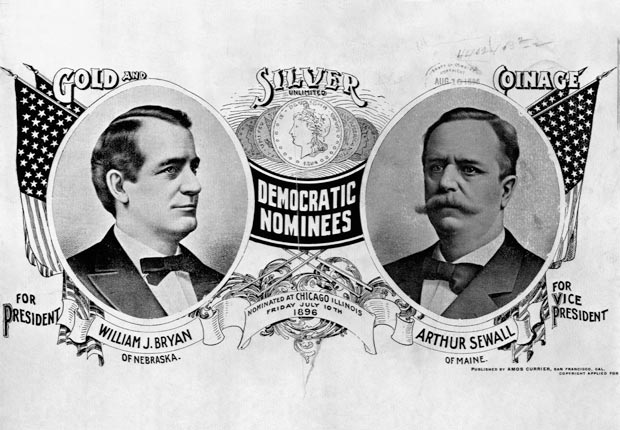 |
| Library of Congress Prints and Photographs Division, cph 3f06263 http://hdl.loc.gov/loc.pnp/cph.3f06263 |
P.S. I'll be signing books at the Montana Historical Society tomorrow (November 8) from 11:00 until 1:00. Plus there will be tea and cookies. Hope to see you there!
Friday, June 1, 2012
Friday Photo: Copper Commando
Anaconda worker Gus Sbragia selects a gear pattern from the forty thousand stored in four stories of the Pattern Shop at the Foundry Department of the Anaconda Copper Mining Company. The photo appeared in the October 23, 1942, Copper Commando, a tabloid-format newspaper intended to spur production of Montana metals during World War II. Pattern-makers created models that engineers used to manufacture and repair equipment for the company's mining, smelting, and refining operations.
P.S. Find more Copper Commando photos at the Montana Memory Project.
 |
| Montana Historical Society Photograph Archives, Robert I. Nesmith collection |
P.S. Find more Copper Commando photos at the Montana Memory Project.
Subscribe to:
Posts (Atom)