Showing posts with label photo. Show all posts

Monday, December 29, 2014

Happy Birthday MHS!

2014 has been the year of both territorial Montana’s and Helena’s 150th anniversaries. The New Year brings yet another 150th milestone celebration: the birthday of the Montana Historical Society. The organization is the second oldest such organization west of the Mississippi, founded when a group of prominent and farsighted men gathered early in 1865 at the Dance and Stuart Store in Virginia City. They included pioneer brothers James and Granville Stuart; vigilante prosecutor Wilbur Fisk Sanders; Territorial Chief Justice Hezekiah Hosmer; territorial legislator F. M. Thompson; and mapmaker Walter DeLacy. Territorial Governor Sidney Edgerton signed the incorporation on February 2, 1865. Unlike most other historical societies, the Montana Historical Society was born while historic events were occurring, and not created as a nostalgic look backwards. Its initial purpose was “to collect and arrange facts in regard to the early history” of the territory. It does that and much, much more.

The Montana Historical Society was founded in the Dance and Stuart Store, Virginia City, in 1865.
Montana Historical Society Photograph Archives
In 1873, the society moved its collection of first-run territorial newspapers and other documents to Helena. Soon after, on January 9, 1874, fire destroyed most of it when Wilbur Fisk Sanders’ law office burned. In 1887, rented quarters in the new territorial capitol at the Lewis and Clark County Courthouse became a more permanent home. Reorganized in 1891, the society became a state agency. In 1902, it moved into its second home in the basement of the new Montana State Capitol.  Reorganized again in 1949, the Veterans and Pioneers Memorial Building became the society’s current home in 1953. Collections of all kinds fill its galleries, its library, its and storage facilities.
Today the society’s six programs are committed to education, research, and preservation that reach across the state in many ways. The research center includes 95 percent of all newspapers published in Montana; 18,000 reels of microfilm; 14,000 maps; 32,000 books and pamphlets; and 350,000 photographic images. The museum houses over 48,000 artifacts as well as textiles and extensive art collections. And the building is bursting at the seams.
The Montana Historical Society is the steward of our stories and belongs to all of Montana. On its 150th anniversary year, we invite you to visit us, become a member, and support your history.

Friday, December 19, 2014

Friday Photo: Santa Claus is Coming

Montana Historical Society Photograph Archives, H-3736
Santa Claus stopped in front of F. Jay Haynes's photo studio to have this photo taken in 1897.

Wednesday, December 17, 2014

Christmas Trees from Forest to Fireside

We all know that Christmas trees can be a drain on the budget, and that is nothing new. In the first settlements of territorial Montana, Christmas trees might come fresh cut from the forest but required an outlay of cash to decorate. Ribbons and ornaments—even those made by hand of scraps—were expensive and hard to come by. Churches, meeting halls, and courthouses were the usual venues for Christmas trees because they could be communally decorated. Gifts, including fruit and candy, were hung on the trees and not usually placed beneath as we do today. Distribution of gifts on the tree was done with great ceremony.

By 1880, Christmas trees were more common in private homes and sold in larger cities for ten to fifty cents. In the next decade, one in every five families had a Christmas tree. By the early 1900s, Christmas trees cost from twenty-five cents to a dollar and most families had their own Christmas trees.  While decorations could still cost more than the tree itself, saving decorations from year to year helped Christmas trees become almost a seasonal necessity. An editorial feature in the Daily Missoulian, December 18, 1910, advised that Christmas trees were for everyone. Even those too old to hang a stocking and those with no young people in there households should not give up on the custom.

Maurice Hain poses with the family's Christmas tree in 1936.
Montana Historical Society Photograph Archives, 945-214
While some argued that cutting trees desecrate the forest, Gifford Pinchot, conservationist and first chief of the U.S. Forest Service, answered these critics. He maintained that cutting a five-foot tree is not the same as logging an old-growth lodge pole pine. A five-foot farmed tree grows in half a decade and can be replaced. Pinchot further remarked, “Trees were destined to be used. What better use could be made of them [than] to give pleasure to millions of people at Christmastime?”

Whether you cut your own or buy your tree, keep the custom and fill your home with Christmas.

Monday, December 15, 2014

America’s “Stiffest Guzzlers”

At Christmastime in 1878, Montana’s territorial capital had been fixed at Helena, Fort Benton was the “Chicago of the Plains,” Butte was a struggling camp, and Miles City was a remote outpost serving brand-new Fort Keogh. Virginia City had lost its once substantial population and status. Captain Thomas Fuller, Collector of the U.S. Internal Revenue, reported on collections in Montana Territory. It was a report that some found disturbing and others relished.

The Central Beer Hall in Helena was one of Montana's many nineteenth-century drinking establishments.
Jorud, photographer. Montana Historical Society Photograph Archives.
Revenues for the fiscal year 1877-1878 in the territory were approximately $25,000, an increase of $3,000. This increase was directly related to the consumption of beer and other spirits. Captain Fuller noted that no “vinuous or spirituous liquors” were produced in Montana. The revenue was from only liquors consumed and malt liquors produced. Twenty-one breweries were operating in Montana in 1878, a number greater than in any other territory. The New North-West of Deer Lodge observed on December 12, 1878, that Montana’s drinkers were the “stiffest beer guzzlers in America.” In addition to the breweries, Montana Territory had 600 total licensed “whisky saloons.” Further, Helena had 161 liquor licenses issued for the fiscal year, more than any other settlement in the territory. Butte came next with 60, Miles City with 54, Virginia City 44, Bozeman 39, Deer Lodge 36, Benton 35, and Missoula 29. There were 95 licenses issued to dealers along the Tongue and Yellowstone rivers compared to only 13 the previous year. Soldiers must have been among the hardiest drinkers.
The New North-West lamented that these statistics revealed Montana to be a “fearfully dissipated people” and encouraged the Good Templars (a fraternal temperance group) to work harder on the population. Territorial population in 1878 was approximately 25,000. According to these statistics, there was a drinking establishment for every 40 men, women, and children—including all the Templars!

Friday, December 12, 2014

Friday Photo: Pet Bear

Montana Historical Society Photograph Archives, PAc 82-19 F11
The Bayerd family kept a pet bear at their ranch on Sheep Creek near White Sulphur Springs. The people are (l. to r.) Carry Tucker, Mr. Bayerd's son, and Mr. Bayerd's father, who looks old enough to know better. Photo taken circa 1890.

P.S. Remember this strange pet? And this one?

Friday, December 5, 2014

Friday Photo: Forsyth Flood

Montana Historical Society Photograph Archives, PAc 76-26 F50
The Yellowstone River flooded in 1918, and Forsyth residents coped with the help of a few boats. Walter Dean took this photograph of the event.

Friday, November 28, 2014

Friday Photo: Standing on the Car

Montana Historical Society Photograph Archives, 94-84.4
This man, Thomas Leslie Lyle, opened a photography studio in Helena in 1914. This photo was taken in 1917, and the location is unknown. Does anyone recognize it?


Thursday, November 27, 2014

Happy Thanksgiving

Thanksgiving was a harvest tradition long celebrated in New England, but it took a while to catch on in Montana. In 1863 there really was no harvest to celebrate and Henry Plummer was perhaps the only resident to observe the occasion. He used it to cultivate good relations with the Sidney Edgerton family, and spent a small fortune freighting in a turkey. You can follow that story here.  

In 1864, miners at Last Chance were too busy searching for gold to celebrate. In 1865, President Abraham Lincoln proclaimed Thanksgiving a holiday to unify the nation torn by the Civil War. Cornelius Hedges observed, however, that southern sympathizers were too busy mourning the “lost cause” to be thankful. In 1875, the Montana territorial legislature formally proclaimed Thanksgiving a holiday. At Sun River, residents held a grand Thanksgiving dance with music by the Fort Shaw band. When the dance ended at three in the morning, everyone had had such a good time they organized a dance club.

By the 1880s, Thanksgiving was a tradition. In 1881, ladies at Helena’s Presbyterian Church held a holiday sale of items that mirrored their roots. New Englanders contributed, for example, miniature Boston baked bean pots. In 1892, the Red Lodge Picket noted that on Wednesday before Thanksgiving, the Miners’ Meat Market featured an exceptionally artistic display arranged by E. J. Dugan, a Kansas City butcher. Beautifully dressed beeves, sheep, and veal hung on the pegs along with turkey and other fowl. The fantastic display was the “finest of any ever made in Red Lodge.”    

By the start of the twentieth century, Thanksgiving traditions were well established, and elaborate meals the norm. The Anaconda Standard noted in 1903 that “The stranger will find Anaconda equal to providing the great American feast.” At the Montana Hotel, orchestra music filtered throughout the hotel from nine till midnight. But the meal was the focus. Along with standard fare, the menu included green sea turtle quenelles, calves’ sweetbreads Genovese, orange fritters with brandy sauce, and frozen egg nog.

May you all once again eat too much and enjoy this day of national celebration.

Montana Historical Society Photograph Archives, postcard collection

Friday, November 21, 2014

Friday Photo: Thanksgiving Turkey

Montana Historical Society Photograph Archives, 950-354
Are you ready for Thanksgiving dinner? I'd say this young man isn't. I hope your feast is filled with joy and free of regret.

P.S. The photo was taken by Evelyn Cameron.

Friday, November 14, 2014

Friday Photo: Milking

Montana Historical Society Photograph Archives, PAc 91-69.64
I hope that today's photograph gives you a chuckle. This woman is a talented milker, but unfortunately nothing is known about the picture or the photographer. Do you recognize who she is or where the picture was taken? Leave a comment and let me know.

Monday, November 10, 2014

A Legacy of War

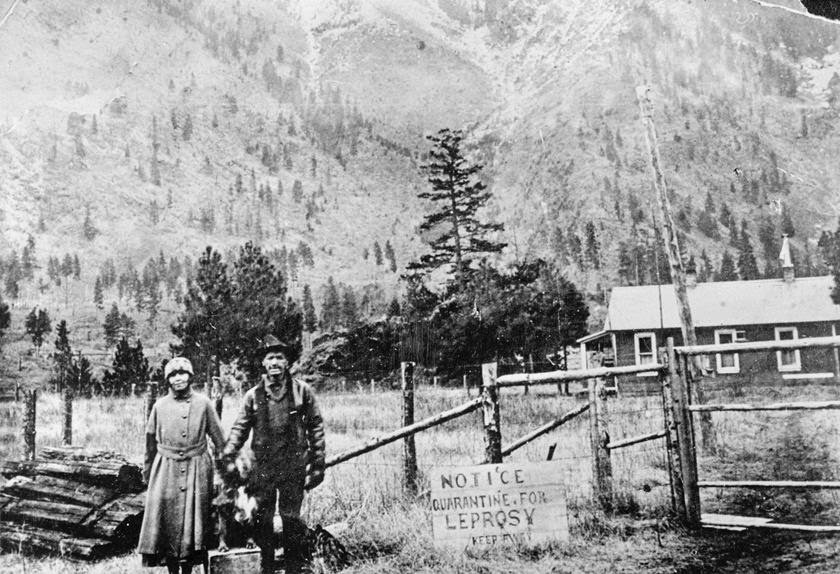
Orville .G. Willett was an army veteran, a state senator, and the person who suggested the name for Mineral County. He was also the victim of a dreaded disease. Willett had suffered undiagnosed bouts of illness for years, but while serving in the legislature in 1917, the Mayo Clinic finally determined the cause. Willett had leprosy. He had become infected while serving his country during the Spanish American War in the Philippines in 1902. He was one of some two hundred veterans of this war to contract the disease.

Willett posed for this legislative portrait just months before his diagnosis.
Montana Historical Society Photograph Archives, 945-620
The State of Montana had no rules and regulations in place for the isolation and quarantine of lepers. It was a mysterious disease, believed to be a fatal and highly contagious. The Alberton community was horrified to learn of the Willetts’ troubles. Willett and his wife were newly married. The couple was placed under quarantine in a small cottage in rural Mineral County near Alberton and cared for at county expense. Willett refused to submit to painful chalmoogra oil treatments, which doctors at that time believed was a viable cure. Instead he resorted to faith healing as his health deteriorated.

Willett and his wife lived under quarantine near Alberton, Montana.
Montana Historical Society Photograph Archives, 945-621
Ten years later in 1927, a legislative act committed Willett—who had continued to refuse medical treatment—to the federal leprosarium at Carville, Louisiana. Although local residents had been supportive of the Willetts, arsonists wasted little time after their departure for Louisiana. Their house and all their possessions burned to the ground. Doctors at Carville were hopeful that Willett would benefit from chalmoogra oil treatment. The disease had not disfigured him, but it was far advanced. Despite treatment, Willett died in 1928.

Today, Carville, Louisiana, is still a center for the study of leprosy, or Hansens’s Disease. Undamaged by Hurricane Katrina, research was disrupted while the facility served as the identification center for 910 victims of the storm.

Friday, November 7, 2014

Friday Photo: Cousin Jack Race Horses

Montana Historical Society Photograph Archives, ST 001.072
The description included with this stereograph states that: "A Cousin Jack is a person from Cornwall." Perhaps this is insight into the humor that photographer N. A. Forsyth intended in his caption. He took the photo in Butte between 1901 and 1911.

Friday, October 24, 2014

Friday Photo: What's the Joke?

Montana Historical Society Photograph Archives, PAc 90-87.NB075A
Bill Fought (left) and Cap Barker pose with their horses circa 1914 near Terry, Montana. One wonders what he said or did to make her laugh. Evelyn Cameron, photographer.

Friday, October 17, 2014

Friday Photo: Pet Cat

Montana Historical Society Photograph Archives, PAc 90-87.N041
Alma and Esther McMurray pose with their pet cat circa 1900-1910. But look past the cuteness in the foreground. The background captures wonderful details of life in a homestead cabin. Evelyn Cameron, photographer.

Friday, October 10, 2014

Friday Photo: St. Labre

Montana Historical Society Photograph Archives, 981-220
These nuns served at St. Labre Mission in Ashland, Montana. Left to right: Sisters Gertrude, Barbara, and Monica, Mother Mary of the Angels, sisters Thecla and Hildegarde, Father Vermaat. Photo by L. A. Huffman

Friday, October 3, 2014

Friday Photo: Dry Cleaners

Montana Historical Society Photograph Archives, Mulvaney Collection, 1723
This Helena tailoring shop probably belonged to Miles York. The date on the calendar is, unfortunately, not legible. It might be July 1910.

Friday, September 26, 2014

Friday Photo: Threshing Crew

Montana Historical Society Photograph Archives, PAc 90-87 4-3
Mabel Williams brings water to the threshing crew on her family's farm near Terry in September 1909. Her friend and neighbor Evelyn Cameron took the photo.

Friday, September 19, 2014

Friday Photo: Ashland

Montana Historical Society Photograph Archives, 981-997
The men of the town of Ashland in Rosebud County turned out to have their photograph taken by L.A. Huffman circa 1910. There appear to be children peeking out the window of the building in the background.

Wednesday, September 17, 2014

Captain James Williams

Pennsylvania native James Williams was the son of Irish and Welsh immigrants. The West lured him as a young man. In 1856, Williams was involved in the violent Border Wars in Kansas where he was a “Free State” man. He followed the rush to Pikes Peak in 1858 and came to Bannack with a wagon train from Denver in 1862. In the absence of a leader, the travelers elected Williams to lead the train and thereafter he was known as Captain, or Cap, for short. Cap Williams followed the rush to Alder Gulch in 1863. Then during those dark turbulent days of lawlessness, he again served as captain, this time of the vigilantes. When robberies and murders terrified citizens, Cap Williams stepped forward to lead the vigilantes in the capture and hanging of some two dozen suspected road agents during winter of 1863-1864.

Montana Historical Society Photograph Archives, 945-626
When this work was finished, Cap married and settled down in the emerald green ranchlands of Madison County’s Ruby Valley. But in March of 1887, searcher’s discovered Cap’s body hidden in a thicket. The newspapers reported that Cap had laid out his mittens and scarf as a pillow. He took a fatal dose of laudanum. He lay down knowing sleep would take over and the cold winter weather would do the rest. Some speculated that Virginia City banker Henry Elling was about to foreclose on his ranch. Others believed that his role as a vigilante weighed so heavily upon him that he could no longer live with the burden. Some however, had a different theory. Cap was a man of integrity, and he would never have willingly left his wife and seven children. Some believe that sentiments against Cap were still rife, and that he had enemies. Perhaps, they speculated, someone came along in the cold and offered him a fatal drink. A tombstone in a tiny burial ground today marks Cap’s grave. We will never know for sure what put him there.

Friday, September 12, 2014

Friday Photo: At the Park

Montana Historical Society Photograph Archives, H-372
This family is relaxing in Miller's Park at Coal Banks Landing, a low-water unloading and refueling site for steamboats headed up the Missouri River to Fort Benton. The landing is now a BLM recreation site. Well-known photographer F. Jay Haynes took the photo.