 |
| Fur trappers arrive at Lolo Hot Springs, Montana, with loads of fur, c. 1890. Montana Historical Society Photograph Archives, Maloney Collection |
Showing posts with label fur trade. Show all posts
Showing posts with label fur trade. Show all posts
Monday, September 2, 2013
Mad as a Hatter
The process of making fabric called felt goes back to ancient civilization and may even predate spinning and weaving. The undercoat of certain animals—including rabbit, muskrat, and beaver—contains microscopic scales that cling together. The pelts were shaved to obtain this underhair which was repeatedly submerged in boiling water, then drained and kneaded like bread dough. This caused the scales to open and cling together. The drying process caused the scales to shrink, thus locking them together to form a solid fabric. Felt makers discovered in the 1600s that mercuric nitrate, when brushed on the fur, causes the scales in the fur to open farther and thus increase in strength, improving the quality of the felt. Hat makers spread the felt over a hat form and pressed and steamed it into shape. Then they brushed the fabric to a sheen. Beaver fur, because of its waterproof qualities, its softness and resilience, was most sought after. The Hudson’s Bay Company capitalized on beaver pelts, which brought about the exploration and exploitation of the habitats of these animals.
Beaver hats were a status symbol, and the industry nearly caused the animal’s extinction here in Montana and elsewhere. Fashions fortunately changed when silk came into favor. The beaver’s near extinction was not the only legacy of the beaver hat industry. Exposure to the mercury fumes in poorly ventilated workshops caused poisoning characterized by trembling, loss of coordination, slurred speech, loosening of teeth, memory loss, depression, irritability, anxiety, and mental illness causing hatters to go crazy. Thus the term “mad as a hatter” is not a joke.

Wednesday, July 18, 2012
Prairie Figs
Johnny Grant, founder of the Grant-Kohrs Ranch, was the son of the factor at the Hudson’s Bay Company fort near Pocatello, Idaho. Johnny’s memoirs, wonderfully edited by Lyndle Meikle under the title Very Close to Trouble, are full of interesting historical anecdotes. One memorable footnote recounts the story of a green Missourian who came into the fort store. Johnny’s father decided to have some sport with the unsuspecting traveler. Castorums are beaver glands that trappers used as bait. There were a number of these foul objects hanging in the store. The Missourian asked what they were. “Prairie figs,” replied the elder Grant. “Are they good to eat?” asked the Missourian. “For those who like them,” answered Grant. “Can I taste one?” Grant answered, “Certainly.” The traveler picked a good full one and bit into it. The putrid gum and oil ran down the sides of his mouth, and Johnny recalled how comical it was to see the man making faces trying to spit it out. For some time he couldn’t speak. Finally he said, “They might be good for those who like them, but I declare I do not.” This comical story and the singular name suggests that Prairie Figs would make a terrific name for a modern-day band!
From Montana Moments: History on the Go
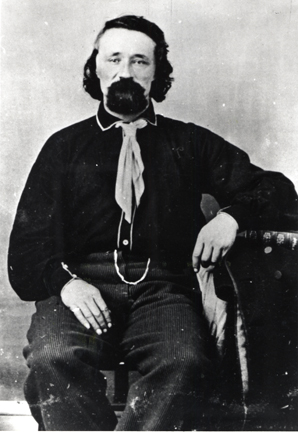 |
| Johnny Grant posed for this photo sometime after founding the Grant-Kohrs Ranch. Montana Historical Society Photograph Archives, 942-461 |
From Montana Moments: History on the Go
Subscribe to:
Posts (Atom)