Friday, August 31, 2012

Friday Photo: Camp Cooking

Happy Friday! The weather looks good for camping this weekend, but for heaven's sake don't light a fire like this one!


Montana Historical Society Photograph Archives, 943-307
Peter Koch cooks at 9,000 feet on the divide between the Gallatin and Madison rivers in 1923.

Wednesday, August 29, 2012

Bill Fairweather

Some men just weren’t meant for good fortune. Bill Fairweather was a tragic example of luck gone awry. In the company of a party of miners on May 26, 1863, Fairweather panned the first gold at Alder Gulch, setting off the famous stampede. The gulch made him rich, but to Fairweather, the gold meant little. Legend has it that he would ride up and down the streets of Virginia City on his horse, Old Antelope, scattering gold nuggets in the dust. He loved to see the children and the Chinese miners scramble for them. He mixed gold dust in his horse’s oats, saying that nothing was too good for Old Antelope, the horse that brought him such good luck. But Fairweather died of hard living at Robber’s Roost in 1875. His pockets were empty and a bottle of whiskey was his only companion. He was not yet forty years old. A diet of gold dust did Fairweather’s horse, Old Antelope, no harm. He long outlived his master, enjoying the Ruby Valley pasture of E. F. Johnson into extreme old age. Fairweather’s remains lie in Hillside Cemetery, a windswept burial ground overlooking Alder Gulch where an iron fence surrounds his grave. A recent marker credits him with the Alder Gulch discovery.

From Montana Moments: History on the Go

Monday, August 27, 2012

Evelyn Cameron

Today's post remembers Evelyn Cameron. She was born on August 26, 1868.

Terry, Montana, on the state’s eastern edge, was home to Evelyn Cameron, a talented woman who documented the homesteading era and Montana outdoors with shutter, lens, and expert eye. Cameron’s photographs capture the spirit of the West just as surely as Charlie Russell’s famous paintings define Montana cowboys. Cameron came to Montana from England with her husband to raise polo ponies to ship back to the British Isles. Although that idea failed, Cameron learned the art of photography and set about capturing life on the eastern plains. She died in 1928, but years later in the late 1970s, Time-Life books editor Donna Lucey stumbled upon 1,800 photo negatives and 2,700 original prints, stored for half a century in the Terry basement of Janet Williams, Cameron’s best friend. Lucey studied Cameron’s meticulous diaries and photographs to research her book, Photographing Montana 1894–1928: The Life and Works of Evelyn Cameron. Published in 2000, it revealed many of Cameron’s photos for the first time. If you visit Terry, be sure to stop at the Prairie County Museum and visit the Cameron ranch site.

Cameron snapped this photo of her brother Alec Flower with a magnificent cabbage harvest in 1898.
Montana Historical Society Photograph Archives PAc 90-87


Dick Brown poses next to a pile of wolf hides in this Cameron photo.
Montana Historical Society Photograph Archives PAc 90-87.24-5

Cameron kneads dough in this 1904 self-portrait.
Montana Historical Society Photograph Archives PAc 90-87.35-5

From Montana Moments: History on the Go
P.S. Remember the scandal Cameron created when she rode into Miles City wearing this skirt?

Friday, August 24, 2012

Friday Photo: Victory Garden


Montana Historical Society Photograph Archives, PAc 2005-4 A1 P.10
A Helena woman picks vegetables in her World War I "victory garden" in August 1918. Can anyone identify the street she's on?

Wednesday, August 22, 2012

Sedman House

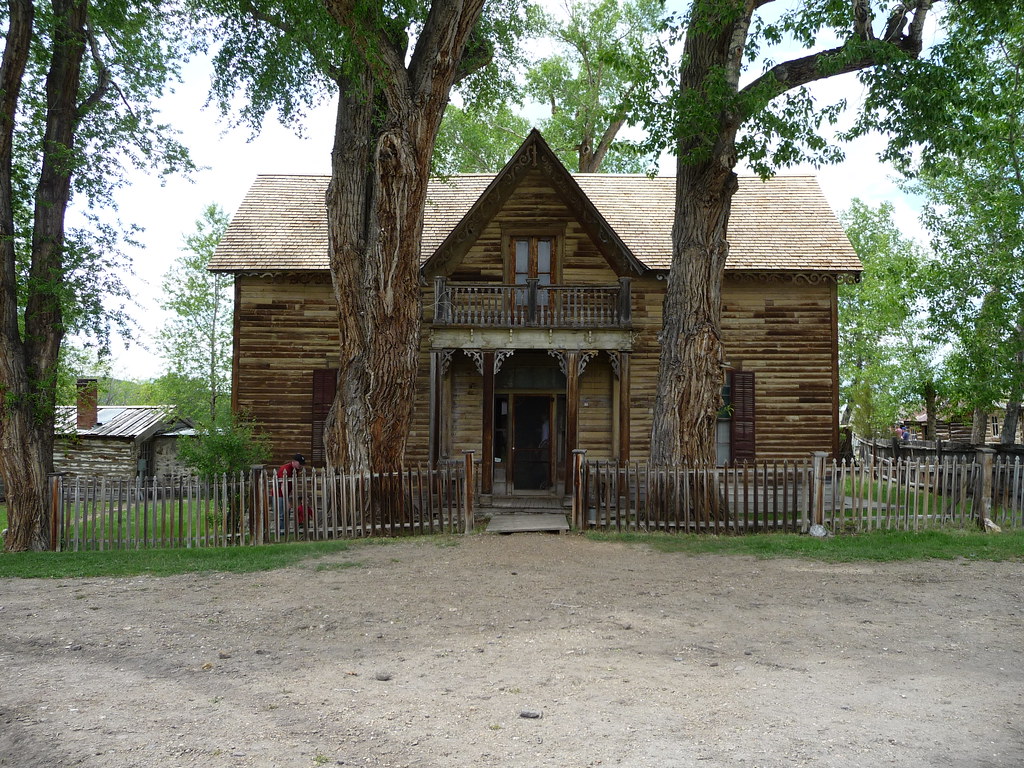
One of Montana’s best-kept secrets is the Sedman House, a beautifully furnished territorial period home in Nevada City, now under state ownership and maintained by the Montana Heritage Commission. It originally stood in nearby Junction City where it was one of the first large homes built in the region in 1873. Its builder, Madison County rancher and territorial legislator Oscar Sedman, met an unfortunate end. In 1881 during the legislative session in Helena, he suddenly took ill and died of “black measles,” the tick-born disease we know today as Rocky Mountain spotted fever. Sedman was the first Montana legislator to die during a session. He left a wife and four small children. His colleagues paid him tribute by draping his official chair in black crepe, turning it backwards to face the wall. After Oscar’s death, two of the Sedmans’ four children died. Mrs. Sedman remarried and moved to Missoula.

Sedman House, June 12, 2009
Photo by E.L. Malvaney via Flickr
The Sedmans’ lovely home later became the Junction Hotel. After that, it served as a stable. Charles Bovey disassembled the badly deteriorated building and moved it a mile and a half to Nevada City where he put it back together. The home today is a focal point. The period furnishings include the desk of vigilante prosecutor Wilbur Fisk Sanders and Colonel Charles Broadwater’s personal gold-trimmed bathtub from his private suite at the far-famed Broadwater Hotel. A visit to the Sedman House in Nevada City is well worth it.

From Montana Moments: History on the Go
P.S. This weekend would be an especially good opportunity to visit the Sedman House.

Monday, August 20, 2012

Old Pitt

Happy Monday, history buffs. Today's post might be my favorite story from all of Montana history.

John Robinson III at one time had the largest elephant herd in captivity. From the 1880s until the 1910s, he trained and traveled with his pachyderms, known as the Military Elephants for the military-themed act that made them famous. Financial hardship forced Robinson to sell several elephants to Ringling Brothers in 1916, but he kept the oldest ones with him at his farm outside Cincinnati. Neighbors got used to seeing them lumbering down the road, pulling wagons, and grazing. After Robinson’s death in 1921, one by one the last three elephants succumbed to old age until the fourth, Petite, nicknamed Pitt, was the last survivor. She was more than 100 years old when Robinson’s widow gave her to the Cole Brothers Circus in 1942.
 
The three elephants on the left became Robinson's Military Elephants, Clara, Petite (Pitt), and Tony.
Photo from Elephants Encyclopedia
The next year, 1943, the circus was traveling across Montana playing one night engagements. They stopped at Dillon to do a show. The crowd thronged into the exhibition tent to marvel at the elephants’ performance. The animal exhibition was just over and the crowd had gathered under the Big Top to enjoy the main show. A storm came up suddenly, and a bolt of lightning hit the exhibition tent striking Pitt. The 102-year-old veteran died instantly. The other elephants and circus owner Zach Terrell were stunned but recovered. Old Pitt had a fine funeral and was buried on the Beaverhead County Fairgrounds. A year later the Cole Brothers Circus again performed at Dillon. Circus folk gathered silently around a granite marker they had paid for. Its careful wording tells Pitt’s story and ends with this: May God Bless Her. Today a white fence in the middle of barren ground surrounds the lonely marker. A recently-planted sapling inside the fence, evidence that someone still cares, will hopefully grow to someday shade Old Pitt’s final resting place.

Photo from RoadsideAmerica.com

Wednesday, August 15, 2012

Daniels County Courthouse

Scobey, the seat of Daniels County, has Montana’s most unusual courthouse. It is a stunning false-fronted building, painted a crisp white. But it has a rather shady past. The building has been enlarged and remodeled inside. What was once a spacious hotel lobby is now divided into county offices. But the courthouse began as a hotel, built sometime before 1913 when the town of Scobey relocated from its original site along the Poplar River flats. This hotel had several owners, but during most of the teens, One-eyed Molly Wakefield owned the building. Molly was a rough character who earned her nickname because she was blind in one eye. A long scar ran across it, hinting at some violent episode in her mysterious past. She came on the train from Kansas City with her four sons, all her belongings, and money in her pockets. Molly bought real estate, including the hotel. She and her sons kept pit bulls for fighting staked between her hotel and the Tallman Hotel next door. There was gambling in Molly’s hotel, as there was in Scobey’s other hotels, but women were the main attraction. The hotel had no indoor bathroom facilities, although the first-floor rooms for entertaining were handily equipped with sinks. A large sleeping room upstairs accommodated legitimate overnight guests. In 1917, federal officials closed red light districts across the nation. One-Eyed Molly disappeared, and her hotel sat empty.


Montana Historical Society Photograph Archives, 950-886
When Scobey became the county seat in 1920, officials had no reservations about taking over the old hotel. Even today, some of the county offices retain telltale sinks. It is Montana’s only brothel-turned-courthouse.

From Montana Moments: History on the Go
P.S. Remember this savvy madam?

Monday, August 13, 2012

Rimini

John Caplice discovered a rich vein in 1864 and soon local mines drew a solid population to this area. The early settlement, first known as Young Ireland, lay nestled in the shadow of Red Mountain’s soaring 8,800-foot peak. In 1884, citizens petitioned for a post office, requesting the name of the town as Lee Mountain after the town’s most important mine. But Territorial Governor Schuyler Crosby informed the delegation that the post office was not inclined to approve names of towns that had more than one word. The governor had just seen a production of the play Francesca da Rimini at Helena’s Ming Opera House and loved it. He suggested the name Rimini, pronounced RIM-i-nee, after the Italian town of that name. But Irish miners assumed the name was Irish because Irishman Richard Barrett played the lead role. The post office was approved, but miners changed the pronunciation to RIM-in-eye and it stuck.

Rimini, c. 1924
Montana Historical Society Photograph Archives, 950-606
Rimini boomed as the Northern Pacific Railroad’s Rimini–Red Mountain branch line hauled gold, silver, lead, and zinc ore to the smelter at East Helena. Local mines generated some 7 million dollars. The Hotel Rimini served delectable meals, and visitors from far-away places strolled along the main street. But mining waned, the post office closed in 1916, and train traffic ended in 1925. Mining remnants lie scattered everywhere. From 1942 to 1944 during World War II, remote Rimini was the U.S. Army’s War Dog Reception and Training Center where dogsled teams trained for search and rescue. Then the town became quiet. Today picturesque Rimini is a patchwork of time periods and home to a handful of residents.

From More Montana Moments
P.S. Remember how this mining town got its curious name?

Friday, August 10, 2012

Cooking on the Hook

The Olympics are winding down, and this is our last post remembering Montana sports and champions (at least for now). Let's remember a sport that has long since been abandoned: cooking on the hook.

Photo by F. Jay Haynes
Montana Historical Society Photograph Archives, H-6318
Members of the Lewis and Clark Expedition heard of the wonders of the Yellowstone region, but they did not venture that far south. When Expedition member John Colter returned to Montana to trap, his near death experience escaping the Blackfeet led him through a portion of what would become Yellowstone Park. Most attributed his descriptions of fire and brimstone to delerium, and they called the area Colter’s Hell. But other stories gradually emerged. One of the famous tales first told by mountain men involved fishing. Montana pioneer attorney Cornelius Hedges was the first to provide a written account. An avid fisherman, Hedges was with the 1870 Washburn-Doane Expedition organized by a group of Montanans to explore the Yellowstone region. Hedges wrote that as he hooked a trout, he missed landing the fish on the bank. The fish came off the hook and flopped into a nearby thermal spring. By the time Hedges retrieved the fish with his pole, the trout was cooked through. While Hedges was too shocked to try it again, others reading his account took up the sport. Henry Winser, in his 1883 guide to Yellowstone Park, describes the art of hooking a trout, swinging the pole over to a thermal pool, and plunging the fish in, hook and line still attached. Cooking on the hook became a favorite sport. One preferred place was the Fishing Cone that Hedges described, which is a spring in the West Thumb Geyser Basin. Fishermen at the Fishing Cone sometimes dressed in a chef’s hat and apron to have their picture taken “cooking on the hook.” The Park once allowed this practice, but it is now prohibited. Cooking on the hook is now just another famous fish story.

Wednesday, August 8, 2012

Speed Skating

Speed skaters Sylvia White and Judy Martz both competed in the 1964 Winter Olympics at Innsbruck, Norway, but it is Judy Martz whom most Montanans remember. The two future teammates met in Butte when Sylvia was a national champion and Judy was just a kid who loved to compete and had not been training. Sylvia challenged Judy to an informal race, and Judy lost by a narrow margin of only two yards. So Judy began to set her sights on real competition. She won a spot in the nationals at St. Paul, and in 1963 she was a member of the U.S. World Speed Skating Team. Later that year, both she and Sylvia White made the U. S. Olympic Speed Skating Team. They were the first Montana women ever to make an Olympic team. Judy skated only once during the games at Innsbruck. She believes that she peaked too early during practice races. When she skated the 1500 meter race, she lost focus, fell and slid, and was too fatigued to gain ground. Even so, she was proud to finish 15th. Today Judy says that competing in that race was a golden experience. Although she doesn’t have a medal that she has to lock in a safety deposit box, she feels as if she has a gold medal tucked in her heart. But competing as one of the first two Montana women at the Olympics was not Judy’s only first. She went on to serve as Montana’s first female lieutenant governor under Mark Racicot from 1997 to 2001. She then won her bid as governor in 2001 and served one term, the first woman to take the helm of Montana’s ship of state.

The 1964 Olympic Speed Skating team, including Judy Martz (bottom row, far left) and Sylvia White (bottom row, second from right). Image from National Speed Skating Museum.

Monday, August 6, 2012

Spokane

Not all of Montana's great athletes have been human. As we continue our look at sports history, let's remember a four-legged champion...

Noah Armstrong made a fortune in the Glendale mines southwest of Butte. He had a ranch in Madison County where he built a beautiful three-story round barn. If you drive along the highway near Twin Bridges in Madison County, you can see it off the highway. Its board-and-batten walls are painted red, and its shape is like a wedding cake, with each story smaller than the one below it.

Photo by Tom Ferris in Hand Raised: The Barns of Montana.
This barn is famous as the birthplace of the only Montana horse to win the Kentucky Derby. Armstrong invested some of his wealth in raising and racing thoroughbreds. In 1887 the famous racehorse Spokane was born in Armstrong’s round barn. A quarter-mile track inside the barn was the colt’s first training ground. Armstrong sent him to Tennessee for further training. In 1889 when Spokane was three, Armstrong entered him in the fifteenth Kentucky Derby. Spokane had only run a few undistinguished races. Bookies overlooked him at six to one odds, favoring the famous Proctor Knott, a proven winner who already had brought his owner seventy thousand dollars. That day at Churchill Downs, thousands witnessed the little copper-colored horse from Montana make racing history. He passed Proctor Knott at the finish line. Spokane went on to win two more big races: the American Derby at Churchill Downs and the Clark Stakes in Chicago, beating the mighty Proctor Knott both times. No other three-year-old horse has ever won all three great races. Spokane lives on in the annals of racing history.

From Montana Moments: History on the Go

Friday, August 3, 2012

Friday Photo: Fishing for Trout

Let's take a day off from remembering the history of Montana champions and go fishing—a classic Montana sport!

Montana Historical Society Photograph Archives, Maloney Collection
Myrta Wright Stevens, photographer
In today's photo, anglers enjoy fishing for trout near Lolo Hot Springs in the 1890s. Which Montana river do you like to fish?

Wednesday, August 1, 2012

Olympic Illness


Our look at Montana sports and champions continues with Eric Flaim, an Olympic speed skater from Butte...

Travelers often complain of strange food and bouts of illness known as Montezuma's revenge, Delhi belly, Turkey trots, and other geographically descriptive distresses. Olympic athletes are susceptible to those upsets like everyone else. And sometimes those distresses cause more trouble than a little discomfort.  Speed skater Eric Flaim of Butte discovered how costly a case of food poisoning could be during the Winter Games in Albertville, France in 1992.

Photo from Wikipedia.com
Eric had won a silver medal in 1988 at Calgary and looked forward to doing well in France. But there was a problem. Eric, along with other athletes, complained bitterly about the food in the Olympic Village. A number of them resorted to cooking for themselves. Eric said that he finally got so sick of his own cooking that he felt compelled to venture out to try the Olympic Village food one more time. It was a bad mistake. He found that not even his own cooking made him as ill as the food in the Village. He was so sick that he was afraid he could not race, and the doctors could not give him the proper medication because of the strict Olympic drug rules. Eric had fallen in a previous race and come back to do well, but he told a reporter that recovering from a fall was one thing. Getting sick and losing everything from your system was a different matter. The bout of food poisoning he endured was so debilitating that it ruined his chances of a medal. He lost his opportunity not to the skating oval, but to the Olympic Village dining room. He did, however, come back in 1994 to earn a silver medal at the Winter Games in Lillehammer, Norway.