Showing posts with label Dillon. Show all posts

Monday, March 17, 2014

Elizabeth Lochrie

The U.S. Treasury Department, the State of Montana, the Ford Motor Company, New York Life Insurance Company, and the First National Bank of Seattle were among the distinguished patrons of Deer Lodge native Elizabeth Lochrie. Formally trained as an artist at the Pratt Institute in New York City, she graduated in 1911 and settled in Butte. From the 1920s to the 1950s, Lochrie established herself as a fine portrait artist. She also painted local rural and urban landscapes and scenes. During 1924 and 1925, Lochrie painted eighteen children’s murals for the Montana State Hospital at Galen. She also created murals for several post office buildings.

Montana Historical Society Photograph Archives, PAc 80-61
In 1937 Lochrie won the U.S. Treasury Department’s competition for News from the States at the Dillon Post Office, depicting the historic arrival of mail in that community. At Glacier National Park, Lochrie studied under Winold Reiss and then served as artist for the Great Northern Railway from 1937 to 1939. While other artists documented the vanishing Indian lifeway, Lochrie did more than that. She immersed herself in Indian culture and learned to converse in various dialects. She traveled the lecture circuit and often used her fees to buy clothing and other items for needy tribal members, especially Blackfeet. In 1932, the Blackfeet Nation adopted her and named her Netchitaki, Woman Alone in Her Way. When she died in 1981, Lochrie left a legacy of more than one thousand paintings, murals, and sculptures. She was one of Montana’s most outstanding twentieth-century artists.

P.S. Have you seen the Women's History Project?

Tuesday, December 25, 2012

Merry Christmas!

I hope you woke up to a full stocking this morning. Merry Christmas!

Montana Historical Society Photograph Archives
The Orr children of Dillon, Montana, hung their stockings and waited for Santa in this c. 1928 photo.
P.S. Dillon was at the center of a stocking controversy in the 1920s.

Monday, August 20, 2012

Old Pitt

Happy Monday, history buffs. Today's post might be my favorite story from all of Montana history.

John Robinson III at one time had the largest elephant herd in captivity. From the 1880s until the 1910s, he trained and traveled with his pachyderms, known as the Military Elephants for the military-themed act that made them famous. Financial hardship forced Robinson to sell several elephants to Ringling Brothers in 1916, but he kept the oldest ones with him at his farm outside Cincinnati. Neighbors got used to seeing them lumbering down the road, pulling wagons, and grazing. After Robinson’s death in 1921, one by one the last three elephants succumbed to old age until the fourth, Petite, nicknamed Pitt, was the last survivor. She was more than 100 years old when Robinson’s widow gave her to the Cole Brothers Circus in 1942.
 
The three elephants on the left became Robinson's Military Elephants, Clara, Petite (Pitt), and Tony.
Photo from Elephants Encyclopedia
The next year, 1943, the circus was traveling across Montana playing one night engagements. They stopped at Dillon to do a show. The crowd thronged into the exhibition tent to marvel at the elephants’ performance. The animal exhibition was just over and the crowd had gathered under the Big Top to enjoy the main show. A storm came up suddenly, and a bolt of lightning hit the exhibition tent striking Pitt. The 102-year-old veteran died instantly. The other elephants and circus owner Zach Terrell were stunned but recovered. Old Pitt had a fine funeral and was buried on the Beaverhead County Fairgrounds. A year later the Cole Brothers Circus again performed at Dillon. Circus folk gathered silently around a granite marker they had paid for. Its careful wording tells Pitt’s story and ends with this: May God Bless Her. Today a white fence in the middle of barren ground surrounds the lonely marker. A recently-planted sapling inside the fence, evidence that someone still cares, will hopefully grow to someday shade Old Pitt’s final resting place.

Photo from RoadsideAmerica.com

Wednesday, May 9, 2012

Ladies Rebel

Ladies’ fashions changed during the 1920s, and not everyone approved. Antiquated corsets with garters attached and bloomers gave way to shorter skirts, rolled silk stockings, and step-ins – an open legged panty that replaced the long-legged bloomers. Rolled silk stockings did away with the need for garters. There was quite an art to rolling them, keeping the seam in the back straight, twisting and turning them to end just above the knee, leaving the thighs bare. It took practice to keep the stockings from falling down, but it was a skill at which every teenage girl was adept.

This cover of Life magazine from February 18, 1926, shows a flapper wearing rolled stockings.
Library of Congress

At the Normal School in Dillon, women students rebelled and cast off their corsets and bloomers in favor of short hems, rolled stockings and step-ins. School administrators were scandalized, and issued this statement: “the girls must wear garters, long stockings, and bloomers, or get on the train and go home.” The dean of women had to enforce the dress code. She posted herself at the foot of the stairs in Main Hall, where she could see underneath as girls walked up the stairs. Any girl detected with rolled stockings and step ins was sent back to the dormitory to change into appropriate attire. The Dillon community watched with interest as this drama unfolded. The rumor was that the Golden Rule and Eliel’s—the two stores that sold women’s undergarments—had to bring out their obsolete inventory of corsets and bloomers for the students to comply with the rules. By the end of the 1920s, dress lengths again became longer, the administration relaxed its rules, and the situation righted itself.  But during the Roaring Twenties, those newfangled fashion trends challenged everyone.

Update: Do you suppose Arline Allen would have worn rolled stockings and step-ins?

Monday, April 16, 2012

Titanic Memory

One hundred years ago yesterday, the Titanic sank...

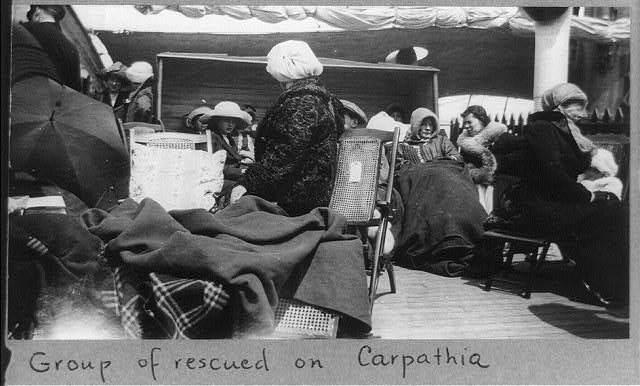
Twenty-year-old Mary Lawrence left Austrian Hungary, employed as a maid to a physician’s family en route to America. Mary seldom spoke about her terrible ordeal aboard the ill-fated Titanic, but in 1939, she did describe her experience to a news reporter. She recalled the utter horror of that night, April 15, 1912. First she heard a terrible crunching sound, then people running, screaming, crying, and shoving and pushing. She saw many fall overboard, and she saw her employer—the doctor—and his wife and their three children—all go over the side of the huge ship and into the water. She jumped from the sinking ship into a boat, suffering a severe and permanent injury to her leg as she landed. All around her people were drowning in the ice-cold water. She recalled crowding into the lifeboat, and several people froze to death during the five hours before help came.

Survivors of the Titanic on board the rescue ship Carpathia. Library of Congress
She could not remember the rescue, but once she arrived at New York City, Mary recalled wandering the streets aimlessly, dazed, homeless, injured, and unable to speak English. After several weeks, she finally met someone from her native homeland who helped her find work on a farm. Several months later she learned of an uncle in Montana. Mary traveled to Dillon and stayed with her uncle there for several years. In 1915 she married Jacob Skender, a miner and smelter worker. The Skenders settled in the Butte neighborhood of Meaderville where they raised six children, but Mary could never put aside that terrible experience. There were more than 2,200 people on the Titanic’s maiden voyage. Of those, Mary Lawrence Skender was one of 705 survivors.

Monday, February 13, 2012

Brother Van’s Love Story

Here's a love story to tug your heartstrings.

Montana’s famous itinerant Methodist minister, William Wesley Van Orsdel, known to most as “Brother Van,” never married. And this is the story of why that was. As Brother Van traveled across Montana territory in the 1870s, he stopped at the sheep ranch of Richard Reynolds in the Beaverhead valley. The family invited him to stay, and there he met Reynolds’ stepdaughter, 13-year-old Jennie Johnston. She and Brother Van became fast friends. When Jennie turned 18, Brother Van was 31. Jennie’s mother wanted her to go to college, and so in September, 1879, she and brother Van postponed their plans and Jennie headed off for Northwest University in Evanston, Illinois. But Jennie became ill with tuberculosis. In the summer of 1880, she returned home to Montana. The next February, 1881, Jennie caught the measles but recovered and helped nurse other family members through what was then a very dangerous illness. But by summer, 1881, Jennie’s health began to fail and she died in October. As she lay in state in the Reynolds’ parlor, Brother Van slipped the wedding ring he would have given her onto her finger. He wore the ring she would have given him for the rest of his life. Jennie, whose mother was a Poindexter, was buried in the Poindexter family cemetery that today is in a cow pasture. Jennie’s grave was moved to Mountain View Cemetery northeast of Dillon and is marked with only a small nameplate. Brother Van lived a long, full, useful life and died in 1919. He is buried in Helena, far from his beloved Jennie.
 
Brother Van (with hand inside his coat) officiated at many weddings around the state, including Helena newspaperman Charles Greenfield's marriage to Elizabeth Nelson in 1913, probably in her home in Vandalia, northwest of Glasgow. But Brother Van himself never married. Photo from I Do: A Cultural History of Montana Weddings by Martha Kohl. Original in Montana Historical Society photograph archives, Helena, 942-477


Friday, January 6, 2012

Friday Photo

Happy Friday! Here's a gem from the Historical Society's collection. Just look at that outfit! That sled! Did you ever have one like it?
Montana Historical Society Photograph Archives catalog PAc 89-119 #52. Used by permission.
Thelma Riley of Dillon, Montana, takes a break from sledding to pose for this 1905 picture by an unidentified photographer.