Wednesday, February 27, 2013

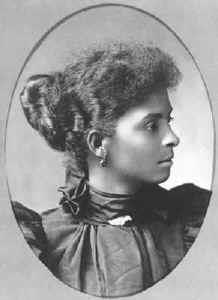
Annie Morgan

Legend has it that African American Annie Morgan was a cook for General George Armstrong Custer. After the Battle of the Little Bighorn, she was out of a job and eventually made her way to Philipsburg in Granite County. This part of the story has been disputed, and Annie’s past is uncertain. However, it is a fact that Granite County attorney David Durfee hired her to take his uncle—who had a severe drinking problem—to an abandoned fox farm on Upper Rock Creek to dry out. Annie cared for the uncle, accomplished a cure, and when he eventually went his own way, she stayed on, filing a homestead claim.

Annie's cabin. Photo courtesy State Historic Preservation Office
One day in 1894, Annie happened upon a local character named Joseph Case, lying on the banks of Rock Creek gravely ill with typhoid. Case was a Civil War veteran from New Jersey who made a living catching fish to sell in Philipsburg where he was known as “Fisher Jack.” Annie nursed Jack through the illness, and to repay her, Jack fenced Annie’s homestead. The pair developed a mutual affection, and when the fence was done, Jack stayed on. Annie died in 1914, and both she and Jack are buried in the Philipsburg cemetery. The Forest Service has beautifully restored Annie’s cabin. In the process, workers discovered a curious object hidden in the upper door frame. Bits of red string, a soap wrapper, and other items consistent with the bundles carried by African root doctors suggest that perhaps Annie carried these traditions, handed down to her from family members, to the Montana frontier. She certainly proved her skills at doctoring. The Morgan-Case Homestead, listed in the National Register of Historic Places, is available for short-term rental by lottery through the Missoula Ranger District.

P.S. If you're interested in staying at the cabin, watch this video.

Monday, February 25, 2013

Octavia Bridgewater

The Army Nurse Corps formed in 1901, and African American nurses served throughout all wars. However, they served as contract nurses and not in the military. At the end of World War I, when the Spanish flu epidemic caused a severe shortage of nurses, the Army Nurse Corps accepted eighteen African American women after Armistice to care for German prisoners of war and African American soldiers stateside.  In 1941, the Army Nurse Corps began accepting a few African American nurses. In 1942, there were 8,000 black nurses in the United States. The Army’s strict quota, however, allowed only 160 to enlist. One of the first black nurses accepted for active duty was Octavia Bridgewater of Helena. She served from January 11, 1943, until November 29, 1945.

Octavia Bridgewater is standing on the far right in this 1926 photo, probably taken in Colorado Gulch near Helena.
Montana Historical Society Photograph Archives, PAc 2002-36 11
Octavia received her nurses training at the Lincoln Hospital School of Nursing in the Bronx in the late 1920s.  At that time, the Lincoln School and the Harlem School of Nursing were the only two schools exclusively for African Americans. Even so, both were under white administration. When Octavia returned to Montana after graduation in 1930, her only option was private duty nursing. After her enlistment in the Army, Octavia and her colleagues realized that if the military quota situation was not lifted, black nurses could never be integrated into the mainstream medical community after the war. Nationally through the black press, these women mobilized for their cause. Slowly, African American nurses pierced the barriers within the military system. The Army and Navy lifted the boycott in 1945. Octavia returned to civilian life to give many years of service to the Helena community as a maternity nurse at St. Peters Hospital. She was also very involved in Montana’s vibrant black community. Octavia was especially proud to have been part of the national movement that helped pave the way for her own civilian nursing career and for the careers of many other black nurses.

Friday, February 22, 2013

Friday Photo: Sperry Glacier

Happy Friday! Do you have any adventures planned for the weekend?

Montana Historical Society Photograph Archives, 956-638
In today's photo, sightseers explore a crevasse in Sperry Glacier in Glacier National Park, circa 1910. Have you ever made the hike up to to the glacier? If you go, use more sense than these hikers and don't tie yourselves together!

P.S. More vintage views of Glacier here and here.

Wednesday, February 20, 2013

J. L. Campbell’s Guide to Idaho

J. L. Campbell’s travel guide to the Territory of Idaho, Idaho: Six Months in the New Gold Regions, was intended to aid would-be emigrants contemplating a journey to the new gold fields. Campbell traveled the region in 1863, but by 1864 when his guide was published, it was already outdated. Montana Territory had been carved out of the vast chunk of Idaho. Campbell’s guide, however, was a useful tool because it described the route from Omaha, Nebraska, to the diggings at Bannack and Virginia City. Campbell offers advice, suggests items to take on the journey, and lists good campsites. His description of the Bannack mines includes a fascinating historical tidbit. He claims that he saw an ancient mine shaft where the miners presumably dug down to gold. A large pine tree, one foot in diameter, had grown in the mine shaft, attesting to the age of the mine. A couple of ancient timber huts stood nearby. Campbell noted that in the dry climate, timber exposed to weather could last a very long time. He theorized that the mines were the work of Spaniards who came north from Mexico exploring in the 1700s as some chronicles suggest. Most modern historians agree, however, that Spanish explorers did not venture this far north. A more likely explanation for this anomaly is that the mine was a stone quarry where Native Americans dug for chert to make weapons.

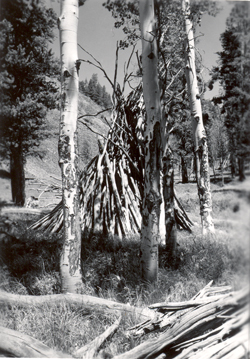
A Shoshone wickiup. Image from explorebigsky.com
Certainly the timber huts are Native American wickiups, not shelters of Spanish origin. These temporary shelters do survive to great age and—along with tipi rings, rock cairns, and other manmade features—are part of Montana’s archaeological record.

Monday, February 18, 2013

Sarah Bickford Revisited

Historians have long told the story of Sarah Gammon Bickford. From slave to Virginia City businesswoman, her life was remarkable.  She was born in North Carolina, and when Sarah was young, her parents were sold and she never saw them again. After the Civil War, she traveled to Virginia City in 1871 as governess to the children of the John L. Murphy family. She soon married John Brown, a white miner, and they had three children. As the story goes, by 1881 two young sons and her husband had died. Her daughter Eva lived to be nine years old and then she died around 1883. Sarah started over, marrying Stephen Bickford, a miner and owner of the local water company. The couple had four children. Her children recalled that growing up, their mother told them poignant stories about her first family. Stephen died in 1900, leaving Sarah to run the water company. She was likely the only black woman in the nation to own a utility at that time.

But there is an epilogue to Sarah’s story. A diligent student researcher recently discovered divorce proceedings in the Madison County Courthouse. Even Sarah’s family apparently believed her first husband had died. But this proved that Sarah took her life into her own hands and charged her first husband with cruelty and abandonment. Samuel Word was her defense attorney. Her husband, John Brown, did not appear in court. Sarah accused him of threatening to kill her, beating her, and leaving her and her children. The judge granted her divorce and gave her sole custody of Eva, their only surviving child. The discovery of Sarah’s divorce gives a new dimension to the life of Sarah Bickford, and adds real courage to her other qualities.
 
P.S. Lots more research about Sarah Bickford at this blog, plus the Sarah Bickford house in Virginia City.
P.P.S. Remember this remarkable woman?

Friday, February 15, 2013

Friday Photo: Doctor Huie Pock

Happy Friday, history buffs! I'll be speaking next week about Montana's Chinese pioneers. It will be a free program at the Montana Historical Society on Wednesday at 10:45. Hope you can make it!

Montana Historical Society Photograph Archives, Lot 025 M1
Huie Pock, second from left, was an herbal physician who also operated a store selling Chinese goods in Butte. Pock appears in Butte city directories listed as a physician from 1895 through 1927. His son, Quong Pock Hui, is seated on the stool. The two others are not identified.

Thursday, February 14, 2013

Romance on Mount Helena

Happy Valentine's Day! Here's a sweet story in honor of the day.

Many a romance blossomed on historic Mount Helena where generations of Helena residents hiked, picnicked, and enjoyed the views.  The engagement of Essie Morris and Moz Silverman was one of those rare, spur-of-the-moment events that capture our imaginations even today. It was the summer of 1903 and a group of six young people had climbed to Mount Helena’s summit for the novelty and adventure of it all. The young ladies promised their mothers that the young men would build a bonfire when they reached the top to signal their successful climb. As the etiquette dictated, Essie’s proper outfit for this outdoor excursion included a large picture hat. Essie was always fastidious about her hats, and this one was especially large and one of her favorites. The young men made the bonfire as they had promised, and Essie took off her hat and tossed it aside. A few moments later she realized that the hat had landed in the fire. Her beautiful hat was a charred ruin. But Moz seized the moment to turn catastrophe into a proposal. He said, “Miss Essie, I’d like nothing better than the privilege of buying your hats for the rest of your life.” Essie said yes, and the local paper announced the engagement. The reporter summed it up, “Thus another romance,” he wrote, “is added to the long list for which Mount Helena is responsible.”

Essie Morris, wearing one of her fabulous hats. Photo courtesy Sydney Silverman Lindauer.

Wednesday, February 13, 2013

African Americans in Great Falls

Great Falls’ African American community and its prominent black citizens have amply contributed to the state’s history. African Americans established the Union Bethel African Methodist Episcopal Church in 1890. The small 40-member congregation raised funds door to door to build the current church in 1917. It became the religious and social heart of Great Falls’ black community. The church offered institutional support for those who took leading roles in the fight against segregation.

Union Bethel Church today. Photo courtesy State Historic Preservation Office.

In 1953, the Cascade County Community Council appointed a committee to study discrimination against black soldiers stationed at nearby Malmstrom Air Force Base. Although Montana had no Whites Only signs as there were in some places, blacks were not allowed in most businesses. An exception was Great Falls’ far-famed Ozark Club. From the 1940s until it burned in 1962, the Ozark Club was Montana’s only social club that employed integrated jazz bands and welcomed an interracial clientele. Great Falls’ black community made other important contributions. Among them, Alma Jacobs was elected the first black president of the Pacific Northwest Library Association in 1957. She was a founder of the Montana Committee for the Humanities, helped build the modern Great Falls Library, and became Montana’s State Librarian in 1974. Geraldine Travis of Great Falls was elected to the Montana House of Representatives, the first black person to serve in the legislature. Currently Great Falls has Montana’s largest African American population, partly because many black soldiers are stationed at Malmstrom Air Force Base. And after a period of declining membership, the Union Bethel Church—listed in the National Register of Historic Places—is now a vital part of the interracial community.

Monday, February 11, 2013

J. P. Ball and Son

In honor of Black History Month, today's post features a father-son team of photographers and their bold and unique statement of equality. Warning! The photos after the jump are shocking. I'd rate this post PG-13 for violence.

James Presley Ball was a professional photographer who came from Cincinnati to Montana in 1887 with his son, J.P. Ball, Jr. They set up a studio in Helena. They were talented and influential African Americans who left an interesting legacy. The younger Ball was the first editor of the Colored Citizen, a short-lived newspaper dedicated to capturing black endorsement of Helena as the state capital.
James Presley Ball. Photo from Calabash by Esther Hall Mumford
As photographers, the Balls documented events and people. They left portraits of prosperous Chinese, blacks, and European immigrants. They also took some curious photos. One bizarre three-photo sequence documents the tragedy of African American William Biggerstaff. The first portrait shows Biggerstaff as a prominent, well dressed gentleman in a suit and vest, posing confidently.

Montana Historical Society Photograph Archives

Friday, February 8, 2013

Friday Photo: Dogsledding

Race to the Sky starts this weekend at Camp Rimini. Will you attend any of the events?

Montana Historical Society Photograph Archives, PAc 2000-54.7
Dogsledder Celey Baum and his team race, possibly in Red Lodge, in 1939. Just look how excited those dogs are!

P.S. Are you a dog person? Here's a story to touch your heart.

Wednesday, February 6, 2013

Marysville Road

Have you ever driven the road out to Marysville? Here's the history of this scenic route.

The road began as a railroad grade for the Montana Central. In 1887, the Northern Pacific and Montana Central railroads raced to complete branch lines to the Drumlummon Mine and Marysville up the narrow canyon. The Northern Pacific’s line ran along one side of Silver Creek while the Montana Central ran on the other side, in the valley. The Northern Pacific won the race and successfully blocked the Montana Central from entering Marysville by refusing to grant it access through its trestle. The Northern Pacific’s route was indeed a remarkable feat of engineering. The tracks clung to the mountainsides, crossing deep gulches, all the while climbing, climbing, until it reached the famous mining camp. The final trestle made an eighteen degree curve into town, swinging the train dramatically over the gulch.

The Northern Pacific Railroad's trestle just outside of Marysville
Image via Legends of America
The Montana Central, unable to gain access to the trestle, built a depot about 1½ miles below Marysville, but it was too far away and thus not profitable. The Montana Central abandoned the line just a few years later in 1889.  The original wagon road to Marysville lay below the Montana Central grade. Once the railroad had been abandoned, travelers began using the abandoned grade and it eventually became the Marysville Road of today. The Northern Pacific’s spectacular trestle dominated the town until 1925 when the railroad pulled up the tracks and removed it. In 1931, a Marysville resident widened the former Montana central grade  into its existing configuration. Lewis and Clark County and the Montana Department of Transportation have worked together to improve it.

P.S. A shout-out to Mark Huffstetler, who's working on a book about Montana's historic railroad depots. You can follow him at Daily Montana.
P.P.S. Helena As She Was has more photos of the Northern Pacific depot and line to Marysville. Scroll down about 3/4 of the way to see them.

Monday, February 4, 2013

Missouri Breaks Homestead

Twenty miles north of Winifred is a remote, hostile, yet beautiful area in the Missouri Breaks National Monument called the Devil’s Pocket. Myrtle Hagadone Hledik, who died in 2006, was one of the last surviving homesteaders who had lived in that that wild area. The Devil’s Pocket was not a place of fond memories for Myrtle. Her parents married in 1913 and the couple had three daughters. Myrtle was the youngest. The family moved to the homestead about three miles upriver from the McCelland Ferry in 1917.

The Hagadone Homestead in 2008. BLM photo.
Myrtle recalled the Missouri River bottomlands as unbearably hot in summer, cruelly cold in winter, and a place of terrible hardship. They grew vegetables, and caught pike and catfish and seldom went hungry. But they had no well, and carried buckets of river water to the house, let the silt settle, and boiled it for cooking and drinking. Rattlesnakes were a terrible danger. They were everywhere, and Myrtle’s sister Mary was bitten once. Her father cut the bite with a straight-edged razor, sucked out the venom, and wrapped a freshly killed chicken around the bite to draw out the rest of the poison. Mary survived. After four years, Myrtle’s mother and father separated. He went to work at another homestead and her mother stayed and worked the homestead alone. She was a mean woman and sent the girls to board in town and go to school. Myrtle’s time at the homestead was done. She eventually learned to cook and worked for several ranches. While Myrtle’s sisters had more pleasant childhood memories, Myrtle remembered that the rugged landscape of that lonely place was something she never wanted to see again.

P.S. You can download a driving tour of some Missouri Breaks Homesteads. But you might want to wait for summer weather to make the trip!

Friday, February 1, 2013

Friday Photo: Growing Up in Butte

A couple of weeks ago, I had the privilege of hearing UM professor Janet Finn speak about children in Butte in the early 1900s, and she inspired me to share this photo.

N.A. Forsyth, photographer. Montana Historical Society Photograph Archives, ST 001.108
The "Young Prospectors" in this c. 1909 photo are digging their own mine. Janet argues that grown-ups braved the dangers of Butte's copper mines so that their children could have a better life. In her words, "Children were, quite simply, Butte's reason to be."

What do you think? You can read more in Janet's book, Mining Childhood: Growing Up in Butte, 1900-1960.