Wednesday, January 30, 2013

Ringing Rocks

The Whitetail-Pipestone Recreation Area eighteen miles east of Butte and north of I-90 hides a natural wonder that is one of Montana’s best kept secrets. The jumbled pile of rust-colored boulders, probably dumped there as debris from an ice-age glacier as it moved and receded eons ago, chime harmoniously when struck with a wrench or hammer. Rocks have been known to be used as musical instruments for several thousand years. So-called lithophone stones have been found among various cultures in India, Africa, Korea, and Vietnam. But Montana’s stones are not the same. If one chiming rock is removed from its pile, it no longer rings. This type of natural chorus is found in only one other place in the United States. Ringing Rocks State Park in rural Pennsylvania draws huge crowds. Montana’s melodious rocks are not nearly so well known. The site attracts fewer than 2,000 people annually. There is no scientific explanation for the ringing rocks, but it may be that a combination of erosion, the way the rocks are joined together, and their geologic makeup produced the conditions that allow them to chime. Each rock makes a different sound. The Montana rocks have been long known, probably discovered by some prospector passing through. Perhaps he dropped his pick, and heard the music as it fell from one boulder to the other. Maybe not better than gold, but such a wonderful discovery likely made his day. Visit this site, accessible by car with a high clearance, and be sure to bring enough hammers for the entire family. You too can then make the real music of the spheres.

A child strikes a rock with a hammer at Ringing Rocks State Park, Pennsylvania. Photo via Wikipedia.


Monday, January 28, 2013

Madame Mustache

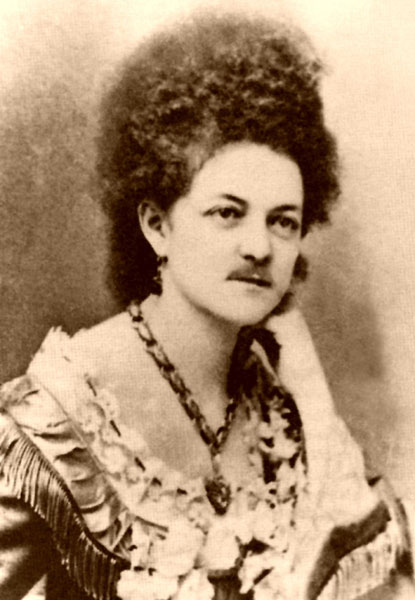
Of all the famous gold rush characters, one stands out as the most ubiquitous. Eleanor Dumont, commonly known as Madame Mustache, appears in an astonishing number of mining camps during the 1860s and 1870s. In her flamboyant wake, she left a trail of legends and stories where ever she dealt cards. And a skilled card dealer she was, introducing the game of twenty-one, the precursor of American Blackjack, at a time when Faro was the common game. An attractive Frenchwoman, she was the West’s first professional card dealer and her gambling emporiums were famous everywhere. In Montana, she reputedly ran houses in Virginia City, Fort Benton and Helena. In Fort Benton, her place of business was called The Jungle. In a second story room on Front Street overlooking the levee, Madame dealt her cards to sailors and miners. An enduring Fort Benton legend has it that Madame once left her card game brandishing a pair of pistols to warn a steamboat captain. She challenged him not to dock his ship as it was carrying a deadly cargo of passengers sick with smallpox. In Helena, Madame ran the Golden Gate, a gambling house near the Helena Herald offices that catered to newspaper employees. Madame in her later years sported a fine dark mustache on her upper lip. Perhaps she did not shave it off because the novelty brought her business.

Photo via Legends of America
Eleanor Dumont ended her career in Bodie, California, where she committed suicide by morphine overdose in 1879. She had a widely attended funeral, and all agreed that she may have been in a shady business, but she was always fair and kind to her customers.

Friday, January 25, 2013

Friday Photo: Pet Wolf

Wolves have been in the news a lot lately, what with the debate over wolf policy. Here's a photo to raise your eyebrows, no matter which side of the debate you're on.

Montana Historical Society Photograph Archives
Eunice Gipson posed with photographer Evelyn Cameron's pet wolf circa 1910-1920.

P.S. More lovely photos by Cameron here, herehere, and here.
P.P.S. Remember when Cameron scandalized Miles City?

Wednesday, January 23, 2013

Brussels Carpet

Floor coverings on the Montana frontier were a luxury only the wealthy could afford. Turkish carpets were the most expensive, but British-made Brussels floor coverings were a near second. Harriet Sanders packed two expensive Brussels carpets in the covered wagon that brought her family West from Ohio. One of the carpets covered the floor in her home in Virginia City, but the other she had no use for and stored it away. Worried that the mice or moths might find it tasty, she was one day inspecting the carpet for damage when a merchant acquaintance happened by. He asked what she was doing and Harriet told him that she had no use for the carpet but hated to see it destroyed by varmints. The merchant offered to sell it for her. Harriett had little hope that the merchant could find a buyer, as Virginia City was so primitive and staples so expensive, she imagined that no one would have use for such a luxury. So she consented and it wasn’t long before the merchant returned and handed her $500 in gold dust. Harriett could hardly believe it, and wondered who had paid such a price for her carpet. She soon discovered the carpet’s fate. The merchant cut it in strips and sold it at $20 a yard. There were no smooth boards at this early date in Virginia City, and so merchants used the carpet to cover their rough counters. Miners often spilled their bags on the carpet in weighing the dust. When word of the next gold strike prompted the merchant to move on to the next boomtown, he burned the carpet and realized handsome sums from the gold dust captured in the pile.

The Brussels carpet in this photo is on display at the Grant-Kohrs Ranch.
Photo courtesy Grant-Kohrs Ranch Foundation.

Monday, January 21, 2013

Scarred Trees

Culturally scarred trees in Glacier National Park, the Nez Perce and Bitterroot Forests, the Flathead Lake area, the Bob Marshall Wilderness, and elsewhere in western Montana are indicative of travel corridors that native people used seasonally. Majestic Ponderosa pines and, less often, western larch and other types of trees served as a source of nutrition in the spring when the sap was running. Food was scarce at this time of the year and the people were hungry. Various tribes harvested the sweet bark, or cambium. For the Salish, it was women’s work. They used a stone knife or ax to make a foot-long waist-high incision on the outer trunk of the tree. A pole thrust upward into the bark served as a lever to loosen and peel the outer bark. Then the women used a sharp knife to shave thin strips from the inner layer. Some of the strips were eaten raw on the spot and immensely enjoyed. What remained was dried on drying racks like jerky. When the strips were completely dry, the women pounded the strips into a fine powder and used it as a nutritious sweetener. The procedure did not kill the tree, and often the scars are so old they are nearly healed over. Lewis and Clark noted the practice of peeling bark in their journals, and some scarred trees were harvested as long ago as the 1700s, before Lewis and Clark trekked through Montana. Ponderosa pines are not ready for harvest until the bark turns a reddish color when the tree is about two hundred years old. Forest fires have claimed some of these treasures, but some of the massive survivors have stood for centuries.

Friday, January 18, 2013

Friday Photo: Skiing at Big Mountain

Happy Friday!

Montana Historical Society Photograph Archives, PAc 97-62 B5 W2-D-735 2
The caption of this undated photo reads, "Annual ski meets are held at many Montana ski runs." Bill Browning snapped the photo for the Montana Chamber of Commerce, probably at Big Mountain near Whitefish. Have you ever skied there?

Wednesday, January 16, 2013

Sedition

Montana had one of the nation’s harshest sedition laws, making it illegal to speak out against U.S. involvement in World War I. Among the dozens of people who went to prison for this crime, Janet Smith was the only woman who did time at Deer Lodge. She and her husband William ran the post office at Sayle south of Miles City and had a ranch in the Powder River country. Mrs. Smith was famous for her cooking and often fed dozens of cowboys at her table. She stood accused of bragging that if the people revolted, she would be the first one to shoulder a gun and get the president. She called the Red Cross a fake and said the disabled, insane, and convicts should be killed to save food instead of the government’s restricting it from the rest of the population. The jury found her guilty. The judge gave her five to ten years, and she was taken from the courtroom sobbing.

Montana Historical Society Research Center, Montana State Prison Records

Her husband had also made seditious statements and was found guilty. Author Clemens P. Work in his book Darkest Before Dawn suggests that the isolation of ranchers like the Smiths made them particularly vulnerable, not realizing the implications of their casual talk. “In 1918,” Work writes, “what was skeptical became unpatriotic, what was thrifty became miserly, and what was opinion became sedition.” Janet Smith served twenty-six months before the Supreme Court reversed her conviction on the grounds that the language with which she was charged was not specific enough to convict her. William Smith was paroled at about the same time. What happened to the Smiths after their release has yet to be discovered.

Montana Historical Society Research Center, Montana State Prison Records

Monday, January 14, 2013

Mining Camp Courthouses

The gold-rush-era towns of Bannack and Virginia City have something in common that has gone almost unnoticed. Bannack, originally the county seat of Beaverhead County, and Virginia City, the county seat of Madison County, share courthouses of very similar design built almost at the same time in the mid-1870s. Loren Olds was the architect of both buildings.

Madison County Courthouse, 1963. Photo by John N. DeHaas Jr.
Library of Congress, HABS MONT,1-BRAN,2--3
While the Madison County courthouse in Virginia City still serves the public housing county offices and the county courtroom, Bannack’s courthouse is known today as the Meade Hotel. That’s because in 1881, the seat of Beaverhead County moved to Dillon. The courthouse sat empty until 1888 when Dr. John Meade remodeled it into a hotel.

Original Beaverhead County Courthouse, 1963. Photo by John N. DeHaas Jr.
Library of Congress, HABS MONT,1-BRAN,2--2

If you have visited each of these two buildings, you may have noticed especially that their grand staircases are identical. These gracefully curving staircases are distinctive, with beautiful newel posts and banisters, manufactured in sections, by the same unknown competent craftsman.

Stairway to second floor, Beaverhead County Courthouse, 1963. Photo by John N. DeHaas Jr.
Library of Congress, HABS MONT,1-BRAN, 2--3
Each staircase has a window with a very deep sill, almost like a window seat. The two courthouses, also similar in exterior appearance, are important landmarks not only because they recall early territorial justice, but also because they were among the first architect-designed buildings on the Montana frontier.

From Montana Moments: History on the Go

Friday, January 11, 2013

Friday Photo: Bull Elk

Happy Friday, history buffs! There's a pile of fresh snow here in Helena. What's it like in your corner of Montana? Are you going to get out and play in it?

Montana Historical Society Photograph Archives, H-3262
Elk in Yellowstone National Park's Hayden Valley struggle to find forage in this 1894 photo by F. Jay Haynes.

Wednesday, January 9, 2013

Patrick Largey’s Murder

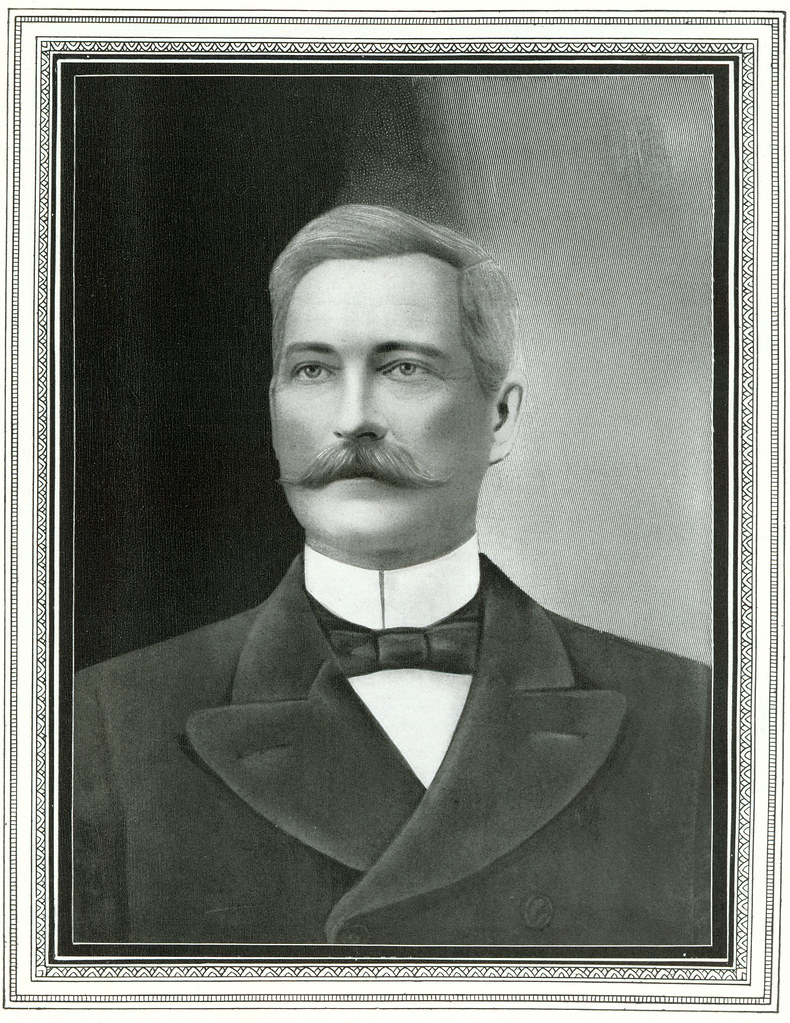
Patrick Largey, Butte’s fourth Copper King, was president of the State Savings Bank, located on the site of the present Metals Bank Building. In January of 1898 miner Thomas Riley gunned Largey down as he sat at his desk. The shooting took place nearly three years to the day after the great powder explosion in the warehouses of the Kenyon Connell and Butte Hardware companies. Illegally stored dynamite caused the blast that killed at least fifty-nine and injured one hundred others. Riley lost a leg in the blast and held Largey personally responsible. Though Largey owned stock in the hardware business, he had no part in the disaster. But Riley, who could no longer work, demanded compensation. Largey and Riley had several violent quarrels, and the last culminated in Largey’s murder.

Portrait of Patrick Largey from A Brief History of Butte, Montana, The World's Greatest Mining Camp
Via the Butte-Silver Bow Public Library's Flickr photostream

Charged, convicted, and sentenced to life in prison, Riley went to the federal prison at Deer Lodge in 1898. He kept his union membership in Local No. 1. In 1910, 170 members signed a petition asking the governor and the Board of Pardons to review Riley’s case. But the influential Largey family made sure that nothing came of it. Riley wrote letters to friends, lawyers, priests, and legislators to no avail. Nearly forty years later, Governor Roy Ayers met Riley during a prison inspection. He found no bitterness left in him and granted seventy-year-old Riley a full pardon. Riley left Deer Lodge in 1937. He died in 1938 after little more than a year of freedom.

From Montana Moments: History on the Go
P.S. Remember what happened when a couple of prisoners tried to escape from the Deer Lodge prison?

Monday, January 7, 2013

Butte Explosion

Butte has had its share of mining disasters and mourned its share of fallen heroes. But no disaster precipitated more fire protection improvements than an explosion that occurred on January 15, 1895. Butte firemen answered a fire call in the South Butte warehouse of the Royal Milling Company. The firemen did not know that tons of blasting powder had been illegally stored in the nearby Kenyon-Connell Commercial Company and Butte Hardware Company warehouses. Flames reached the powder, and the first terrific explosion blew the metal roof of the Kenyon-Connell building one hundred feet in the air, hurling bystanders and nearly the entire Butte fire department to their deaths.

A page from Souvenir History of the Butte Fire Department
As passersby rushed to aid victims, two more blasts turned iron bars and metal pipes stored in the warehouse into deadly missiles that found targets as distant as a mile from the explosions. Searing oil rained down on the crowd. Sidewalks throughout Butte all the way to Walkerville glistened with broken glass from shattered windows. Authorities counted at least fifty-nine dead and more than one hundred injured, but Butte’s transient population and the complete annihilation of some victims suggested the toll was much higher. Only the Speculator Mine disaster in 1917 eclipsed this horrendous calamity.


Update: Richard Gibson tells the stories of two firefighters who survived the explosion on his blog, Butte History.

Friday, January 4, 2013

Friday Photo: Was Henry Plummer Innocent?

Recently, I got to chat with radio host Aaron Flint about Henry Plummer and the vigilantes, Custer's dogs, Langford Peel's tombstone, and lots of other wonderful tidbits from Montana history. Here's a link to Voices of Montana where you can hear the whole conversation.

E.C. Schoettner, photographer, Montana Historical Society Photograph Archives.
We'll probably never have absolute proof of Henry Plummer's guilt or innocence. But while you listen to the show and ponder the evidence, here's a photo of his grave. Plummer was buried in Hangman's Gulch within sight of Bannack.

Wednesday, January 2, 2013

Wassweiler Hot Springs

Montana has a number of hot springs that gained popularity for recreational and therapeutic use during the nineteenth and early twentieth centuries. Ferdinand and Caroline Wassweiler operated one of the first near Ten Mile Creek just west of Helena. Their first hotel and bathhouse opened in 1865. The soothing mineral water offered local miners a relaxing day off from the dusty diggings in Last Chance Gulch.

Montana Historical Society Photograph Archives, 951-609
In 1869, the Wassweilers gained title to the land and two hot water springs. But short of funds in 1874, they sold their hotel and water rights to Colonel Charles Broadwater. Broadwater then ran the Wassweilers’ hotel until 1889 when his grand Broadwater Hotel and Natatorium opened on the property a short distance away. All traces of his first hotel have since vanished, but Wassweiler kept eighty acres and built a second hotel on that same site in 1883. The little complex survives out on U.S. Highway 12 west of town. The hotel features seven exterior doors accessing the separate guest rooms. A stone building a few steps behind served as the bathhouse. Wooden tubs outfitted each of its four individual compartments. Local legend has it that when the famed Broadwater Hotel opened, the Wassweilers lost business. So Wassweiler converted his bathhouse to cribs and imported ladies to entertain miners. The Wassweilers’ hotel and bathhouse, in its second life, operated until 1904. These are the only hot springs hotel structures left in the Helena area.

From Montana Moments: History on the Go