Monday, December 31, 2012

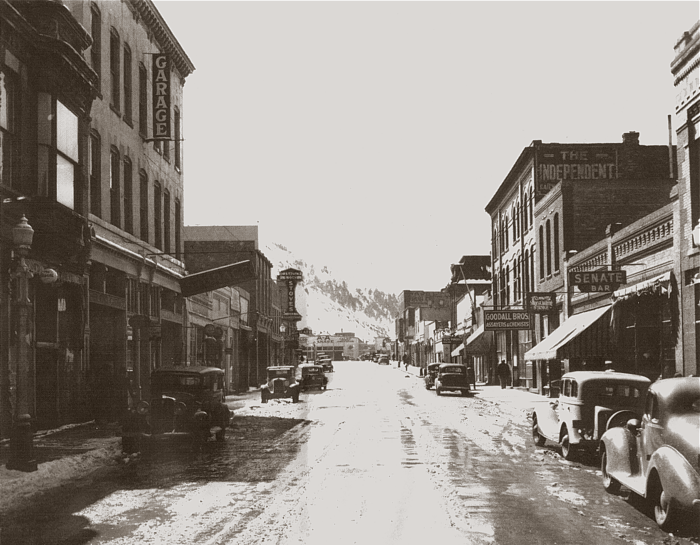
Shopping the Gulch on New Year’s Day 1894

On New Year’s Day in 1894, the Helena Independent advertised numerous sales, activities, and special deals. For three dollars, you could buy a year’s subscription to the Weekly Independent and receive a free leather-bound 800-page cookbook. August Fack advertised that you could visit his California Wine House and enjoy his brand-new art acquisitions just in from Germany. The New York Store offered a variety of dress fabric reduced from a dollar a yard to 75 cents.

In 1894, the New York Store was located on Main Street in the three-story building on the right. When this photo was taken in the 1930s, that building housed the Independent newspaper.
Photo from the Wes and Carol Synness collection via Helena As She Was.
At the railway agent’s office, $100 could buy you a roundtrip, two-week vacation to Hot Springs, Arkansas, including train fare, all meals, and choice of hotels. If you dropped in the City Drug Store, you could find Gypsy Queen Hair Grower or Hockio’s Turkish Myrrh for the teeth.  Shopping the gulch in the 1890s was never complete without a stop at Hepperdiezel’s in the Novelty Block at 13 South Main Street.
 
Hepperdiezal’s was located in the Novelty Block during the 1890s and early 1900s. The building, shown here in 1970,  was a victim of Urban Renewal.
Montana Historical Society Photograph Archives, 953-209
According to Belle Fligelman Winestine, “you could smell this delicious butter and sugar smell as you came up the Gulch, a half a block away.” Mrs. Hepperdiezal stayed behind the counter in her crinkly clean starched pink and white striped shirtwaist and white collar selling less expensive taffy and butterscotch. Mr. Hepperdiezel was in charge of the more expensive candies, which the customer chose one by one to be carefully packed in elegant satin boxes. Three steps spanned the back of the store and led to a second level. Lanes of artificial palm trees and a fountain decorated the parlor area where patrons sat at marble-topped tables. Hepperdiezel’s ice cream sodas, at two for 24 cents, were the perfect end to a long day of shopping.  

Friday, December 28, 2012

Friday Photo: Crow Indian Winter Camp

Happy Friday! We got a dusting of fresh snow for Christmas in Helena. It was almost as picturesque as the scene in this stereograph.

Montana Historical Society Photograph Archives, ST 002.101

Henry Bird Calfee, a photographer from Bozeman, snapped this photo of a Crow Indian Camp circa 1874-1881 in the Yellowstone River Valley.

Tuesday, December 25, 2012

Merry Christmas!

I hope you woke up to a full stocking this morning. Merry Christmas!

Montana Historical Society Photograph Archives
The Orr children of Dillon, Montana, hung their stockings and waited for Santa in this c. 1928 photo.
P.S. Dillon was at the center of a stocking controversy in the 1920s.

Monday, December 24, 2012

Anaconda Copper Mining Company’s Benevolence

The Anaconda Copper Mining Company controlled much of Montana in the first half of the twentieth century, and many compared its grip to a giant snake coiled around the state.

"In the coils of the Anaconda," Butte Daily Bulletin, October 2, 1920
The company tried to soften that negativity by doing good works, especially at Christmastime. The three hundred children at the state orphanage at Twin Bridges especially benefited from the company’s public generosity. In 1934, at the height of the Great Depression, the company carried out what the Anaconda Standard termed its “annual task of love.” Children at the orphanage were asked to submit a first and second request from Santa Claus, and the list then went to the Anaconda Company offices in Butte. Secretarial staff then did the shopping, choosing gifts according to the list. Among the gifts in 1934 were sheepskin coats, doll buggies, pleated hip skirts, skates, tinker toys, Tarzan books, phonographs, sleds, leatherette helmets, wrist watches, Brownie cameras, and bamboo fishing outfits. Staff individually wrapped each gift and decorated it with ribbons, tinsel, and ornaments, topping the finished package with a Christmas card bearing the child’s name and cottage number. The children lived in cottages on the property and each cottage had its own individual tree. Late on Christmas Eve, the gifts, along with a generous supply of candy and nuts, were placed beneath the trees in their respective cottages. The Anaconda Company extended equal benevolence to the children at the State Tuberculosis Sanitarium at Galen and the crippled children of Butte. At least on Christmas morning, the coiled snake of the Anaconda Copper Mining Company directed its grip to a truly needy population and used its wealth to do something good.

Friday, December 21, 2012

Miles City Christmas 1884

Miles City, Montana, looked forward to the holidays in 1884. On Christmas Eve, the Daily Yellowstone Journal instructed its readers to “Get the hinges of your jaws ready to warble “Merry Christmas” to friends and neighbors. And be sure,” said the Journal, “to clear your chimneys for the descent of Kris Kringle.” But not entirely in the Christmas spirit, the Journal recorded the final percentile grades of public school students, certainly embarrassing several like George Busch of the senior class who earned a 40, Kate Cupples who earned a 56, and others. Now that’s a gift for a parent—to have your child’s ill achievement published in the newspaper, and on Christmas Eve.

From Chronicling America, Library of Congress
On a more festive note, the Journal advertised the perfect Christmas present: The Missouri Steam Washer. No home, said the Journal, is complete without it. Patented in 1883, the advertisement claimed that the contraption was so simple to use that a ten-year-old could do the family wash in an hour. Wouldn’t the kids love that present! Or you could buy a buffalo coat for $15, or pantaloons for $1.50. And the Journal had some advice on sizing up the roasted Christmas turkey: “Don’t look in its mouth as if it were an old horse with a tooth ache,” said the Journal. “Just gently dislocate its wings. If it’s old and tough, you’ll have to tug pretty hard on the flappers.” When it comes to dessert, said the Journal, there will be no poison in your pastry if you use Dr. Price’s pure extract of vanilla. So shake the snow out of the Christmas tree and unhinge your jaws for Christmas dinner.
Wednesday, December 19, 2012

100 Christmases

Mary McGinnis of Butte celebrated her 100th Christmas in 1934. Andrew Jackson was president when she was born in 1834, and she was married in New York before the Civil War began. Her husband left for the gold fields of California, promising to send for her if things worked out. He did send for her in 1861, and that Christmas is the one of all the one hundred that she always remembered. That Christmas Day in 1861 found Mrs. McGinnis aboard a schooner off the coast of Central America bound for San Francisco, not far from where the Panama Canal today joins the two oceans. But there was no such shortcut back then, and ships had to go all the way around the horn of South America to reach California.

An advertisement for passage on a ship like the one on which Mary McGinnis sailed
Mrs. McGinnis recalled that Christmas morning on the ship, crowded with miners bound to try their luck in California. The Christmas spirit was strong among that motley group. A storm raged off the coast and waves dashed against the sides of the ship, yet the group paused for a short service to commemorate the meaning of the holiday. The vessel creaked and lurched, and a hush fell over the rough miners and assorted passengers and crew. “I could never forget it,” said Mrs. McGinnis, “if I lived another hundred years.” In due time the ship arrived at San Francisco, and Mrs. McGinnis was reunited with her husband.  She later lived in most of the major gold camps in the West and came to Butte to live with a daughter after her husband died. She outlived her daughter and most of her family, and cherished their memories, but that one Christmas aboard the ship was to her the most memorable.

Monday, December 17, 2012

Ice Skating in Butte

Butte celebrated the long-anticipated formal opening of the Pavilion Ice Rink, the largest and finest rink west of Chicago, late in 1884. The amphitheater was located on Alaska Street, one block east of the Butte Silver Bow County Courthouse, where the parking lot of the Butte-Silver Bow Archives is today. During the weeks leading up to the opening, the Daily Miner reported problems in freezing the rink because of the vast area of ice it required. The skating area was 9,000 square feet. A culvert supplying water for the ice ran beneath a cement floor. The ice was formed in thin layers of fine spray to a final depth of six inches. The process was labor intensive, and thus the opening was postponed throughout December as managers worked to build up the layers of ice. Finally, a pre-opening Grand Masquerade on December 20 attracted skaters from Anaconda and Deer Lodge. The Northern Pacific offered special rates and reserved seats at no extra charge for those out-of-towners attending the gala. The event featured floral arrangements from San Francisco, a flowing bronze fountain from Chicago that cost $600, special effects from new electric lighting, a newly uniformed brass band, a completely dust-free environment, and four hundred pairs of the celebrated New York Club skates for rent. There was also an experienced bouncer to make certain no bad characters gained admittance. After the preview on December 20, the rink opened to the public on Christmas Day, and on New Year’s Eve, professional skaters from back East promised the best entertainment ever produced on ice. The rink, however, proved too difficult to maintain, and soon it was no more.

May your holidays be as festive as those celebrations.

Postcard courtesy Nancy Oram


Friday, December 14, 2012

Friday Photo: Christmas Tree

Now that you know the stories of Montana's first two national Christmas trees (here and here), have a look at this photo of a less spectacular (but no less heartwarming) Christmas tree.

Montana Historical Society Photograph Archives, 945-214
Maurice Hain decked this one out and posed beside it in 1936. Have you put up a tree yet?

P.S. I'll be talking and signing books this morning at 11:30 at the Montana Historical Society. Hope to see you there!

Wednesday, December 12, 2012

Montana's Second National Christmas Tree

Montana has three times contributed the nation’s official Christmas tree, in 1958, 1989, and most recently in 2008. The second time, 1989, was the year Montana celebrated its statehood centennial. That year the national Christmas tree came from the Kootenai National Forest in Lincoln County. In October of 1989, the Capitol Christmas Tree Committee advertised for a woodcutter to cut the chosen tree. The committee was looking for a person with community involvement who knew how to use a chain saw. They found their man in Bill Crismore, president of the Montana Logging Association, who was a Libby resident active in the community. On Saturday November 18, a crowd gathered to see the giant Engelmann Spruce felled. But as Crismore’s chainsaw did its work, the tree had a mind of its own and fell the wrong way, narrowly missing 300 spectators. Attached cables diverted its path, and the tree fell across a truck instead of into the road. Efforts to move it caused its upper trunk to snap, and the tree could not be used.

Bozeman Daily Chronicle, November 19, 1989
Clipping from the Montana Historical Society Research Center vertical file
Fortunately, there was another choice that had actually been the favorite in the first place. The 43-year-old, 67-foot Engelmann Spruce was soon felled and on its way to Washington, D.C. The limbs of the broken tree were cut and sent along with the new tree for use in case its branches were broken in transit. Crismore later said ruefully that had he known so many people would be present, he would have chosen the second tree anyhow. People milling around and children running in and out impeded his work and made the felling more dangerous and difficult to calculate.

Preparing the tree for its trip to DC. Western News, November 1989
Clipping from the Montana Historical Society Research Center vertical file

Monday, December 10, 2012

Montana’s First National Christmas Tree

Montana has donated the national Christmas tree displayed outside on the White House lawn three times:  in 1958, 1989, and 2008. The tradition of the national tree stretches back to President Calvin Coolidge. During his administration in 1923, the Society for Electrical Development conceived the idea of a national decorated tree to encourage electricity and electric lighting in holiday decorating.

The first national Christmas tree was lit on December 24, 1923.
Library of Congress Prints and Photographs Division, National Photo Company Collection, LC-F81- 28049
The national outdoor tree has since become the official symbol of the holiday season, but also symbolizes current events. For example, from 1942 to 1944 during World War II blackouts prevented lighting the tree; in 1980 the tree was only fully lit for 417 seconds, each second symbolized each day hostages had been in captivity in Iran; in 1985, lights were dimmed on Christmas Eve in observance of American hostages in Lebanon, and in 2001 families of victims of 9/11 participated in the lighting of the tree. The trees have come from across the nation. Sometimes they have been cut trees, and sometimes living trees that were later planted. In 1958, Montana got its first turn to supply the national tree. The Libby Chamber of Commerce presented President Dwight Eisenhower with an Engelmann Spruce cut in the Kootenai National Forest. The tree was 99 feet tall, but cut 24 feet up its base to make a 75-foot tree. The tree, weighing some 5,000 pounds, rested on two flatbed rail cars with its branches wrapped and cradled for the 2,490-mile journey from Libby to Washington, D.C. President Eisenhower tripped the electric switch on December 24. Today, trees are lit early in December to allow a longer holiday season.

Friday, December 7, 2012

Friday Photo: Healthful Holiday

Will you be cooking a Christmas feast like this one that Rose Drew Paulley hosted in Lavina in 1938?

Montana Historical Society Photograph Archives
We tend to overindulge during these special times of year, and we pay for those extra pounds in the New Year. But it's not a modern problem, as an article from 1881 goes to show...

In 1881, Montana newspapers ran an article cautioning holiday hostesses to think carefully about the health of their guests. "Friends," said the article, "those of you who expect to treat your children to a holiday feast, let us give you a hint. Why are all our holidays filled with unreasonable feasting? Overeating at Thanksgiving, Christmas, and New Year’s causes sickness, and doctors always expect to be busy at this time of year. Instead of loading the table with certain foods that injure the digestive system and work mischief in every part of one’s vital organs, wouldn’t it be better to put more healthful foods on the table? How can certain foods be pronounced unwholesome and bad for you, but at those special times of the year considered good and desirable? Women control the meals in their households and could greatly reform the world if they heeded this advice and put wholesome food that does not stimulate the palate into gluttony on their tables." The article went on to point out that there are other ways people get sick during the holidays besides overindulging. Keeping late hours then sleeping late, compressing the stomach in tight clothing, wearing thin shoes, neglecting to bathe to keep the pores open, exchanging warm daytime clothing for evening attire, eating at irregular times, fretting over unimportant issues and taking quack medicines for imaginary maladies all compound the misery of holiday ill health. Back in 1881, these things were all of concern. Things haven’t changed very much, have they?

P.S. Remember this 1893 recipe for duck?

Wednesday, December 5, 2012

Montana Trolleys

More than 80,000 trolleys once clanged over 45,000 miles of track in cities across the United States. Between 1888 and 1890, there were twenty-seven attempts to establish street railway service in nine Montana cities, but credit goes to Billings for establishing the first operational system. Two bright yellow horse-drawn cars ferried passengers in 1883. Business boomed temporarily when railway promoters offered twenty-five cent tickets and coupons for free beer at a local brewery. But the company soon went out of business. Its two wayward horses refused to keep to a schedule. Reliable service in Montana began in Helena on September 25, 1886. Hundreds watched in awe as the Helena Street Railway Company’s two horse-drawn Pullman cars made their maiden trips to the depot on newly laid iron rails. Soon, steam engines pulled some of the cars, but residents complained about the noisy, dirty coal-burning engines. Dust from the smoke settled in homes and the commotion frightened horse traffic. By the early 1890s, an assortment of trolleys operating on steam, horsepower, and the new electric system operated in Montana cities.
 
Horse-drawn trolleys like this newly-refurbished gem on Helena’s south Walking Mall once ferried passengers to the depot. Photo courtesy of Dean Rognrud.

Montana first licensed automobiles in 1913. This, World War I, postwar inflation, and changing travel patterns took their toll. The Billings Traction Company folded in 1917. Bozeman’s system closed because of complaints that trolleys pushed aside snow, interfering with automobiles. Helena’s last car entered the barn at midnight on New Year’s Day in 1928; bus service began a few hours later. The Rainbow Hotel in Great Falls hosted a funeral in December 1931 for its trolleys. Guests filed past a battered streetcar and sang specially composed songs conceding that the trolleys "ain't gonna run no more." Missoula’s streetcar service ended in 1932, Butte’s in 1937, and Montana’s last trolley bell clanged in 1951 with a final run between Anaconda’s smelter and the town of Opportunity.

Monday, December 3, 2012

Wreck of the Bertrand

John J. Roe of St. Louis founded the Idaho and Montana Transportation Line and the Diamond R Transportation Company in 1864. The company carried everything imaginable by steamboat up the Missouri River from St. Louis to Ft. Benton. Its ox-drawn freighters then carried the goods to the various destinations. The treacherous steamboat voyage took two months. The steamer Bertrand left St. Louis in the early spring of 1865 carrying an astonishing inventory bound for Fort Benton, including 6,000 kegs of nails, mining equipment, and food and clothing. The goods were to be delivered to Virginia City, Deer Lodge, and Hell Gate (present day Missoula). On April 1, the boat hit a snag twenty miles north of Omaha and sank. All passengers and crew escaped, but the inventory—fortunately insured—was lost. In 1968, the wreck was rediscovered and the goods, preserved for a century in the river’s silt, were recovered. The cargo is a microcosm of frontier life. Among the recovered items are powdered lemonade; canned pineapple; brandied cherries; imported olives; salted and dried beef, mutton, and pork; jars of French mustard, catsup, and honey; clocks and combs; lamps and mirrors; patent medicines with their paper labels intact; 3,000 textiles including bolts of silk and 137 men’s coats in 7 different styles; shoes and boots; barrels of whiskey; hammers, doorknobs, pick axes, and blasting powder; washboards; plows; and sleigh bells. It’s hard to imagine some of these luxury items for sale in primitive log cabins. The DeSoto National Wildlife Refuge in Iowa includes a museum displaying some of the artifacts recovered from the Bertrand.


Artifacts recovered from the steamboat Bertrand, displayed in the visitor center at DeSoto National Wildlife Refuge