 |
| Montana Historical Society Photograph Archives, PAc 93-25 A3 214 |
Friday, June 29, 2012
Friday Photo: Glacier National Park Tour Bus
Did you hear? The Going-to-the-Sun Road is open, and the forecast for the park is calling for sixties and seventies all weekend. Wouldn't you love to take a tour?
The Blackfeet inducted western artist E. W. Deming into the tribe and named him Eight Bears for his family of eight. In this photo, the Demings pose in a tour bus circa 1914 with their Blackfeet driver, Lazy Boy, at the wheel.

Wednesday, June 27, 2012
Arline Allen’s Embarrassing Innuendo
 Yesterday I got a treat. My publisher gave me a handful of copies of my new book, More Montana Moments, fresh from the printer! You won't find it in most stores for another month or so, but the Montana Historical Society Museum Store does have copies available. Here's one of my favorite excerpts:
The Allen family long operated one of Helena’s most popular livery stables, the Allen Livery at Ewing and Breckenridge. The former stable has a long and colorful history and is Helena’s best-preserved reminder of this vital business. Its many “ghost signs” are also remarkably preserved. By 1867, William H. Allen established the business on his rich mining claim where he picked gold nuggets out of the dirt. Allen’s nephew, Joseph Allen, soon arrived to help out and eventually took over the business. Joseph built the current stone and brick stable around 1885. Contrary to popular belief, the upstairs never in its long history housed prostitution. Rather lodging rooms accommodated the livery’s hostlers and stablemen. Joseph Allen and his wife Lurlie had a daughter, Arline, who grew up around her father’s horses. She and her friends never learned to ride sidesaddle, but rode astride and wore divided riding skirts like other Montana women. Arline and her friends followed the trails all over the hills and had many adventures. But in 1912 when Arline was sixteen, both her mother and father died. Arline went to live with her grandmother in Virginia. She had a hard time because girls there never rode astride, but only sidesaddle. She found horseback riding and ice skating in long full skirts terribly confining and longed to put on her Montana divided riding skirt. Shocked, her grandmother would not allow it. On her first ice skating date in Virginia, Arline said to the young man, “If I could just take this skirt off, I could really show you something!” Arline spent the rest of her life trying to live that one down.
P.S. Remember the scandal caused by this divided riding skirt?
Monday, June 25, 2012
First Missoula Cemetery
In the summer of 1974, a Missoula homeowner was adding a porch to his house on Cherry Street when he got a big surprise. The backhoe digging the foundation unearthed something that should not have been there: human bones. The coroner confirmed the discovery of two sets of bones encased in the decayed wood of old-fashioned coffins. Authorities determined that no foul play was involved. These were simply historic burials, the individuals placed in the ground by loved ones hoping for their eternal rest. The pieces of metal hardware, splintered wood, and bone fragments were collected in a box that today sits on a shelf in a University of Montana laboratory. The bones serve as teaching tools for anthropology students. Those who have studied the contents of the box have solved some of the mystery. Historic maps of Missoula and newspaper clippings show that Missoula’s first cemetery was located in the area in 1865. It fell into disuse with the opening of the current city cemetery in 1884, and the last burial there occurred in 1895. When the land was subdivided in the 1940s, traces of the old cemetery disappeared, but, according to city records, most burials were not removed. This is not particularly uncommon. Other Montana communities have subdivisions located on historic burial grounds. Helena’s Robinson Park and its adjacent residential streets, built over the town’s first Catholic cemetery, is one example. But to whom did the two sets of bones belong? Students determined long ago that one was a child and the other a female adult. Coffin hardware fragments were consistent with nineteenth-century caskets styles. But whose eternal sleep was so rudely interrupted? That is a part of the mystery that will probably never be solved.
Friday, June 22, 2012
Friday Photo: Libby Logger Days
Libby Logger Days started yesterday and runs through the weekend. Are you going?
Competitors put muscle into the cross-cut saw (also known as the misery whip) at Libby Logger Days. Photo by Bill Browning. Date unknown.
 |
| Montana Historical Society Photograph Archives, PAc 2002-62 E1B-10890 |
Wednesday, June 20, 2012
Pictograph Cave Cannibals
English professor H. Melville Sayre of the Montana School of Mines at Butte led the first archaeological excavations at Pictograph Cave, a National Historic Landmark, near Billings. Under foreman Oscar T. Lewis, a Glendive rancher and self-taught archaeologist, the dig was funded by the Depression-era New Deal Works Progress Administration of the 1930s. It put numerous crew members to work. According to locals who frequented the excavation site as visitors in 1937 and 1938, both Sayre and Lewis told fantastic tales. They claimed to have found evidence that Ice Age occupants practiced cannibalism. They backed up their story with the supposed discovery of human teeth, a human skull with knife marks consistent with removal of the tongue, and butchered human rib bones bearing human teeth marks. While Sayre’s formal report to Governor Roy Ayers is considerably less flamboyant, he does mention that some items yielded evidence consistent with cannibalistic activity. Lewis further speculates in his notes that notched bone projectile points found in the caves came from Inuits in the Arctic. He figured that the Inuits harpooned buffalo that did not die, but migrated south where they were eventually killed by the early inhabitants of the Yellowstone Valley. Writer Glendolin Damon Wagner, who wrote about evidence of cannibalism among other indigenous peoples, painted a vivid picture of the finds in Pictograph Cave in the Rocky Mountain Husbandman of May 3, 1938. But when professional archaeologist Dr. William Mulloy took over the Pictograph Cave excavations in 1941, these tales died a swift death. If evidence of cannibalism existed, it has been lost along with many of the artifacts discovered under Lewis and Sayre. Most scientists discount cannibalism among Montana’s first peoples as nothing more than bunk.
Archaeologists Gus Helbronner (left) and Wahle Phelan during excavation of Pictograph Cave, c. 1937
Click the photo for a bigger version.
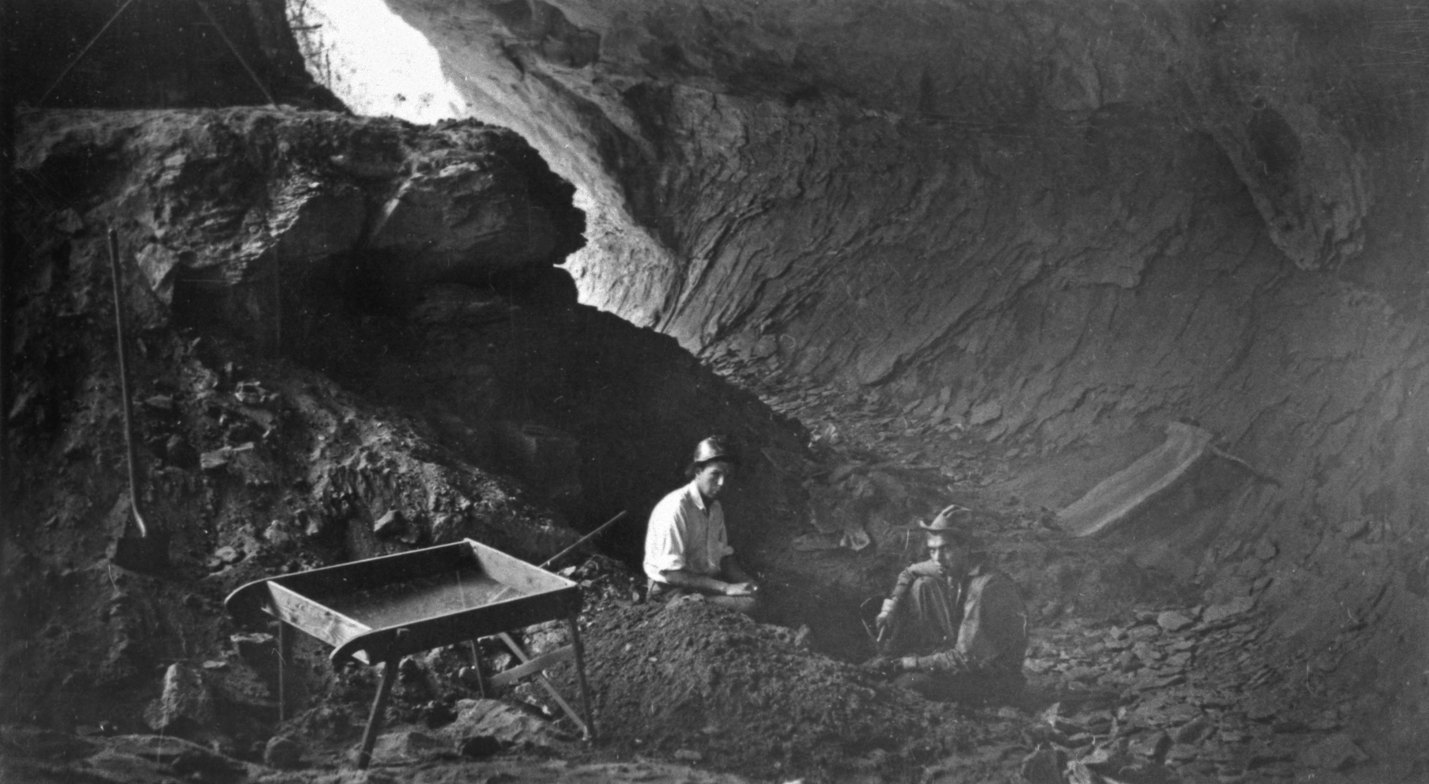 |
| Bill Browne, photographer, Montana Historical Society Photograph Archives, PAc 90-96 P3 #18 |
Monday, June 18, 2012
Crow Agency Archaeology
Archeological investigations have recently exposed the foundations of the second Crow agency in the Stillwater Valley near Absarokee. A full-scale excavation, conducted by Aaberg Cultural Resources, came about as preliminary to the Montana Department of Transportation’s planned widening of a three-mile stretch of Highway 78. Testing for archaeological sites is required for projects that disturb the right-of-way. The highway bisected the suspected location of the agency that existed there between 1875 and 1884. The agency is historically important because it encompasses a difficult period in Crow history. Not only were the Crows struggling to transition from hunting to farming during this decade, the tribe also suffered from epidemics of measles and scarlet fever. Preliminary test pits of the area yielded enough artifacts to warrant further investigation. In 2006 Aaberg surveyed the site with a magnetometer. This instrument reveals solid objects underground and translates them to a computer generated map. Comparing his findings with an 1878 map of the agency, Aaberg determined that the rectangular compound exactly lined up with scattered anomalies the magnetometer revealed. This exciting discovery led to the excavations in the summer of 2011. Crews uncovered portions of the foundations of the compound that included the agent’s, clerk’s, and doctor’s offices. A layer of charcoal and ash substantiates the fact that the site was burned upon abandonment. Decorative beads, animal bones, broken bottles, and other artifacts, currently under analysis, will eventually be housed at the curation facility on the Little Big Horn College campus in Crow Agency. Study of these artifacts and the tragic story they tell will help write this chapter of Montana’s past.
 |
| Archaeologist Steve Aaberg sites the location of the next unit to be dug, while field crew members excavate a unit believed to be the agency doctor's office. |
 |
| Staff members from the State Historic Preservation Office work with the field crew to screen for artifacts. Both photos from the Montana Historical Society's Facebook page |
Friday, June 15, 2012
Friday Photo: Bikes
What are you up to this weekend? Biking, perhaps?
Crow School boys and girls show off their bikes at Crow Agency in 1896. Left to right: Unidentified, Unidentified, Russell White Bear, Henry Shin Bone, Annie Wesley, Addie Bear in the Middle, Fanny Butterfly, Kitty Deer Nose. Photographer unknown. Click the photo for a bigger version.
P.S. Remember these intrepid cyclists?
 |
| Montana Historical Society Photograph Archives, 955-925 |
P.S. Remember these intrepid cyclists?
Wednesday, June 13, 2012
Homestead Horror!
A Plentywood rancher once told of a childhood experience that made a lasting impression. Before the Rural Electrification Administration brought electricity to many ranches in the late 1930s, the New Deal’s Agricultural Adjustment Administration helped Montana farmers by channeling some ten million dollars worth of contract money into the desperate economy. Some families who benefitted from this new money splurged on automobiles. This particular family was proud of their new car, and in the evenings they would go visiting. One warm spring evening as the family returned home after such a visit, they drove into the driveway. As they approached the dark house, the headlights flashed upon the attic window, and they saw a white figure moving back and forth in the light. As was the family custom, the children drew straws to see who had to go into the dark house first to light the kerosene lamp. The short straw fell to this youngster. He was terrified, but his father told him to get to it, and so he approached the house with weak knees. Instructed to discover what was in the window, the youngster slowly made his way up the stairs, taking the treads one by one. He thought he would faint he was so scared. Finally he got to the top stair, took a deep breath, and flung the door open. Relief flooded through him. During the cold winter months, his mother used the attic to hang the laundry, and hanging in the window was a forgotten pair of long johns swaying in the breeze.
Monday, June 11, 2012
Bill Stockton’s Chief Joseph
Bill Stockton was a sheepman and artist who returned to Montana after World War II to settle on his family ranch near Grass Range. Art and sheep seem an odd combination, but Stockton’s tender heart, love for his animals, and closeness to the land provided a lifetime of inspiration. His legacy includes writings, sketches, paintings, and sculpture. Stockton found the plight of Chief Joseph and the Nez Perces, who tried unsuccessfully to flee from the U.S. Army to sanctuary in Canada, extremely troubling. So in the 1950s he created a haunting metal sculpture known as Chief Joseph. It depicts a head with arms upraised in poignant recapitulation.

Stockton sent the piece to an art retailer in Billings. Thieves broke into the business and stole the sculpture and several other pieces of Stockton’s work.A year later, a young Indian man allegedly committed suicide by jumping off a bridge into the Yellowstone River. As Yellowstone County officials dragged the river looking for him, they not only recovered the young man’s body, but they also discovered Stockton’s sculpture of Chief Joseph. It had been in the river for a year. It was as if the spirit of the young man aided in the recovery of the artwork. The sculpture later was entered in the Great Falls Russell Art Show and Auction where journalist Kay Hansen saw it. She knew she had to have the piece. With only nine dollars in her pocket, Hansen bid and acquired the sculpture, paying for it in monthly installments. She has recently donated it to the Montana Historical Society. It is one of Stockton’s most important creations.
Friday, June 8, 2012
Friday Photo: One-Room Schoolhouse
For the students and teachers who are finishing up the school year...
The five students of Marsh in Prairie County, Montana, posed with their teacher on January 20, 1914. The photo was taken by Evelyn Cameron.
P.S. Remember the drama at Paris Gibson Junior High?
 |
| Montana Historical Society Photograph Archives, PAc 90-87.63-3 |
The five students of Marsh in Prairie County, Montana, posed with their teacher on January 20, 1914. The photo was taken by Evelyn Cameron.
P.S. Remember the drama at Paris Gibson Junior High?
Wednesday, June 6, 2012
Carrie Nation
In 1910, the hatchet-wielding, bar-smashing temperance crusader Carrie Nation came to Butte. At that time Butte had 275 saloons; even Mayor Charles Nevin owned a bar. Booze joints in nearby Anaconda sported signs that read, “All Nations welcome except Carrie,” while reformers welcomed her with open arms. Onlookers cheered as the stout sixty-three-year-old Mrs. Nation, with a flourish and a crowd in tow, charged down the length of Butte’s notorious Pleasant Alley.
She had some difficulty communicating with the resident prostitutes because few of them spoke English. At the end of the alley back on Mercury Street, she burst into the Irish World, a well-known parlor house, and met her match in madam May Maloy. The two got into a scuffle, and Maloy booted Mrs. Nation out the door with a well-placed kick. She emerged with her bonnet askew, suffering from a wrenched elbow. It was a moment Maloy’s patrons savored, and they celebrated with drinks all around. Thus Carrie Nation made not so much as a single convert in Butte. In fact, Butte likes to claim that Maloy’s was the last saloon Carrie Nation ever set foot in. While that’s not exactly true, it may have marked a turning point in her career.
From Montana Moments: History on the Go
 |
| Carrie Nation flourishes her hatchet in this 1909 photo. Kansas State Historical Society, B Nation, Carrie *48 |
From Montana Moments: History on the Go
Monday, June 4, 2012
A Persistent Myth
Stories abound across the West about “Chinese tunnels” beneath the buildings and streets of cities and towns. According to Priscilla Wegars of the University of Idaho, a foremost authority on Asian culture in the West, there is overwhelming evidence that “Chinese tunnels” are nothing more than myths. Not a single “Chinese tunnel” has ever been identified. While it is true that Chinese businesses, opium dens, and even living quarters are sometimes found in basement spaces, these in no way can be called “tunnels.” The Chinese were often targets of discrimination, but they did not live underground because of persecution as many believe. Basements were simply cheaper to rent than rooms above ground. Further, the basements of nineteenth- and early-twentieth-century business blocks frequently had arched doorways leading to sidewalk vaults. These were storage or delivery areas. Lit by glass blocks turned purple with age, these mysterious vaults had nothing to do with the Chinese. Tunnel systems beneath downtown areas in Helena, Butte, Missoula, Bozeman, and elsewhere do exist; they served as steam-heat delivery systems. While sometimes steam tunnels served clandestine purposes, particularly for alcohol delivery during Prohibition, these passageways cannot be termed “Chinese tunnels.” Finally, in all settlements where mining was extensive, hand-dug tunnels often remain beneath residential neighborhoods and downtown business areas. Miners of all ethnic groups dug tunnels, and there is nothing that makes a tunnel exclusively Chinese.
From Montana Moments: History on the Go
P.S. Remember this remnant of Chinese culture found in Big Timber?
From Montana Moments: History on the Go
P.S. Remember this remnant of Chinese culture found in Big Timber?
Friday, June 1, 2012
Friday Photo: Copper Commando
Anaconda worker Gus Sbragia selects a gear pattern from the forty thousand stored in four stories of the Pattern Shop at the Foundry Department of the Anaconda Copper Mining Company. The photo appeared in the October 23, 1942, Copper Commando, a tabloid-format newspaper intended to spur production of Montana metals during World War II. Pattern-makers created models that engineers used to manufacture and repair equipment for the company's mining, smelting, and refining operations.
P.S. Find more Copper Commando photos at the Montana Memory Project.
 |
| Montana Historical Society Photograph Archives, Robert I. Nesmith collection |
P.S. Find more Copper Commando photos at the Montana Memory Project.
Subscribe to:
Posts (Atom)