The forecast is calling for a good chance of snow through the weekend. Are you going sledding?
Sledding in frontier Montana was a lively sport enjoyed by boys and men wherever there was snow and a hill. They built sleds in all shapes and sizes, painted them in bright colors, and gave them fanciful names. But Mary Ronan in her reminiscence, Girl from the Gulches, recalls a very memorable adventure she had on Christmas Eve 1864 on a vehicle that was entirely makeshift. Sledding was a sport absolutely forbidden to girls. Even on discreet sidestreets, it was not regarded as a ladylike activity since long skirts and petticoats and coasting downhill didn’t mix. An accident, upending a young lady, could ruin her reputation forever. On this memorable Christmas Eve, Mary and her friends brought evergreens to the Catholic church that stood on Catholic Hill, where the Tower Hill Apartments on South Ewing Street are today. The sun was about to set when the young people were finished decorating. They came out into the frosty air. Charlie Curtis took hold of one of the branches of a large fir tree they had cut. He invited Mary to step aboard and to coast down Broadway. Without a moment’s hesitation, she stepped on one of the thick branches. A young man on each side took her hand to steady her. Charlie pulled the tree into the street, hopped on, pushed off and away they went with Mary and Charlie hanging onto the sturdy branches. The cold wind rushed past as they flew down the hill. For Mary, that forbidden ride was an exhilarating adventure she never forgot, and the best Christmas present ever.
Wednesday, November 30, 2011

Monday, November 28, 2011
Julian Anderson
Are you planning any holiday parties this year? Here's a recipe that Julian Anderson would have served to the rich and famous at the Montana Club.
Bowl of Egg Nogg
2 1/2 pounds fine pulverized sugar; 20 fresh eggs; have the yolks separated; beat as thin as water, and add the yolks of the eggs into the sugar and dissolve by stirring; 2 quarts of good brandy; 1 1/2 pints of Jamaica rum; 2 gallons of good rich milk. Mix the ingredients well with a ladle, and stir continually while pouring in the milk, to prevent curdling; then beat the whites of the eggs to a stiff froth and put this on top of the mixture; then fill a glass with a ladle, put some pieces of the egg froth on top, grate a little nutmeg on top and serve.
Recipe from Golden Jubilee Edition: Recipes by the Master of Mixes as served by him at the Montana Club, Helena, Montana, for fifty continuous years, June 1893 to June 1943. The Montana Historical Society's research center has the original.

Julian Anderson was a beloved and special individual who gave many years of service to the far-famed Montana Club in Helena. There is no record of his birth in Hamburg, Germany. His parents moved there as household slaves of a Caroline County, Virginia, family. The family had fled the South at the beginning of the Civil War. Julian observed his birthday on September 23, since his mother told him that he was born at “fodder-pulling time.” After the Civil War, when Julian was six or seven, the Andersons returned to the United States. They moved west to Denver. Julian struck out on his own, learned the trades of baker and confectioner in Laramie, Wyoming, and came to Helena in 1887. He worked at the Merchant’s Hotel and then as night clerk at the brand-new Broadwater Hotel. In 1893 he began as bartender at the Montana Club. Julian was famous as the master of mixes. Even though he was a highly skilled drink master, he never took a drink himself. He served such world-famous figures as Prince Albert of Belgium, Prince Olaf of Norway, Mark Twain, Otis Skinner, William Jennings Bryan, artist Charlie Russell, and all the Copper Kings. He even heard Teddy Roosevelt say “dee-lighted” in person. He hardly missed pouring a drink when the club burned down, despite the fact that his own son Harry caused the tragedy. In 1938, members celebrated Julian’s forty-fifth anniversary with the club, signing a tribute to him that read: “To Julian Anderson who never forgets us, is always constant, pleasant and competent. In sincere appreciation of his forty-five years with the Montana Club.” Julian retired in 1953 after sixty years of serving club patrons. He died in 1961 at 102.
Bowl of Egg Nogg
2 1/2 pounds fine pulverized sugar; 20 fresh eggs; have the yolks separated; beat as thin as water, and add the yolks of the eggs into the sugar and dissolve by stirring; 2 quarts of good brandy; 1 1/2 pints of Jamaica rum; 2 gallons of good rich milk. Mix the ingredients well with a ladle, and stir continually while pouring in the milk, to prevent curdling; then beat the whites of the eggs to a stiff froth and put this on top of the mixture; then fill a glass with a ladle, put some pieces of the egg froth on top, grate a little nutmeg on top and serve.
Recipe from Golden Jubilee Edition: Recipes by the Master of Mixes as served by him at the Montana Club, Helena, Montana, for fifty continuous years, June 1893 to June 1943. The Montana Historical Society's research center has the original.
Photo from Golden Jubilee Edition: Recipes by the Master of Mixes
Julian Anderson was a beloved and special individual who gave many years of service to the far-famed Montana Club in Helena. There is no record of his birth in Hamburg, Germany. His parents moved there as household slaves of a Caroline County, Virginia, family. The family had fled the South at the beginning of the Civil War. Julian observed his birthday on September 23, since his mother told him that he was born at “fodder-pulling time.” After the Civil War, when Julian was six or seven, the Andersons returned to the United States. They moved west to Denver. Julian struck out on his own, learned the trades of baker and confectioner in Laramie, Wyoming, and came to Helena in 1887. He worked at the Merchant’s Hotel and then as night clerk at the brand-new Broadwater Hotel. In 1893 he began as bartender at the Montana Club. Julian was famous as the master of mixes. Even though he was a highly skilled drink master, he never took a drink himself. He served such world-famous figures as Prince Albert of Belgium, Prince Olaf of Norway, Mark Twain, Otis Skinner, William Jennings Bryan, artist Charlie Russell, and all the Copper Kings. He even heard Teddy Roosevelt say “dee-lighted” in person. He hardly missed pouring a drink when the club burned down, despite the fact that his own son Harry caused the tragedy. In 1938, members celebrated Julian’s forty-fifth anniversary with the club, signing a tribute to him that read: “To Julian Anderson who never forgets us, is always constant, pleasant and competent. In sincere appreciation of his forty-five years with the Montana Club.” Julian retired in 1953 after sixty years of serving club patrons. He died in 1961 at 102.
Friday, November 25, 2011
Friday Photo
Happy Friday, history buffs! Are you shopping today, or are you avoiding the stores?


Making a sale in the general store. Birney, Montana. Photo by Arthur Rothstein, June 1939.
Wednesday, November 23, 2011
Thanksgiving Turkeys
Earthquakes rocked the Helena valley in October of 1935, leaving four people dead, a community terrified, and widespread destruction in the aftermath. There was significant damage in the 6th Ward, especially at the National Biscuit Company, the Northern Pacific depot, and along Railroad and Helena Avenues.
One family on Boulder Avenue was buried under rubble when their house collapsed. The father dug himself out and rescued his injured wife and their two small children.
In the nearby commercial district that had grown to serve the Northern Pacific Railroad, many small businesses suffered, and one grocer lost more than just his building. For many years this grocer had specialized in fresh turkeys he plucked and dressed himself. No one seemed to notice that the birds from this particular grocer never included gizzards. This is because he had a secret. His turkeys arrived via the Northern Pacific from an area that had once been extensively placer mined; the turkeys pecked around in the tailing piles. When he butchered the turkeys, he found that the stones collected in their gizzards were sometimes not just pebbles, but gold nuggets. The grocer kept his golden treasure in a huge jug he kept hidden in his basement. Over the years, his stash of nuggets had grown so that the jug was almost full. When the earthquake struck, his building collapsed in on itself, forever burying the jug full of golden nuggets. Neighbor kids talked about the 6th Ward’s buried treasure for years, and it became legendary. That jug full of treasure remains buried somewhere in the commercial district to this day.
P.S. You can see more photos of the earthquake damage on the Helena As She Was site.
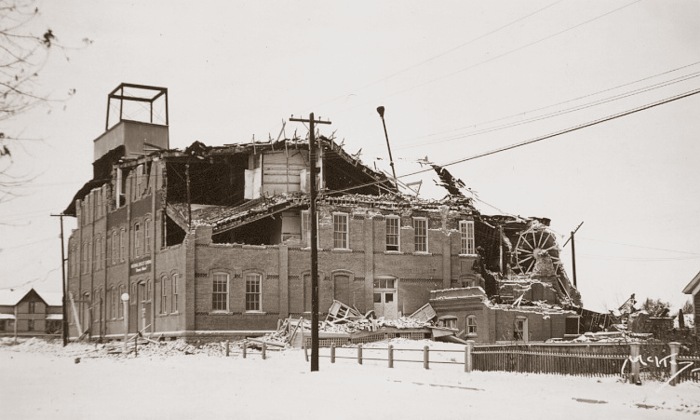 |
| East Side of the National Biscuit Co. Factory, Taken from Boulder Ave. Photo from Helena As She Was |
 |
| Charles Purdy and his wife and two small children were buried under the rubble of their house (at left). Photo from Helena As She Was |
In the nearby commercial district that had grown to serve the Northern Pacific Railroad, many small businesses suffered, and one grocer lost more than just his building. For many years this grocer had specialized in fresh turkeys he plucked and dressed himself. No one seemed to notice that the birds from this particular grocer never included gizzards. This is because he had a secret. His turkeys arrived via the Northern Pacific from an area that had once been extensively placer mined; the turkeys pecked around in the tailing piles. When he butchered the turkeys, he found that the stones collected in their gizzards were sometimes not just pebbles, but gold nuggets. The grocer kept his golden treasure in a huge jug he kept hidden in his basement. Over the years, his stash of nuggets had grown so that the jug was almost full. When the earthquake struck, his building collapsed in on itself, forever burying the jug full of golden nuggets. Neighbor kids talked about the 6th Ward’s buried treasure for years, and it became legendary. That jug full of treasure remains buried somewhere in the commercial district to this day.
P.S. You can see more photos of the earthquake damage on the Helena As She Was site.
Monday, November 21, 2011
Thanksgiving past and present
The first official observance of Thanksgiving after the creation of Montana Territory came in 1865. Although President Lincoln had established the last Thursday of November as Thanksgiving Day, following Lincoln’s assassination, President Johnson chose December 7th as the day of official observance. Residents of the mining camps paused in their relentless search for golden treasure and gave thanks for their good luck and for the end of the Civil War. In Virginia City, businesses closed. There were private celebrations and culinary preparations in many homes and restaurants. The Montana Post reported that sleighs were gliding merrily around town all day, men hobnobbed at the bars, and there was a singing party in the governor’s office. But in many a lonely cabin and isolated homestead, Thanksgiving was a time for memories of other days, loved ones far away, and serious reflection. The next year, 1866, at Last Chance, celebrations were more community oriented. Young ladies put on their pretties and attended the Firemen’s Ball on Thanksgiving Eve at the Young America Hall. Markets were well supplied for Thanksgiving Day feasts. Shoppers could choose elk, deer, bear, sage hens, grouse and pheasant. There was no mention of turkeys, however, at Thanksgiving tables on that particular holiday. In Virginia City, the day was unremarkable. There were no church services, no suspension of labor, and no formal public thanks. The Montana Post noted, “When the population of Montana becomes stable, another order will prevail, and Thanksgiving will be greeted with more ceremony.” But in private, families gathered at their tables as earnestly and faithfully as if they lived in the States.
Some things haven't changed, have they? Are you planning any new Thanksgiving traditions this year? I am. I'm cooking a goose in addition to the usual turkey.
Some things haven't changed, have they? Are you planning any new Thanksgiving traditions this year? I am. I'm cooking a goose in addition to the usual turkey.
Friday, November 18, 2011
Wilbur Fisk Sanders
Over the course of more than a century, many illustrious men—and women—have served Montana as legislators. Our current lawmakers follow in some very big footsteps. One of the best known is Wilbur Fisk Sanders, whose long career as an attorney famed for his speechmaking began with a famous trial in Nevada City on a snowy December day in 1863.
Sanders was the only man brave enough to prosecute George Ives, a suspected road agent accused of a brutal murder. Ives’s trial, conviction, and swift hanging on Nevada City’s main street served as catalyst to the forming of the famous vigilantes a few days later. Sanders’s first home in Virginia City and his second home—now the Sanders Bed and Breakfast in Helena—are important historical sites. Throughout his long career, Sanders was always outspoken and not easily intimidated. One winter day in Helena Episcopal Bishop Daniel Tuttle and Sanders met on a steep and icy street, and at that moment Sanders slipped and fell. The Bishop looked down on the prostrate man and observed, “The wicked stand in slippery places, Mr. Sanders.” Looking up, Sanders shot back, “I see they do Bishop, but damned if I see how they can.”
From Montana Moments: History on the Go
 |
| Montana Historical Society Photograph Archives, 944-853 |
From Montana Moments: History on the Go
Subscribe to:
Posts (Atom)